
Film Title: Bight Cast: Maiara Walsh, Cameron Cowperthwaite, Mark Hapka, Maya Stojan Director: Maiara Walsh Writer: Maiara Walsh, Cameron Cowperthwaite Distribution: Scatena & Rosner (S&R Films) Production: White Room 80 Proof Pictures (in association with) Release Date: February 10, 2026. Review by: Mother of Movies
Skip to a Specific Section
There is something inherently messy about the human condition when we try to complicate the things that should be simple. Released just in time to ruin your Valentine’s Day plans, Bight (2026) is not the traditional romantic romp you watch while eating heart-shaped chocolates. Instead, it is a psychological thriller that acts like a warning label for anyone thinking their relationship problems can be solved by adding more people to the mix. It’s a film that starts with the end, blood swirling down a shower drain, and then spends the next ninety minutes showing you exactly how the water got so red.
I have watched a plethora of films lately that utilize the in media res opening, showing us the catastrophe before the context. Bight is no exception, introducing us to Atticus (Cameron Cowperthwaite) and Charlie (played by the film’s director, Maiara Walsh). They are washing off the sins of the night, and even without dialogue, the tension is thick enough to choke on. Atticus is an artist who, from the jump, looks miserable. He pines for an experience, a specific moment captured in a photograph on their wall that we, the intrusive onlookers, don’t get to see. He claims it was the last time he saw Charlie happy.
Bight (2026) – A Tight Knot of Romantic Self-Destruction
I’m instantly on the back foot with Atticus. Without getting too rant-y, sometimes adulting is hard. Charlie seems to be working herself to the bone to keep their lifestyle afloat, meaning he isn’t getting the attention he craves. It feels like a petulant complaint when she is knee-deep in just doing her thing, handling PR crises and modeling gigs. But Atticus wants to decorate. He wants his ten minutes. He wants to relive the glory days of their open relationship, specifically a foursome they had months prior with another couple, Sebastian (Mark Hapka) and Naomi (Maya Stojan).
The narrative really kicks in when they attend a “celebration” dinner hosted by Sebastian and Naomi. It’s only been a few months since they took their relationship outside of themselves, but the energy has shifted. While Atticus pushes to reconnect, Charlie is hesitant. She argues that her happiness in that past moment was real, but things change. When they arrive, the vibe is entirely wrong. Sebastian and Naomi seem to be existing in a different genre of film entirely, something colder, more calculated.
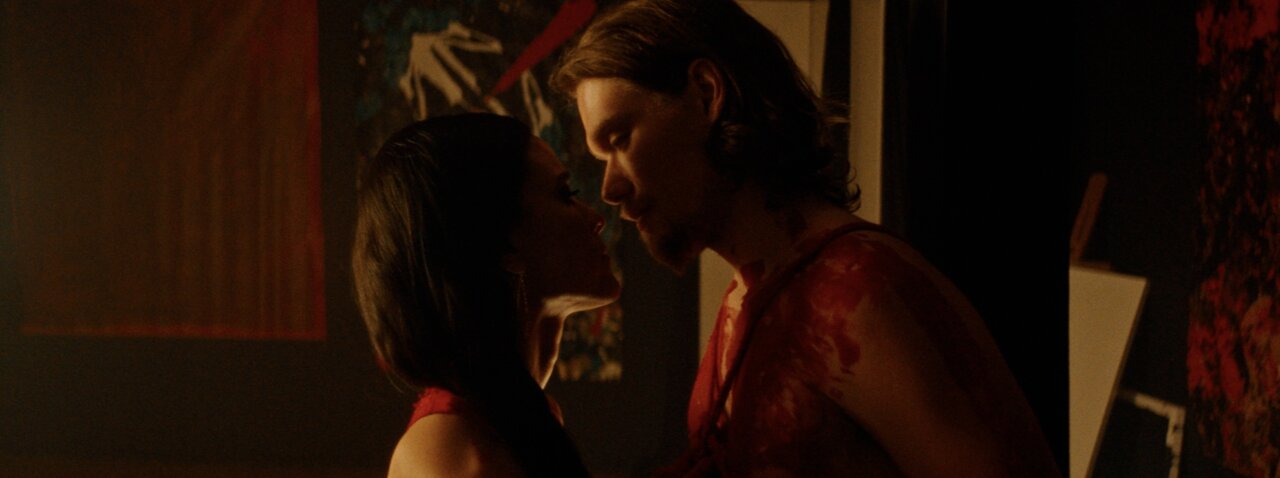
“She finds a subject that she fixates on and she lets it consume her.”
I noticed tiny moments that screamed danger. As they walk to the apartment, Atticus trashes Sebastian’s “fancy pants” attitude, yet when they are greeted, Naomi’s hand lingers on Atticus’s arm just a second too long while Charlie’s back is turned. It’s subtle, but it’s there. The camera work here is fantastic, homing in on micro-expressions. There is a shot of Atticus looking at Naomi’s newest painting while Sebastian stands behind him, casually mentioning that her art changes as her muse changes. It’s a bold statement that made me want to fast-forward to see who gets stabbed first.
Why Bight Is The Kink-Horror Debut of The Year
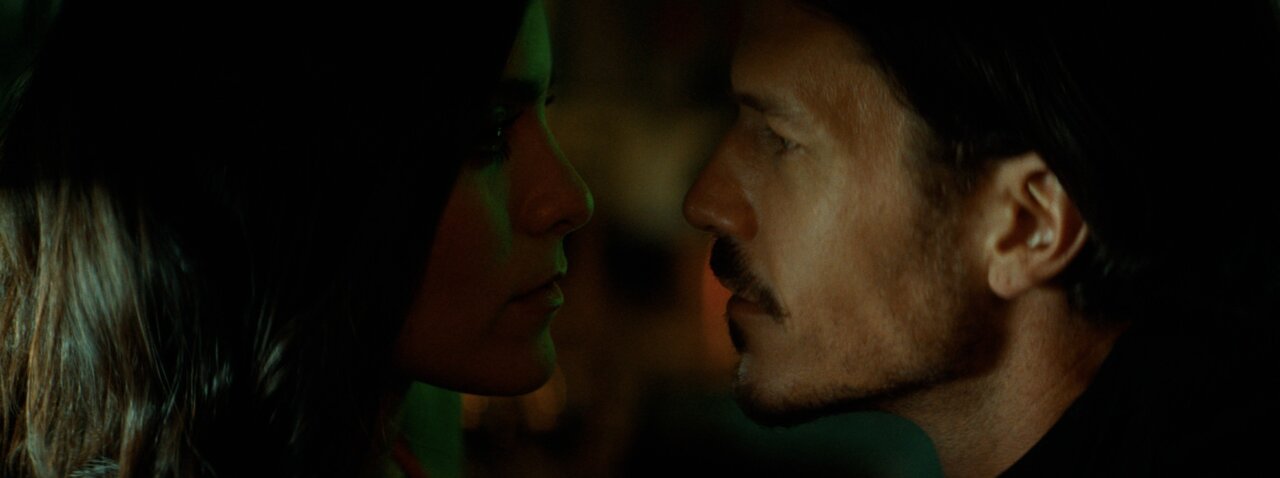
The technical aspects of Bight are where the film truly shines, acting as the bread in this particular sandwich. The lighting is oppressive and sensual, moving from the sterile coldness of the real world to the warm, suffocating hues of Sebastian’s apartment. The score is ace, underscoring the awkwardness of the dinner scene where Sebastian grinds up a powder to spike their drinks. It’s rare for a debut director to have such a firm grasp on atmospheric tension. Walsh frames the scenes with a voyeuristic eye, making me feel complicit just by watching.
However, the middle act does suffer from a bit of pacing drag. Once the drugs kick in and the “photo shoot” begins, the film descends into a delirium that is visually stunning but narratively disorienting. Sebastian micromanages Atticus and Charlie through a series of poses, stripping them of their agency and their clothes. He forces Charlie to acknowledge Naomi’s hands on her husband, a moment that makes Charlie physically recoil. It’s uncomfortable, which is the point, but there were moments I felt the script was spinning its wheels before the inevitable explosion of violence.
But then, the performances pull you back in. Mark Hapka is terrifyingly calm as the puppet master, delivering lines like:
“In order to feel safe, we have to trust our partner.”
With a menacing irony. And Cowperthwaite does a solid job of navigating Atticus’s descent from bored husband to desperate survivor. The complexities of their dynamic, the jealousy, the secrets, the hidden love affairs, are peeled back layer by layer. It turns out Atticus and Naomi may have kept the lines of communication open a little too wide after that initial foursome.
“Assumptions have such a bad rap for being right every fucking time”
When Sebastian finally reveals his hand, torturing the pair with the knowledge of their betrayals, the psychological warfare hits harder than the physical violence. He admits to knowing they’ve been sleeping together behind his back, and the revelation that Naomi might have been in on the setup (to a degree) adds a sting of betrayal that Atticus wasn’t expecting.
Bight manages to be a dark, witty, and grungy look at the underbelly of modern relationships. It strangles the idea that “having it all” is consequence-free. While I don’t know much about the intricacies of the swinger lifestyle, I’ve seen enough to know that when jealousy enters the chat, reason leaves the building.
Rating and Verdict
In any case, the fact that I watched this twice is telling. Bight drags the messy, bleeding heart of polyamory into the studio lights and refuses to let it hide in the shadows. It taps into concepts of art, betrayal, and psychosis with a vice-like grip. It’s a film that looks gorgeous even while its characters are doing ugly things to one another. For an indie diving into this niche, it offers enough narrative range to please a wider audience than just the kink community.
Bight is rated
4 Dinner parties I’m glad I wasn’t invited to out of 5
Sensual Dread & Toxic Art
Bight operates like a fever dream of infidelity. It’s not just about the horror of the kill, but the horror of being truly known by someone who hates you. Walsh’s debut is sharp, visually arresting, and profoundly uncomfortable.
Film Trailer

Streaming Options for Bight 2026
Debut Filmmaker Highlight
The Actor-Director Pivot Maiara Walsh, known primarily for her work in front of the camera, makes a confident transition to the director’s chair with Bight. Often, actors-turned-directors excel at extracting raw, vulnerable performances, and Walsh is no exception. Here, there is a focus on the unspoken tension between characters, letting the silence and the physicality of the actors do the heavy lifting where dialogue would usually intrude. She directs with an empathy for the messiness of her characters, refusing to judge them even as she puts them through hell.
For a debut feature, Walsh displays a visual language.The direction in Bight is led by a claustrophobic intimacy. Tight framing and a saturated, almost sickly color palette to mirror the characters’ internal states. She favors a “dream logic” aesthetic similar to the neon-soaked psychological thrillers of recent years, using lighting not just for visibility, but as a narrative tool to signal the shift from reality to drug-fueled nightmare. This high-style approach suggests a filmmaker who is as interested in the canvas as she is in the story.
Similar Titles & Other Movies that Explore Kink
Did you love the uncomfortable tension of Bight? Watch any of these similar titles for more of the same energy:
- The Menu (2022): If you enjoyed the “dinner party from hell” vibe where the host has a sinister agenda, and the guests are trapped by their own choices, this social satire serves up a similar dish of dread.
- Sanctuary (2022): A psychosexual thriller that takes place in a single location, exploring power dynamics, role-playing, and the thin line between professional kink and personal madness.
- Infinity Pool (2023): For those who liked the drug-fueled, rich-people-behaving-badly aesthetic. It dives deep into identity, lack of consequences, and the surreal horror of losing yourself in a foreign environment.
- Fresh (2022): A modern dating horror that starts as a romance before taking a sharp left turn into captivity and survival, much like how Bight lures you in with relationship drama before pulling the rug out.
- On the Edge: (2022): For those who hate the subtlety and just want the raw edges.
- Morgana (2019): A true story and documentary with a feel-good attitude towards bondage.
- Twisted (2026): A surgeon and two lesbian hustlers. That’s all you need to know.
Spoiler Section & Ending Analysis
The following section discusses the specific ending details and the blood-soaked finale. If you want to keep the mystery alive, turn back now. You have been warned.
The Ending Explained
The climax of Bight is a chaotic blur of violence that contradicts itself. In the heat of the confrontation, Sebastian slits Charlie’s throat, drenching Atticus in her blood. It is a visceral, shocking moment that seemingly ends her life. Atticus then breaks his bonds, subdues Sebastian, and kills him. Then Charlie and Atticus “hide the bodies” and clean up the scene before succumbing to the heat of the moment in the car before they leave.
However, the final scene throws the entire reality of the film into question. We see Atticus at his own successful art show. He is clean, celebrated, and stands on stage thanking his wife, Charlie, who is not only alive but pregnant. As the applause fades away, the camera reveals Sebastian standing beside him, a ghost or a manifestation of his guilt. The camera then zooms out to reveal that the room is actually empty. There is no audience. Just Atticus and his art.
What Does it all Mean?
Because the ending is ambiguous, here are three ways to interpret what we just saw. You can decide which version of the truth you believe. I couldn’t choose between them and think it’s a little bit of each:
The Artist’s Sacrifice: The entire film was an allegory for the artistic process, consuming the muse to create the masterpiece. Atticus “sacrificed” Charlie (metaphorically or literally) to fuel his art. The ending suggests that in his pursuit of validation, he alienated everyone. He has his show, but he has no one to share it with, and the memory of what he did (represented by Sebastian) will follow him forever. The “pregnant Charlie” is just another creation of his mind, the life he could have had if he hadn’t chosen his ego over her.
The Psychotic Break: Atticus never left the apartment alive, or perhaps he never left his own mind. The pressure of his failing marriage, his inadequacy as an artist, and the drugs administered by Sebastian caused a complete psychological fracture. The murder of Charlie was real, and the “art show” is a delusion he is living in to cope with the fact that he destroyed the person he loved. The empty room signifies his total isolation from reality.
The “Survivor” Guilt: The throat-slitting was the hallucination induced by the drugs. In reality, Atticus and Charlie managed to kill Sebastian and escape (hence the “cleaning up”). They survived, but the trauma broke Atticus. The final scene shows that while he got what he wanted (success, a child), he is haunted by Sebastian and the emptiness of his achievement. The “empty room” represents that, despite having it all, he feels alone. especially since he loved Naomi too.
Bight
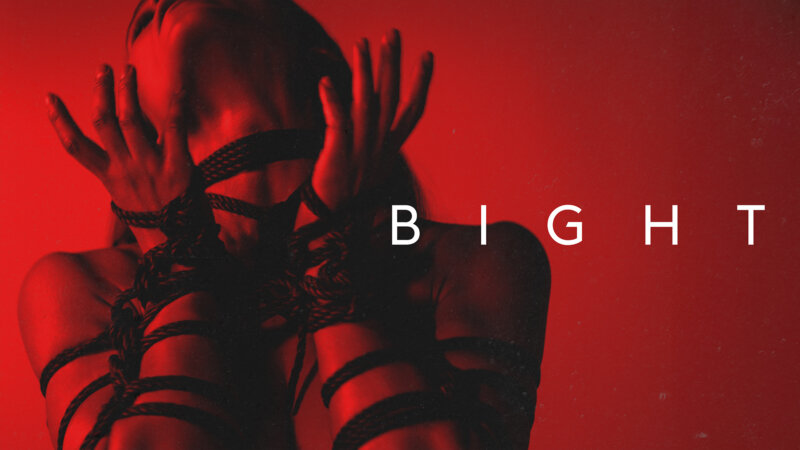
Director: Maiara Walsh
Date Created: 2026-02-10 17:45
4
