
Film Title: Self Help
Director: Erik Bloomquist
Writer: Erik Bloomquist
Distribution: Mainframe Pictures
Release Date: 2025 (FrightFest World Premiere)
Cast: Jake Weber, Landry Bender, Madison Lintz, Amy Hargreaves
Review by: Mother of Movies, I’ve followed Erik Bloomquist since his early days. So when I spotted him popping up for FrightFest, I reached out to PR because the best thing about this critiquing hobby is discovering filmmakers before they become household names.
Content Warning
This review discusses cult manipulation, psychological trauma, and contains mild spoilers about character dynamics. Major plot reveals are saved for the spoiler section at the end.
Erik Bloomquist’s Latest Delivers Twisted Family Therapy
Self Help begins with a cool atmosphere, a killer tune, and a fun setting inside what appears to be an arcade-restaurant hybrid. Think of it like a night version of a play café for us Australians. The opening sequence immediately establishes the film’s tonal complexity, introducing us to a gregarious-looking man working amongst patrons with an attitude as big as his game. Enter Olivia, dressed in a fuzzy outfit, searching for her missing mother, who’s just found herself face-to-not-face with an overly friendly clown.
Self Help’s Deceptively Fun Opening
What follows is a jarring shift from playful to disturbing as Olivia finds herself with front row seats to a very different kind of “play date.” One scream and an accident later, and Olivia is left stunned, while her mother is left with more than one secret to hide. The camerawork is diverse, which is exactly what you’d expect from any filmmaker trying to make their mark in the business. However, I wasn’t entirely sold on the half-faced shots and the ambiguity surrounding Olivia’s mother’s face, but as her distinctive voice is largely recognizable, I can see why this style was chosen.
Cult Psychology Meets Slasher Sensibilities
Flash forward to Olivia in her freshman year of high school (or thereabouts, she’s older). Now in high school, Self Help flaunts the psychological scars on Olivia and waves a wand over Sophie’s past. Their friendship is cleverly dressed in opposites attract. Believable and genuine, while Olvia sleeps with men who don’t want her, Sophie helps her feel better about life. This dynamic becomes crucial as the film progresses into cult territory. Sophie wants her to face her fear of seeing her mother and offers to tag along after an invitation to meet up presents itself.
Shortly after, Olivia discovers that Mommy has married Curtis Clarke, a guy who runs the self-help group. Complete with a recruitment video sequence that feels like a South Park-esque satire, the obligatory round-robin introductions allow Olivia to see what her mom’s been up to as Curtis proclaims he used to be a former cult member. But this isn’t a cult and, he proves that by having everyone cheer that they’re not in a cult. Instead, the idea that they’re striving for “Radical Autonomy ” is introduced.
Jake Weber’s performance as Curtis strikes the right balance between charismatic leader and underlying menace. His chemistry with the ensemble cast, particularly Landry Bender’s Olivia and Madison Lintz’s Sophie, creates believable group dynamics that make the manipulation feel genuinely unsettling.
Erik Bloomquist’s Atmospheric Mastery in Self Help
The vibe becomes increasingly ominous as the cult elements develop. While some of the cultish behavior feels light in Self Help, the sound design lifts it just enough to create something you can’t look away from. The cult programming resembles hypnotism as Curtis talks his guests into understanding they are now reborn and owe no one else. Olivia and her friend seem credulous enough to stick around, but given the estrangement between Olivia and her mother, you wonder why they’re not heading to a nearby hotel to make more sensible choices.
The beautiful background of a nearby lake and waterway proves an excellent choice for lighting, making everyone look stunning in a way that feels intentionally cinematic. What elevates this above typical cult horror is Bloomquist’s willingness to embrace absurdity. When one of his members, Andy, stabs his own eyes out with a sharp piece of bark during the “no reminders” exercise, it’s simultaneously shocking and darkly comedic. The film walks this tonal tightrope throughout, never quite letting you settle into genre expectations.
Performance Dynamics and Character Development
Owen, played by, provides an interesting pivot after being cast out for forgetting he shouldn’t question the leader. It’s a development that somehow works within the film’s heightened reality, like a version of any slasher where incompetent authority figures are replaced by equally flawed characters. The discovery that all the participants have intense childhood trauma creates a twisted therapy group dynamic that feels both inevitable and surprising.
Owen’s past is revealed as a mirror of the opening incident, establishing a pattern of violence masquerading as an accident. Self Help becomes a tidy, overtly tropey good time. The emotion that usually weaves into the atmosphere is laid out front and center here, giving it a specific energy. But I did laugh when watching two figures run across a hilltop in darkness from a distance.
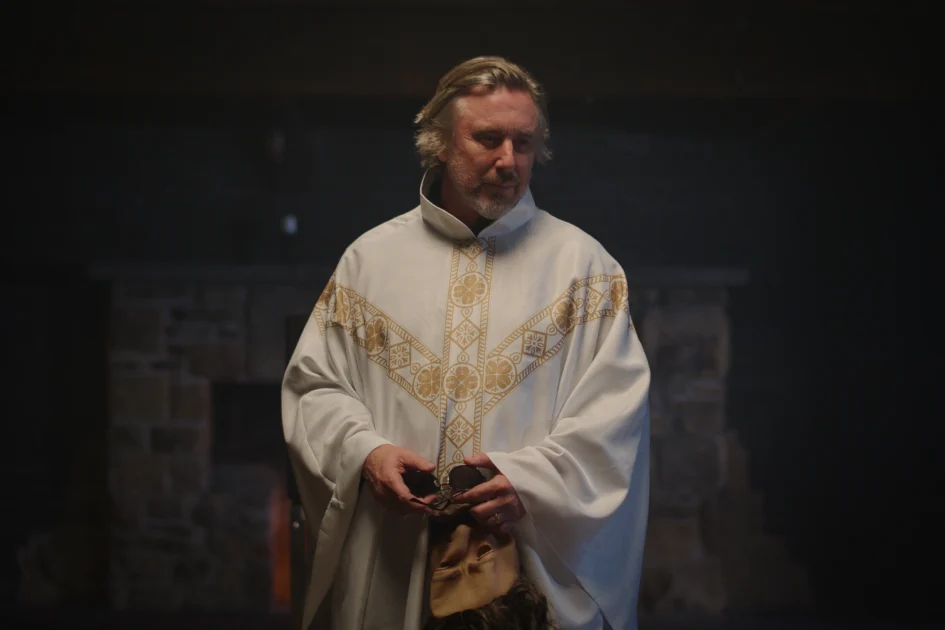
Visual Style and Technical Execution
Most of the gore stays off-screen except for the eye-gouging sequence, but aesthetically, seeing Andy wandering around with giant bloody bandages proved ineffective. It slightly detracts from the tender moment between Joanne and Andy finding each other. Whether in peace or something more romantic, it remains ambiguous.
The film travels along nicely despite chunky plotting devices. When Olivia reveals her true self, the film pivots again into a reverse slasher where the protagonist becomes the antagonist. This structural shift demonstrates Bloomquist’s understanding of genre conventions and his willingness to subvert them. The feminine rage sequence, where Olivia goes to town on a clown, feels cathartic and disturbing in equal measure. The finale of Self Help is simultaneously triumphant and deeply unsettling, but exactly the kind of complexity that makes independent horror so fun.
Self-Help 2025 is rated
3.5 Radical autonomy journeys out of 5
“The film walks this tonal tightrope throughout, never quite letting you settle into genre expectations while balancing charismatic manipulation with underlying menace.”
– Mother of Movies
Cast:
- Landry Bender as Olivia
- Jake Weber as Curtis
- Madison Lintz as Sophie
- Courtesy of Mainframe Pictures
Director: Erik Bloomquist
Distribution: Mainframe Pictures. More slasher movies on Mother of Movies: X 2022 / The Haunted Forest 2025 / Clown in a Cornfield.

Final Act Spoiler Warning – Self Help Explained
The following section reveals major plot points and the film’s ending. Last chance to turn back.
In the opening, Olivia accidentally kills her mother’s special friend and is played by frequent Bloomquist collaborator Adam Weppler (wearing a clown mask and only seen for a brief moment). Later, the same mask is used by Owen as his membership face. After being kicked out of the group, he reveals himself as a spy seeking revenge. His mother was also married to Curtis.
The final revelation that Sophie is Kurtis’s biological daughter recontextualizes the entire narrative, making Olivia’s journey feel like an elaborate manipulation from the start.
Double murderer Olivia heads home while Owen stands on the railway tracks, suggesting multiple tragic conclusions.
Halloween rolls around, with Curtis is now going by Barry. He and his daughter skipped town, leaving Rebecca to figure out what the hell just happened.
One trick-or-treater wearing a Founders Day mask provides a final nod to Erik Bloomqvist’s previous film and as well as suggesting the cycle continues.
Self Help

Date Created: 2025-08-23 11:46
3.5
