Film Title: Other
Cast: Olga Kurylenko (Alice), Jean Schatz (La bête), Lola Bonaventure (Alice), Jacqueline Ghaye (Elena), Philip Schurer (Charlie), Sacha Nugent (Garçon au masque), plus Ange Dialot Nawasadio, Anne-Pascale Clairembourg, Julie Maes.
Director: David Moreau
Writers: Jon Goldman, David Moreau
Distribution: France — July 9, 2025; USA — Shudder, October 17, 2025; UK/Australia — TBD
Review by: Mother of Movies
While this review avoids explicit end-scene reveals, the discussion includes speculation on the film’s monster origins and flashback imagery that may affect your viewing experience. Proceed if you’re cool with that.
A Silent Whistle in the Dark: Opening Impressions
David Moreau’s (O.T.H.E.R) Other doesn’t ease you into its world; it stalks you. The first POV shot drags us through shadow-laced woods, the camera locked into a claustrophobic framing that’s almost suffocating. A missing poster flutters in the protagonist’s hand, and the silence is punctuated only by the faint idea of a dog whistle, a sound we never hear because it’s diegetic to Alice’s world, not ours. This choice in sound design immediately signals that Other is more interested in what we don’t hear than what we do.
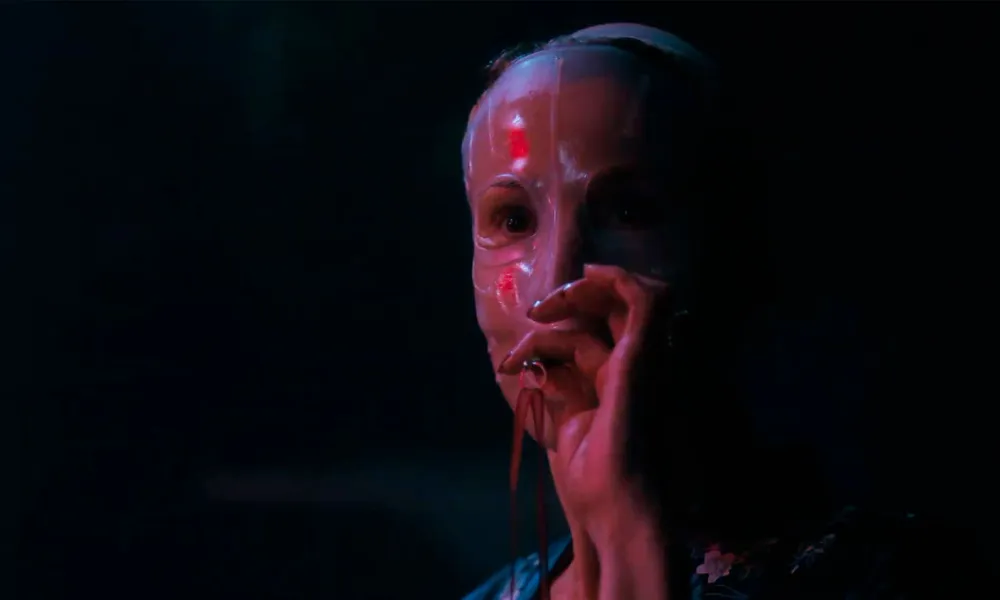
The red flashing silent alarm outside the house is pure horror iconography, a visual motif that’s both domestic and alien. A woman steps into its glow wearing a trendy face mask, a nod to modern anxieties and an aesthetic choice that feels both fashion and foreboding. She’s looking for her dog. She finds only the collar. Then darkness takes her, violently, ambiguously, before the cut.
From Dogs to Domestic Horror: The Narrative’s Uneasy Pulse
The next scene pivots into a strange tonal gear: two lovers, the animal control call-out, and an unsettling case of a mother dog eating her puppies. In another film, this would be a throwaway grotesque moment, but here it’s a thematic echo, motherhood, violence, and distorted caretaking. Alice assures the dog she won’t hurt it, but has no plan when it lunges. The owner shoots it. We never get a clear view of the animal, a classic monster concealment move that keeps La bête (Jean Schatz) in the shadows until the film wants to weaponize our curiosity.
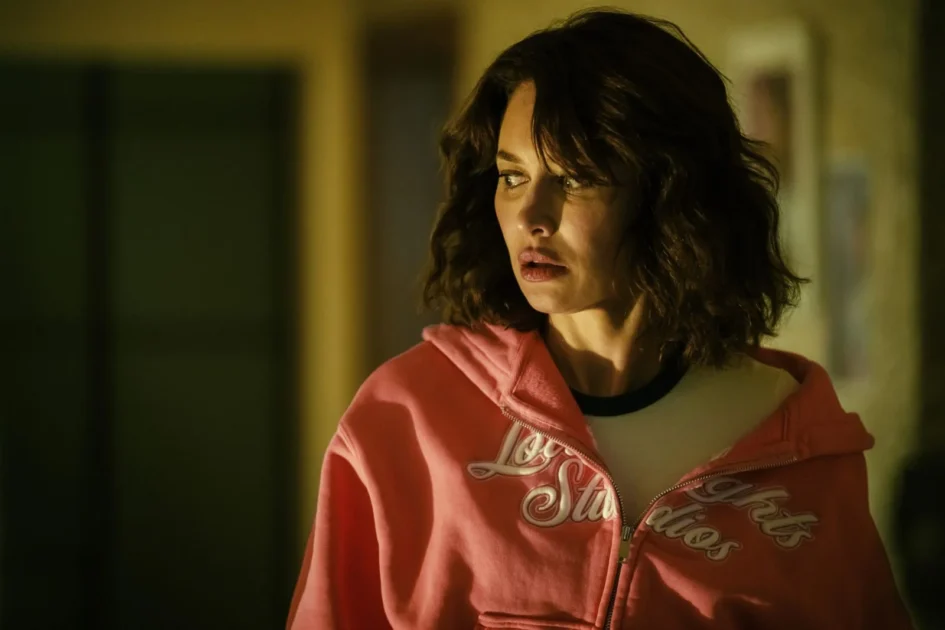
Then the narrative traps Alice at her mother’s home, a place where the walls seem to hum with unspoken history. A neighbor arrives offering condolences and cryptic warnings: “Don’t stick around too long… There is something wrong with this house.”
It’s the sort of exposition that feels less like storytelling and more like a curse being cast.
The Good / Bad / Good Sandwich
Good: Moreau’s direction thrives on ambiguity. The cinematography uses chiaroscuro textures to blur the edges of the frame, keeping us unsure of what’s lurking just beyond its focus. The score is deliberately restrained, letting silence become a predator. This technique explains a lot of what the film doesn’t.
Bad: The narrative pacing sometimes knots itself too tightly. Without a clear supernatural or psychological commitment, certain mid-film scenes feel like narrative wheel-spinning, especially the prolonged animal control subplot. A few character beats, particularly with Charlie (Philip Schurer), are left dangling without payoff.
Good: That said, the unpredictability is part of the charm. In a streaming horror landscape flooded with formula, Other feels genuinely dangerous. It’s a film where you can’t guess if the next scene will be a quiet domestic exchange or a masked stranger telling you to hide your face before something eats it.
About the Filmmaker
Other — adjective, noun, pronoun, or adverb meaning different, additional, or remaining. It can also be used as a verb, meaning to treat someone or something as alien or inferior.
David Moreau (Them, Mads) often works with narratives that trap characters in spaces that feel familiar yet hostile. His visual stamp mixes European art-horror pacing with American genre beats. Here, working with Jon Goldman, he sharpens the edges of maternal horror into a crossbreed of creature feature and psychological trauma. Moreau’s monsters, human or otherwise, are rarely just flesh and teeth; they’re metaphors given claws.
Other 2025 – Ending Explained – Click to find out
Flashbacks, Faces, and Familial Terror
Through jagged flashbacks, we glimpse Alice’s childhood under Elena (Jacqueline Ghaye), a mother whose tyranny over diet, exercise, and appearances is painted with almost surrealist cruelty. These are not warm sepia memories; they’re expressionistic fragments where mise-en-scène turns bread into threat and prom dresses into weapons. The most disturbing reveal is a pregnancy, Elena binding Alice’s stomach with tape, then violently removing the baby.
Whether literal or metaphorical, these scenes suggest the “dog” haunting the house is no animal at all, but a deformed child, domesticated in secret, its rage fixated on faces. Moreau wisely keeps this ambiguous, leaning into absurdism where ordinary domestic settings warp into illogical menace.
Comparable Titles
If you liked Other, you might also be drawn to:
- Goodnight Mommy (2014) — Austrian psychological horror about maternal identity.
- The Lodge (2019) — Snowbound paranoia and fractured family dynamics.
- Them (Ils, 2006) — Moreau’s earlier work focuses on the unseen menace.
- The Babadook (2014) — A monster as a manifestation of grief and trauma.
- Hole in the Ground (2019) — A psychological horror film that needs you to figure out who is real.
- Bound (2020) – Fractured identity? This one has that in spades.
Rating:
Other (O.T.H.E.R) is rated
3.5 Dogs without collars are sometimes something else entirely out of 5
Other
Director: David Moreau
Date Created: 2025-07-09 22:09
3.5
