

Simon Stone’s adaptation of Ruth Ware’s bestselling novel, The Woman in Cabin 10, arrives on Netflix with all the trappings of a prestige psychological thriller: Keira Knightley, a luxury yacht setting, and enough red herrings to stock a maritime market. Yet for all its polished cinematography and committed performances, this nautical mystery feels frustratingly familiar, like boarding a vessel you’ve sailed on before under a different name.
This review navigates through major plot points and reveals the killer’s identity. If you prefer to board this yacht blind, dock here and come back later.
All Aboard the Predictability Express
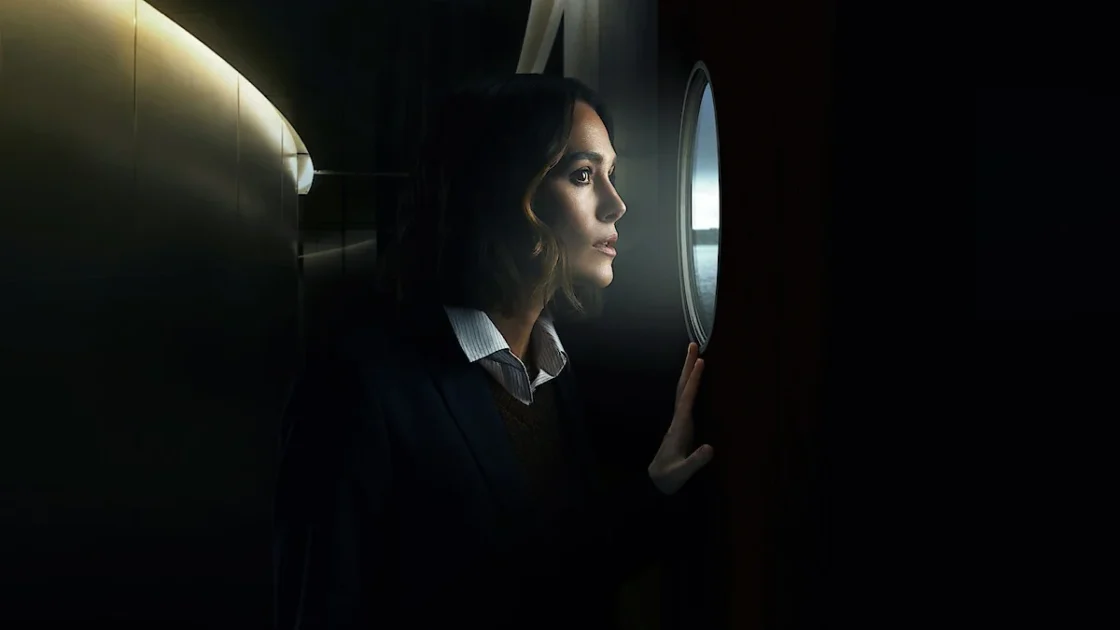
Knightley stars as Laura, an award-winning journalist still recovering from trauma who finds herself aboard the Aurora, a cutting-edge luxury yacht on its maiden voyage. What begins as an exclusive charity fundraiser quickly transforms into a claustrophobic nightmare when Laura witnesses what she believes is a woman being thrown overboard from the mysterious cabin 10. The problem? According to everyone else on board, such a woman does not exist.
The film’s strongest asset lies in its atmospheric tension during the opening act. Stone, who co-wrote the screenplay with Joe Shrapnel and Anna Waterhouse, understands how to weaponize the yacht’s sleek corridors and endless ocean backdrop to create genuine unease. The production design transforms the Aurora into a floating prison of glass and steel, where Laura’s increasing isolation feels palpable. When she discovers blood on the balcony wall only to have it mysteriously disappear, the gaslighting mechanics click into place with satisfying precision.
Knightley delivers a committed performance as a woman whose professional instincts clash with everyone’s insistence that she’s imagining things. Her Laura carries the weight of past trauma, revealed through effective flashback sequences involving a previous interview subject’s murder, and Knightley navigates the character’s paranoia and determination with convincing vulnerability. The supporting ensemble, including Guy Pearce as the yacht’s enigmatic owner Richard and David Ajala as photographer Ben, maintains the necessary air of suspicion that keeps viewers guessing, at least initially.
When the Plot Springs a Leak
Unfortunately, the film’s central mystery unravels in ways that feel more contrived than clever. The revelation that Ben orchestrated an elaborate scheme involving AI-assisted facial matching to find a doppelganger for Richard’s cancer-stricken wife, Anne, stretches credibility to its breaking point. While the concept of using technology to enable deception feels timely, the execution requires multiple leaps of logic that the screenplay never adequately addresses.
The notion that Ben could locate not just a facial match but a complete physical double for a cancer patient, complete with the willingness to shave her head and impersonate someone for days, feels like a plot device borrowed from a less grounded thriller. Art Malik’s Dr. Mehta serves as the requisite corrupt medical professional, but his motivations and the ease with which Ben manipulates him into murder feel underdeveloped.
Stone’s direction maintains visual polish throughout, with cinematographer Darius Khondji creating a suitably ominous atmosphere that makes effective use of the yacht’s confined spaces and the endless ocean beyond. The film’s technical elements, from the production design to the sound mixing, create an immersive experience that almost distracts from the narrative’s shortcomings.
Familiar Waters
The Woman in Cabin 10 joins a growing subgenre of “transportation gaslighting” thrillers, where isolated protagonists find their sanity questioned in confined spaces. Like Flightplan or The Lady Vanishes, it relies on the psychological horror of being told your reality doesn’t exist. However, where those films maintained their mystery through clever misdirection, Stone’s adaptation telegraphs its twists with heavy-handed foreshadowing.
The film’s exploration of wealth, power, and moral corruption feels particularly relevant in our current climate of billionaire excess and corporate malfeasance. Anne’s planned disinheritance of Ben in favor of cancer research provides a compelling motive, and the yacht setting, a literal symbol of obscene wealth floating above the world’s problems, offers rich metaphorical potential that the film only occasionally exploits.
Laura’s final triumph, reading Anne’s speech and exposing the conspiracy, provides emotional satisfaction even if the path to get there feels overly convoluted. Knightley sells the moment with appropriate fury, transforming from victim to avenger in a way that honors both the character’s journalistic integrity and her personal journey.
The Verdict
The Woman in Cabin 10 succeeds as a competent thriller that benefits from strong production values and Knightley’s anchoring performance, but it never transcends its genre limitations to become something truly memorable. Stone demonstrates solid directorial instincts, particularly in building atmosphere and managing the ensemble cast, but the adaptation struggles with the inherent challenges of translating Ware’s internal psychological landscape to the screen.
For viewers seeking a well-crafted thriller with familiar beats, the film delivers adequate entertainment. However, those hoping for genuine surprises or innovative takes on the isolated-protagonist formula may find themselves checking their watches rather than the horizon. Like many Netflix originals, it’s perfectly serviceable content that fills a slot without leaving a lasting impression.

The Woman in Cabin 10 is rated
3 out of 5 waves that look familiar but still get you wet.
Familiar Waters & Predictable Tides
The Woman in Cabin 10 delivers Knightley’s committed performance in a yacht-bound thriller that maintains atmospheric tension but never transcends its genre limitations. Like many Netflix originals, it’s perfectly serviceable without leaving lasting waves.
Filmmaker Spotlight
Simon Stone, primarily known for his work in theater, brings a stage director’s attention to character dynamics and confined-space tension to his film work. His previous feature, The Daughter (2015), demonstrated similar strengths in intimate psychological drama, though The Woman in Cabin 10 represents his first venture into mainstream thriller territory. Co-writers Joe Shrapnel and Anna Waterhouse previously collaborated on The Siege of Jadotville and bring experience in adapting source material, though their screenplay here struggles to maintain the novel’s internal psychological complexity in visual form.
The adaptation of Ruth Ware’s 2016 novel faced the inherent challenge of translating a first-person psychological thriller to the screen. Ware’s book was praised for its claustrophobic atmosphere and unreliable narrator elements, both of which prove difficult to maintain when the camera provides objective visual evidence. The novel spent several weeks on bestseller lists and was optioned relatively quickly, suggesting Hollywood’s continued appetite for domestic psychological thrillers in the post-Gone Girl landscape.

Production Companies
CBS Films
Sister Pictures
Gotham Group
Love a mystery and whodunnit film? No Exit / Disappearance at Clifton Hill / Somewhere Quiet / Who Killed Santa
The Woman in Cabin 10

Director: Simon Stone
Date Created: 2025-10-10 21:11
3
