
Film Title: HIM (2025) / Review by: Mother of Movies
Cast: Tyriq Withers, Marlon Wayans, Jim Jefferies, Julia Fox
Director: Justin Tipping
Writers: Skip Bronkie, Zack Akers, Justin Tipping
Distribution: Universal Pictures (theatrical, worldwide)
Production: Monkeypaw Productions, Soundtrack New York
Release Date: 2025 (theatrical)
Justin Tipping’s HIM doesn’t ease you into its nightmare; it drops you straight into the shallow end of a blood-soaked baptismal font. Where American football culture performs its most sacred rituals. What begins as young quarterback Cam’s (Tyriq Withers) recovery story after a brutal head injury morphs into something far more sinister. A fever-dream exposé on how we devour our heroes before they’ve even finished signing their contracts.
This review dissects the film’s surrealist imagery, ritualistic violence, and thematic gut-punches without revealing the final confrontation’s outcome. If you prefer to experience Cam’s descent completely blind, bookmark this for after viewing.
The Altar of American Exceptionalism
The Monkeypaw Productions stamp (Jordan Peele’s company, for those keeping score) telegraphs the film’s DNA immediately. This isn’t Friday Night Lights with a dark filter; it’s closer to if Whiplash and Get Out had a nightmare baby raised on CTE (Chronic Traumatic Encephalopathy, the degenerative brain disease caused by repeated head trauma) research papers and prosperity gospel sermons. Writers Skip Bronkie and Zack Akers (the minds behind Brand New Cherry Flavor‘s hallucinogenic body horror) collaborate with Tipping to craft something that feels less like traditional sports drama and more like watching someone’s psyche get flayed in real-time.
The Machinery Being the Goat
Tipping employs a deliberately disorienting visual language throughout. The camera stays low, almost ground-level, rarely looking up unless Cam occupies the frame. When he does, he’s centered like a specimen under glass. It’s second-person perspective filmmaking that creates immediate dissociation. Like we’re witnessing Cam’s potential coma rather than his comeback tour. Every frame whispers that something is fundamentally wrong here, even when nothing overtly horrific is happening yet.
The aesthetic oscillates between clinical examination and religious iconography with zero subtlety. Cam gets measured, prodded, and examined like livestock at auction. Specialists circle him. Influencers prattle about jade eggs (Julia Fox appears as this film’s most aggressively bizarre character, dispensing wellness nonsense that curdles into something more predatory). Meanwhile, the score swells with church-worthy harmonics that feel profoundly wrong. All this accompanies what we’re seeing: a young Black athlete being processed through an industrial complex that will chew him up whether he succeeds or fails.
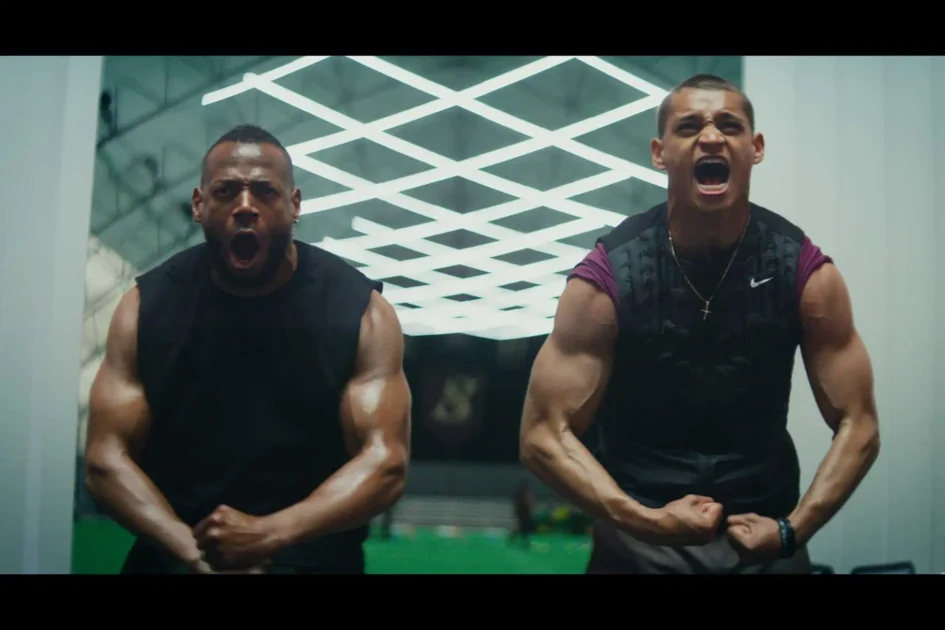
The training sequences under GOAT quarterback Isaiah White (Marlon Wayans, weaponizing his charisma into something genuinely unnerving) abandon any pretense of normalcy. Volunteers get smacked in the face at close range by automated football launchers when Cam misses throws. Marco, the Australian therapist (Jim Jefferies), administers constant injections for pain that everyone celebrates like sacraments. Cam takes helmet-to-helmet collisions that are filmed like X-rays of brain matter colliding, and the trauma is praised as proof of commitment.
Abusive mentorship filtered through the lens of gladiatorial combat. Where the only people who survive are the ones willing to literally bleed for the entertainment of others.
Six Phases to Martyrdom
The film structures Cam’s transformation through distinct phases announced via title cards: Fun, Poise, Leadership, Resilience, Vision, Sacrifice. Each phase strips away another layer of his humanity while the system celebrates his increasing brutalization and isolation as “development.”
There is a volunteer who bleeds for Cam’s mistakes. A ball launcher with speeds increasing until the man’s face becomes a canvas of suffering. Isaiah watches with approval. This is what it costs in his world. Someone always bleeds, and you’d better make sure it’s not you.
He collapses during drills. Large ornate figures wearing giant cowboy hats, the same as from his initial assault, wander around in the desert. They replicate the trauma that nearly killed him. It’s the first indication that Cam’s recovery isn’t happening despite violence, but through it.
There is a shift where Cam begins fighting back. Isaiah tries to make a wager. He wants to take his youth for all the money, cars, houses, and women. Cam refuses.
“Nah, I like to earn my status.”
He says, and in that moment, Isaiah looks at him differently. They shoot at bloody T-shirts mounted on poles, and one appears to be a person in a suit lying on the ground. Cam shoots that one. It falls over. The metaphor isn’t subtle, but it lands with the weight of inevitability.
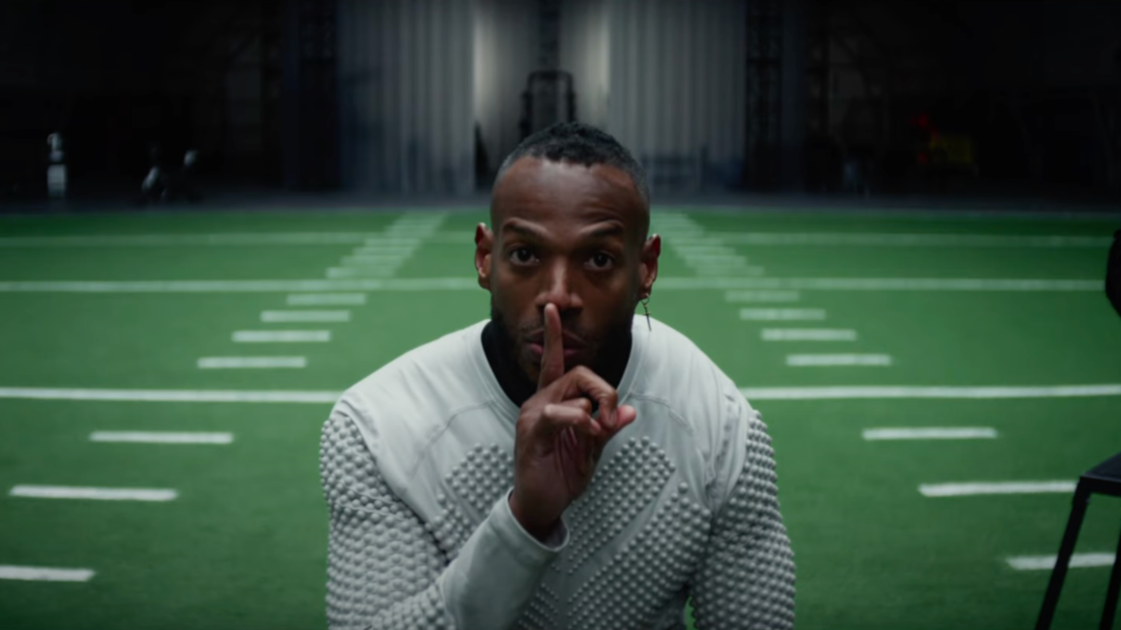
Tipping stages scenes as a deliberate Last Supper tableau. Cam tells his backstory. His father forced him into football as a small boy, but all he wanted was to be a kid. He tells his new mentors that he told his dad he was done, and then his father died. The camera pulls back to reveal twelve figures at the table, Cam positioned beneath wall markings that frame his head like a crown of thorns. Everyone’s waiting to see if he’ll drink from the cup being offered.
Blood Inheritance and Borrowed Time
The film’s most provocative moments reveal themselves in layers. Isaiah has been giving Cam his own blood through transfusions. Not metaphorically, literally passing down his “legacy” through plasma and platelets, like some twisted version of apostolic succession. The blood transfusion bags bear Isaiah White’s name. The football itself becomes a religious artifact, quarterbacks are the anointed priests, and the stadium transforms into a temple demanding human sacrifice.
Painted white-faced fans attack Cam in a sauna (screaming “We don’t want you here”). Tipping reveals something more insidious: these are Isaiah’s own fans, terrified that Cam’s youth will render their idol obsolete. The violence isn’t about team loyalty; it’s about the cannibalistic nature of fandom that demands fresh meat while mourning the discarded carcasses of yesterday’s heroes.
Isaiah enters the sauna, bashes the woman back, holds her by the neck, kisses her, then throws her against the wall. She’s dead. He tells Cam to go, that he’ll clean up the mess. The intimacy of that kiss before the kill reveals everything about Isaiah’s relationship to his own mythology. He loves his fans even as he destroys them, just as the system loves its athletes even as it grinds them to paste.
The Party Where Souls Get Sold and a new GOAT is Made
The final act abandons any remaining grip on conventional reality. Cam attends a party where the owners of the MSV Saviours make their offer. They sit in a circle, adorned in jewels and necklaces. Elsie warned him earlier: “You just gotta roll with the ritual.” She wasn’t kidding.
Marco is beheaded, or maybe not; the film’s commitment to surrealism makes literal interpretation slippery, but the therapist who’s been injecting Cam with Isaiah’s blood and pain management cocktails is definitely gone. Cam wakes up on a slab of ice, receiving another blood transfusion. He pulls out the cannula and goes to confront Isaiah.
“You’ve been giving me your blood,” Cam says and punches him.
What follows is the conversation that’s been building since frame one: the traditions of football, how blood passes down through each quarterback, how only one can remain. “What’s the opposite of a saviour?” Isaiah asks. “A killer.”
But Cam rejects the premise. “You’re wrong.”
Then he picks up a helmet and proves Isaiah right anyway.
Quote from the sports drama HIM 2025
The Circular Arena and What Comes After
The climactic fight happens in a circular red-lit room. Football jerseys hanging like battle standards, something watching from the ceiling that might be a crowd or might be judgment itself. It’s brutal. Bones break. Blood flows. Isaiah’s arm snaps. The violence goes on long enough to become genuinely uncomfortable, which is exactly the point. This isn’t heroic combat. This is two men destroying each other because the system demands it.
Cam wins. He limps out of the arena covered in blood, leaving a trail behind him. He enters the stadium where the real ceremony awaits. Elsie sat at a table, and the Star-Spangled Banner chimes through the air. A group of people behind ornate masks and cheerleaders with covered faces. Everything and everyone is anonymous and interchangeable.
Cam realises he’s been groomed for this exact moment. They’ve been watching him since he was a small boy playing football with his father. All he needs to do to receive the gifts, the money, the fame, the immortality, is sign the contract. Something inside him snaps. The revelation lands like a gut punch; his dad wasn’t just a football-obsessed parent. He was part of the machinery from the beginning.
Cam starts mowing down everyone in charge. Sword. Pickaxe. The surrealist Mad Max aesthetic that’s been lurking at the edges of the film explodes into full carnage. The owner threatens to kill Cam’s family if he doesn’t sign. He continues to kill, not for himself, but to protect the people he loves from this system that devours everything it touches.
Elsie makes one final attempt to “take care of him herself.” She falls on her own long dagger. Even the supposed allies in this world are complicit, willing to sacrifice themselves to maintain the sports-fueled engine.
Cam doesn’t have a love interest in this nightmare; he has a girlfriend back home, someone outside this corrupted ecosystem, someone who represents the life he could have had if he’d never been drafted into this gladiatorial nightmare. The film’s refusal to bring her into the final act is mercy. She doesn’t belong in this blood-soaked temple.
The Aesthetics of Exploitation
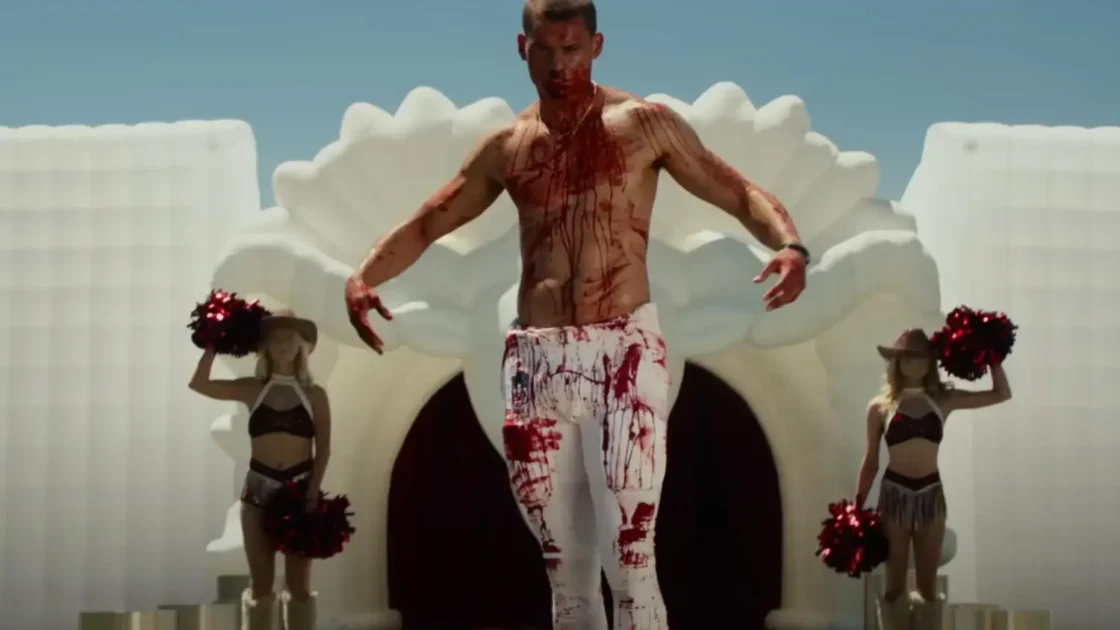
What makes HIM so effectively uncomfortable is how it uses genre conventions against itself. The shiny pink and red pom-pom decorations that recur throughout feel like party favors at a funeral. The Mad Max-style painted fans in the desert aren’t random surrealism. They’re the logical endpoint of fandom taken to its most feral extreme, people so consumed by worship that they’ve lost their humanity.
The blonde woman was spitting and screeching at Cam’s limousine like a feral prophet. Elsie, the jade egg wellness influencer who casually mentions “just roll with the ritual.” Every element feels slightly off-kilter, like watching someone else’s nightmare where the symbols make emotional sense, but logical sense has left the building.
Tipping’s direction (alongside his work on The Chi and Dear White People) demonstrates a filmmaker deeply interested in how systemic violence gets packaged as an opportunity for marginalized communities. The film never lets you forget that every single person in Isaiah’s training program is Black, that the owners wear literal masks, that the cheerleaders have no faces.
Marlon Wayans deserves specific recognition for playing Isaiah as simultaneously mentor, predator, victim, and villain. He’s been through this exact meat grinder, survived by becoming the grinder itself, and now genuinely believes he’s helping Cam by subjecting him to the same trauma. It’s a performance that understands how abuse perpetuates itself through generations, how the abused become abusers while still carrying their own scars, how charisma can be the most dangerous weapon of all.
Every Black player in Isaiah’s stable (notably, the only white faces belong to Marco and the expendable volunteer) exists in this ecosystem of exploitation dressed up as opportunity. The film doesn’t bother being subtle about its commentary. It positions these athletes as modern-day gladiators, with owners literally sitting behind ornate masks during contract negotiations. There are faceless cheerleaders on the sidelines, and the Star-Spangled Banner chanted like an incantation before the real violence begins.
When the Game Eats Its Players
HIM isn’t an easy watch, and it’s not trying to be. Tipping has crafted something that sits uncomfortably between elevated horror, sports drama, and social commentary, refusing to commit fully to any single genre because the reality it’s depicting doesn’t fit neatly into boxes. This is a film about how American culture manufactures martyrs from athletes, particularly Black athletes whose bodies become commodities in a system that profits from their destruction.
The film’s willingness to go full blood-opera in its final act provides genuine catharsis. Watching Cam systematically dismantle the power structure that’s been exploiting him since childhood feels earned after everything we’ve witnessed. It’s not a happy ending, Cam’s still covered in blood, his brain still damaged, his future still uncertain, but it’s an honest ending. Sometimes the only way out of the grinder is to break it from the inside, even if you destroy yourself in the process.
Tipping, Bronkie, and Akers have created something genuinely strange and genuinely angry. A film that understands the difference between depicting violence and glorifying it, between showing exploitation and participating in it. In an era where we’re finally reckoning with CTE’s long-term devastation, with how predominantly Black labor enriches predominantly white owners, with the true cost of contact sports. HIM arrives like a Molotov cocktail through a stadium skybox window. It’s not here to make you comfortable. It’s here to force you to examine your own relationship with sports entertainment, and to ask what you’re willing to watch people destroy themselves for.
Filmmaker’s Stamp
Justin Tipping made his feature debut with Kicks (2016). Kicks is a coming-of-age story about a teenager in the Bay Area trying to reclaim his stolen Air Jordans. This film similarly examined how material objects become loaded with meaning in communities where respect and identity are constantly under threat. His television work on Dear White People and The Chi demonstrates a consistent interest in how systemic oppression operates through seemingly mundane institutional structures.
Skip Bronkie and Zack Akers created the cult Netflix series Brand New Cherry Flavor (2021), a hallucinogenic revenge thriller about a filmmaker in 1990s Los Angeles that featured body horror, supernatural elements, and a protagonist literally vomiting up kittens. Their collaboration with Tipping makes perfect sense. They specialize in taking genre conventions and twisting them into shapes that reveal uncomfortable truths about power, exploitation, and the entertainment industry’s appetite for fresh meat.
Industry Context & Reception – HIM, also known as GOAT
HIM premiered to divisive reactions, with some critics praising its vision and others finding its obscure approach too opaque. The film arrives amid ongoing conversations about CTE in professional football, with recent studies linking repeated head trauma to early-onset dementia, depression, and violent behavior. The NFL has faced multiple lawsuits from former players. The sport’s long-term viability at youth levels remains hotly debated.
The film’s examination of how Black athletes get exploited by predominantly white ownership structures also resonates with current discourse around NIL (Name, Image, Likeness) rights in college sports and ongoing labor disputes in professional leagues. Universal Pictures gave this film a wide theatrical release (rather than burying it on streaming).
Online discussions have focused heavily on the film’s religious imagery. Some viewers are interpreting it as a critique of how American Christianity gets weaponized to justify exploitation (“prosperity gospel meets contact sports”). In contrast, others see it as a commentary on how sports culture itself functions as modern religion, complete with rituals, sacrifices, and martyrs. I agree with the latter.
HIM is rated:
4.5 out of 5 Helmets Filled With Blood Transfusions That Finally Get Smashed Into The Owners’ Faces
Surrealist Body Horror Meets Sports Drama
HIM is what happens when Monkeypaw Productions applies Get Out’s DNA to Whiplash’s abusive mentorship, then filters it through CTE research and prosperity gospel. Tipping’s surrealist nightmare exposes how American sports culture devours its heroes, particularly Black athletes, while calling it opportunity.
Similar Films to HIM 2025’s Sports Horror
If HIM resonated (or disturbed) you, consider these films that similarly deconstruct culture, exploitation, and body horror:
- Whiplash (2014) — Damien Chazelle’s psychological thriller about abusive mentorship in competitive music, where a teacher’s brutality gets justified as “pushing greatness.”
- Concussion (2015) — Will Smith stars in this drama about Dr. Bennet Omalu’s discovery of CTE in NFL players, exposing the league’s cover-up of brain trauma evidence.
- Brand New Cherry Flavor (2021) — The Netflix series from HIM’s writers, Bronkie and Akers, featuring Hollywood exploitation with similar hallucinogenic aesthetics.
- Nope (2022) — Jordan Peele’s Monkeypaw film about spectacle, exploitation, and what we’re willing to sacrifice (literally) for entertainment, thematic sibling to HIM’s sports critique.
- Grafted (2024) — The price of popularity.
- The Ugly Stepsister (2025) — Fairytales. What would you give up for the man of your dreams?
- Together (2025) — Love, marriage, and everything in between.
HIM
Director: Justin Tipping
Date Created: 2025-09-18 18:53
4.5
