
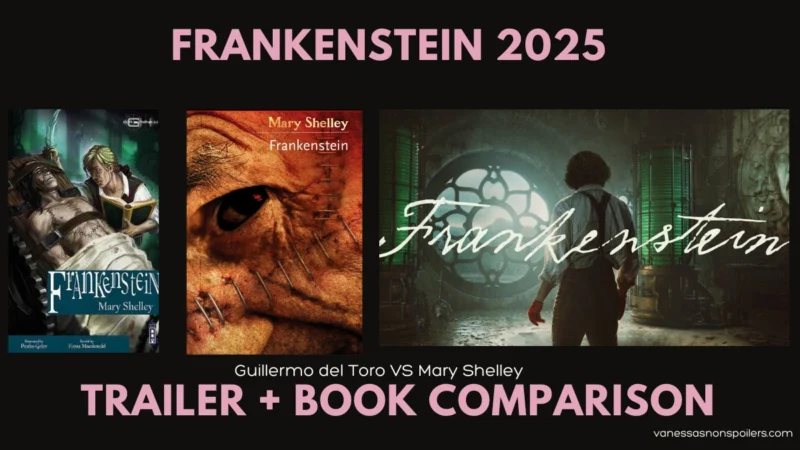
Guillermo del Toro’s Frankenstein 2025 Trailer opens with a confession that sets the entire narrative framework:
“I had determined that the memory of my evils should die with me.”
It’s a promise Victor Frankenstein cannot keep, and del Toro knows it. The visual language immediately establishes this as something beyond typical monster fare. This is operatic tragedy dressed in lightning and shadow. The trailer is great, and I watched it after the film. It’s always better that way. So let’s look at it closely before comparing the book to the film. If you want the full review, Mother of Movies has that too.
Frankenstein 2025 Trailer Analysis
“Some of what I will tell you is fact. Some is not. But it is all true,”
Victor declares, and in that single line, del Toro telegraphs his entire approach to Mary Shelley’s source material. He’s not interested in faithful adaptation for its own sake; he’s after the emotional truth beneath the Gothic horror. The question posed,
“What manner of devil made him?”,
is answered with brutal simplicity:
“I did.”
This isn’t a film about a monster. It’s about the man who played God and couldn’t live with the consequences.
The Frankenstein 2025 trailer visual progression from Victor’s “vision” to “inevitable” to “unavoidable” truth mirrors the obsessive descent that defines both Shelley’s novel and del Toro’s interpretation. When Victor admits, “In seeking life… I created death,” we’re watching a filmmaker who understands that Frankenstein has always been about the violence of creation itself. Whether that’s bringing life from death or making cinema from literature.
The final cry of “Victor!” echoing through the trailer isn’t just a creature calling for its maker. It’s the sound of accountability, of sins that refuse to stay buried, of love and rage tangled into something that transcends both. Del Toro has built his career on understanding that monsters are just mirrors, and this trailer promises he’s finally found the perfect reflection.

Skip to a Specific Section
Novel Departures and Literary Fidelity – Mary Shelley Frankenstein Comparison
For those familiar with Mary Shelley’s original 1818 text, del Toro’s adaptation makes several significant structural changes while maintaining the novel’s thematic core. In Shelley’s version, the narrative is framed through Captain Walton’s letters to his sister. With Victor’s story nested inside and the Creature’s testimony nested within that, a Russian doll of perspectives. Del Toro streamlines this to a two-part structure (Victor’s account, then the Creature’s), which works better cinematically while preserving the novel’s emphasis on multiple viewpoints.
The most substantial addition is the expanded role of Victor’s brother William (Felix Kammerer), whose character is given significant screen time and development. In the novel, William exists primarily as a victim. His murder by Frankenstein is a pivotal plot point, but we never really know him as a person. Del Toro fleshes out the brother relationship, using William as a mirror to show what Victor could have been. If only he’d chosen connection over obsession. Felix Kammerer’s William Frankenstein said “Frankenstein: The Anatomy Lesson”; they had never seen this character given such dimension in previous adaptations, and it adds considerable emotional weight to later events.
Guillermo del Toro’s Netflix adaptation
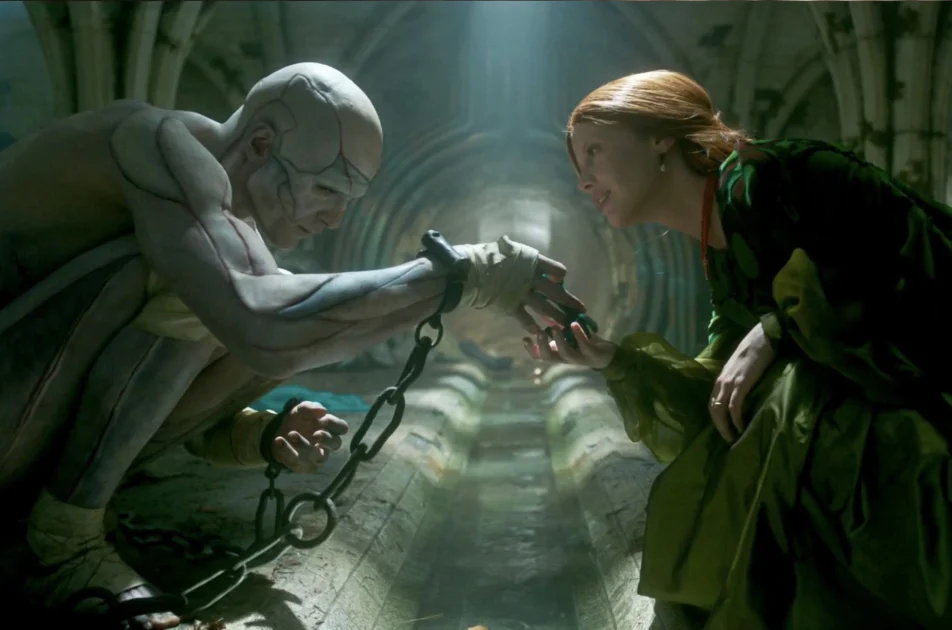
Elizabeth’s characterization also shifts notably from Shelley’s text. In the novel, Elizabeth is Victor’s cousin (later changed to an adopted sister in some editions) and serves primarily as an idealized feminine figure, virtuous, patient, and ultimately doomed. Mia Goth’s Elizabeth retains the compassion but gains agency and complexity. Her relationship with the Creature is given far more screen time and emotional depth than in the source material. She remains largely unaware of the Creature’s existence until it’s too late. Here, she becomes the film’s moral compass, the person who demonstrates what Victor should have done from the beginning.
The ending represents del Toro’s most significant departure from Shelley’s conclusion. In the novel, Victor dies aboard Walton’s ship after his pursuit of the Creature into the Arctic. The Creature, mourning over Victor’s body, vows to build his own funeral pyre and disappear into the darkness. Del Toro’s ending (detailed in the spoiler section below) takes a different path toward redemption that aligns more with his recurring themes across Cronos, Pinocchio, and now Frankenstein. The idea that acceptance and forgiveness might be possible even for those born from unnatural acts.
Full Review and Best Quotes + More Frankenstein Films You Might Like
- Read the full Mother of Movies review of Frankenstein (2025) here → [Review & Filmmaker’s Signature]
- CinePhil A Berliner Film Blog reviewed Frankenstein too.
- Read about The Invisible Man. A brilliant film helmed by Elizabeth Moss and directed by Leigh Whannell.
- Read about Depraved 2019. I loved it. Many didn’t. Directed by Larry Fessenden
- Perhaps you like an indie version better: Tales of Frankenstein 2019, directed and written by Don Glut.
- Lisa Frankenstein 2024 is an odd adaptation, if you can call it that. Find out more about that here.
Legacy of Shelley’s Monster — Five Notable Modern Reinterpretations
Frankenstein; or, The Modern Prometheus
The following section reveals crucial plot details about the film’s conclusion, including character fates and final resolutions. Turn back now if you haven’t watched.
The ending reinforces del Toro’s lifelong fascination with creation as both salvation and curse…
SPOILER SECTION: The Ending and Victor’s Fate
Book: Del Toro’s ending diverges significantly from Mary Shelley’s novel in ways that align with his broader artistic vision. In Shelley’s original, Victor dies aboard Captain Walton’s ship, his body consumed by the obsessive pursuit of his creation. The Creature, finding Victor’s corpse, delivers a final monologue expressing remorse and vows to build his own funeral pyre in the Arctic, disappearing into darkness and death.
2025 Adaptation: Del Toro takes a different path. Victor ultimately faces the consequences of his abandonment, but the film allows him a moment of recognition before the end. He finally sees the Creature not as a failed experiment, but as a person he wronged. This moment of understanding comes too late to save Victor, but it’s enough to free the Creature from the cycle of violence and revenge.
The film’s final images show the Creature bathed in morning light, accepting that he will continue to exist in a world that may never fully accept him. He is choosing life anyway. It’s the same ending del Toro gave Pinocchio and the vampire in Cronos: a character forgiving their own imperfections and choosing to live with them rather than seeking obliteration.
Some viewers wanted the darker ending, wanted to see the Creature follow Victor into death as Shelley wrote it. Others hoped for Elizabeth to become the Creature’s companion, completing that act of creation Victor refused. But del Toro is arguing that redemption doesn’t require a romantic partner or a companion made from corpses. It requires only the willingness to forgive yourself for being imperfectly made and to keep living despite the pain of existence.
Victor’s death comes not as punishment but as the inevitable result of a life spent running from what he created. The Creature’s survival is del Toro’s ultimate statement: that even those born from violence and abandonment can choose to be more than their origins. It’s a hopeful ending for a Gothic tragedy. Whether that works for you will depend on whether you believe monsters deserve hope.

