
Devil in Disguise: John Wayne Gacy
Created by Patrick Macmanus
Starring: Michael Chernus, Gabriel Luna, James Badge Dale, Michael Angarano, Chris Sullivan, and Marin Ireland.
No. of episodes 8
Production companies: Littleton Road Productions \ NBC News Studios \ Universal Content Productions
Original release Network Peacock
Release October 16, 2025. Review by Mother of Movies
This review discusses documented historical events, victim stories, and case details from John Wayne Gacy’s crimes and trial. While the Devil in Disguise limited series avoids graphic depictions, the subject matter involves sexual violence, murder, and systemic failures. Reader discretion advised.
Skip to a Specific Section
The Monster Wasn’t Hiding: The System Just Refused to Look
Devil in Disguise: John Wayne Gacy doesn’t want your voyeuristic gaze. It wants your reckoning. In an era where true crime has become comfort food for algorithm-fed audiences, Patrick Macmanus’s limited series for Peacock commits an act of radical restraint: it refuses to show you the murders. Not one. Instead, it forces you to sit with something far more uncomfortable, the institutional rot that allowed 33 young men and boys to vanish while a community leader hosted wife-swapping parties and screened pornography for the Jaycees.
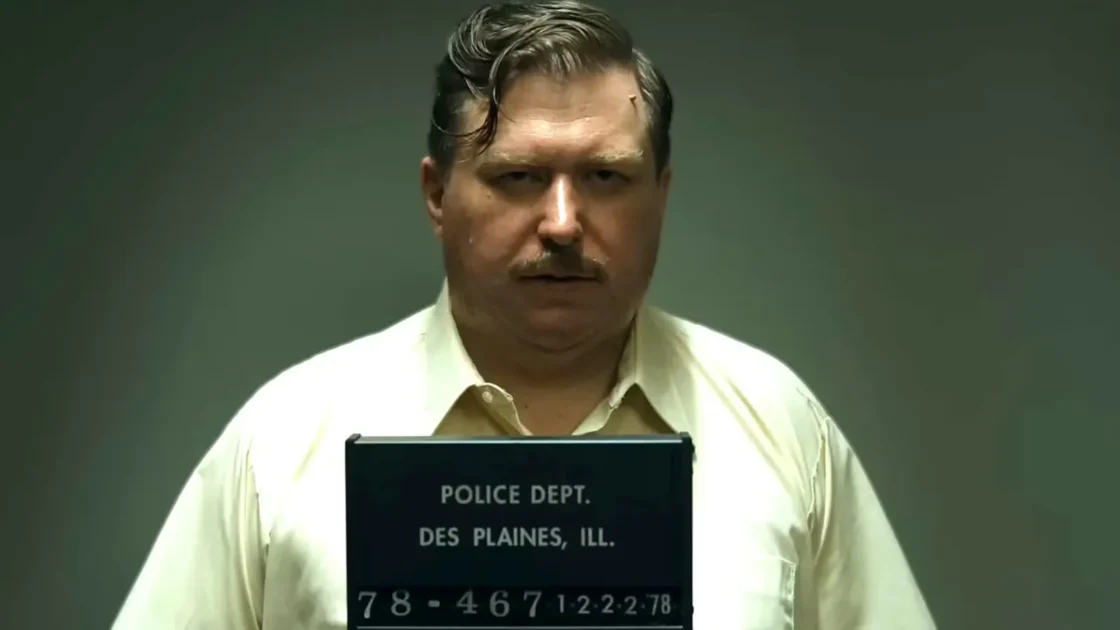
This isn’t Dahmer with its unflinching brutality. It’s not even Mindhunter‘s procedural seduction (a technique where the narrative draws you in through investigative detail rather than shock value). This is something closer to Conversations with a Killer: The Ted Bundy Tapes, a dissection of how society’s biases become body counts. Michael Chernus embodies Gacy not as a theatrical boogeyman but as a suffocating presence, the kind of man whose charm curdles the moment you’re alone with him. Gabriel Luna’s Det. Rafael Tovar and James Badge Dale’s Joe Kozenczak anchor the investigative throughline with the weary determination of cops who know they’re fighting their own department as much as a killer.
“Teenagers Just Run Away” The Refrain That Became a Death Sentence
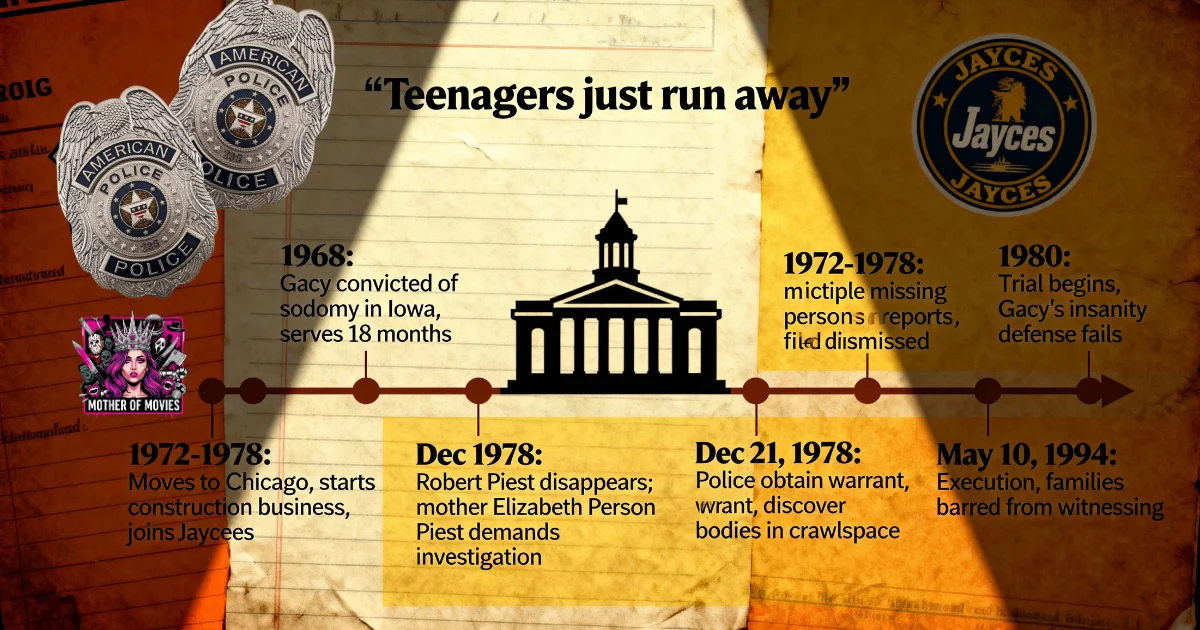
The series opens with Robert Piest’s disappearance in December 1978. His mother (Marin Ireland, delivering gut-wrenching restraint) goes to pick him up from his pharmacy job for her birthday dinner. He mentions a contractor offering him a job. He never comes home. When she reports it, the lead detective’s dismissiveness is immediate: teenagers run away.
Except Piest wasn’t a runaway. He was a kid with a family birthday waiting. And Gacy, the Devil in Disguise, already convicted of sodomy in Iowa, was the last person seen with him. The fact that it took a mother’s relentless advocacy and a detective’s “cop feeling” to even begin an investigation is the series’ thesis statement. The system didn’t fail these boys. It was designed to ignore them.
Episode after episode, we watch precincts hand-wave missing person reports. “Fairies,” one cop mutters in a recap montage. The word lands like a slur and an epitaph. The series doesn’t flinch from the homophobia that turned 33 deaths into administrative inconveniences. Whether Piest was gay is never confirmed, but the assumption that he might be was enough to deprioritize his life.
This is where the Conversations with a Killer: The Ted Bundy Tapes comparison becomes unavoidable. Both series expose how law enforcement’s prejudices against sex workers, against LGBTQIA+ individuals, against anyone deemed “less credible”, create hunting grounds for predators. Bundy exploited class and gender bias. Gacy exploited sexuality and age. The badges looked the other way in both The Jaycees, Pornography, and the Banality of Evil’s Social Calendar
One of the series’ most chilling revelations is Gacy’s community standing. He wasn’t just tolerated, he was celebrated. As vice president of the Springfield, Illinois Jaycees and an “energetic, high-performing member” in Waterloo, Gacy hosted recruitment parties where he screened pornographic films. This wasn’t scandalous. It made him a leader.
The series doesn’t moralize. It simply shows: a man who systematically raped and murdered teenagers was lauded because he threw good parties and knew how to work a room. The cognitive dissonance (the mental strain of holding contradictory beliefs, in this case, “community pillar” vs. “serial predator”) is suffocating. It’s a reminder that evil doesn’t always announce itself with red flags. Sometimes it comes with a Jaycees pin and a firm handshake
Sam Amirante’s Burden: The Confession No One Could Use
Michael Angarano’s portrayal of defense attorney Sam Amirante is the series’ moral anchor. In Episode 2, Gacy, drunk, rattled by police surveillance, confesses all 32 murders to Sam. But Sam only has notes. No recording. No corroboration. Just the weight of knowing his client is a mass murderer and being legally bound to defend him.
The series uses this as a pressure valve (a narrative device that releases tension through character introspection rather than action). We watch Sam grapple with the ethics of his profession, the public’s hatred, and his own complicity in a system that demands he argue for Gacy’s insanity. “There isn’t a world where he ain’t crazy… right?” he asks. Gacy’s response: “Put the blame where it belongs.”
It’s a line that echoes through every episode. Where does the blame belong? With Gacy? With the cops who ignored reports? With the Jaycees who elevated him? With a society that treated queer and young victims as disposable?
David Cram and Jeffrey Rignall — Survival Isn’t Victory
Episodes 7 and 8 shift focus to the survivors and the aftermath. David Cram (Brandon McEwan), one of Gacy’s young employees, is groomed, manipulated, and dismissed when he reports his suspicions. The series doesn’t vilify him for not doing more; it shows how the system’s indifference paralyzed him. He did his due diligence. He was ignored.
Jeffrey Rignall’s (Augustus Prew) story is even more harrowing. As one of Gacy’s few surviving victims, he spent years trying to get justice, only to be dismissed as unreliable. The series treats his trauma with the gravity it deserves, refusing to sensationalize his assault while honoring his fight for recognition.
The finale’s execution sequence is a masterclass in restraint. Families who were promised closure are barred from witnessing Gacy’s death, forced to wait in separate rooms while officials renege on their word. It’s a final, bitter reminder: the system that failed to protect these boys failed their families, too. Justice, when it finally came, was hollow.
Why This Series Matters Now
In 2025, as true crime continues to dominate streaming platforms, Devil in Disguise: John Wayne Gacy asks a necessary question: Who are these stories for? If they’re just trauma porn for binge-watchers, they’re complicit in the same voyeurism that allowed Gacy to thrive. But if they center the victims, the failures, and the systemic rot, they become something else. An indictment. A memorial. A warning.
This series is all three.
Rating & Verdict
4.5 Uncomfortable truths out of 5
Restraint Over Exploitation
Devil in Disguise: John Wayne Gacy refuses to give you the murders. Instead, it hands you the systemic rot, the families’ grief, and the institutional failures that turned 33 deaths into footnotes. This is true crime as indictment, not entertainment.
Filmmaker Stamps & Cast of Devil in Disguise John Wayne Gacy
- Patrick Macmanus (Creator/Writer) cut his teeth on The Sinner and Mare of Easttown, two series that weaponize small-town secrets and institutional decay. His stamp: slow-burn procedurals where the crime is a scalpel for dissecting community rot. Here, he applies that to documented history, trusting restraint over sensationalism.
- Michael Chernus (Gacy) is best known for comedic turns (Orange Is the New Black, Severance), making his casting a risk that pays off. He strips Gacy of theatricality, playing him as a man who believes his own lies, terrifying precisely because he’s banal.
- Gabriel Luna (Det. Tovar) brings the same quiet intensity from The Last of Us and Terminator: Dark Fate, grounding the procedural with weary determination.
- Marin Ireland (Elizabeth Piest) is a character actor’s character actor (The Umbrella Academy, Sneaky Pete), and her restraint here is devastating, a mother’s grief without melodrama.
Controversy Note: The series faced criticism pre-release from victim advocacy groups concerned about re-traumatizing families. Macmanus consulted with survivors and families during production, and several (including Rignall’s estate) publicly supported the project for its focus on systemic failures rather than Gacy’s mythology.
“This isn’t trauma porn for binge-watchers. It’s an indictment, a memorial, and a warning, all three at once.”
— Mother of Movies
![[Devil in Disguise] Detectives Rafael Tovar (Gabriel Luna) and Joe Kozenczak (James Badge Dale) reviewing case files in dimly lit police precinct](https://vanessasnonspoilers.com/wp-content/uploads/2025/12/True-crime-series-that-doesnt-show-murders-945x630.webp)
Similar Films/Series (4 Comparisons) to the Devil in Disguise
- Conversations with a Killer: The Ted Bundy Tapes (2019) — Systemic bias enabling serial killers through victim dismissal
- The Jinx (2015) — Procedural investigation exposing institutional complicity
- Unbelievable (2019) — Police failures and victim-blaming in sexual assault cases
- Mare of Easttown (2021) — Small-town procedural dissecting community rot and institutional decay
If You Prefer Exploitation Murder Films and Series, You Need These Titles
- No Tears in Hell (2025) — Alexander Spesivtsev’s crimes are atrocious, and the camera wants you to see them.
- Best True Crime Movies From Australia, 4 Shocking Titles — All Australian true stories, can’t miss these.
- Charlie Says VS The Haunting of Sharon Tate — Two films, one review. Both well-known and want the trauma on screen.
Devil in Disguise John Wayne Gacy Documentary – Soundtrack
Are there any documentaries or shows available on streaming platforms about John Wayne Gacy that mention the song?
The John Wayne Gacy Tapes” credits its music to composer Justin Melland, i.e. original score, not a licensed/pop song. “Devil in Disguise” has its original score by composers Leopold Ross and Nick Chuba. you can find it below to listen to and buy it online via the link provided.
Which online stores sell vinyl or physical copies of “Devil in Disguise John Wayne Gacy”?
You can find Devil In Disguise: John Wayne Gacy (Original Series Soundtrack) on Amazon MP3 Version for under $10.
Devil in Disguise – Soundtrack Full Album on Spotify, Here’s a Track to Start With
Devil in Disguise: John Wayne Gacy

Director: Patrick Macmanus
Date Created: 2025-10-16 15:43
4.5
