
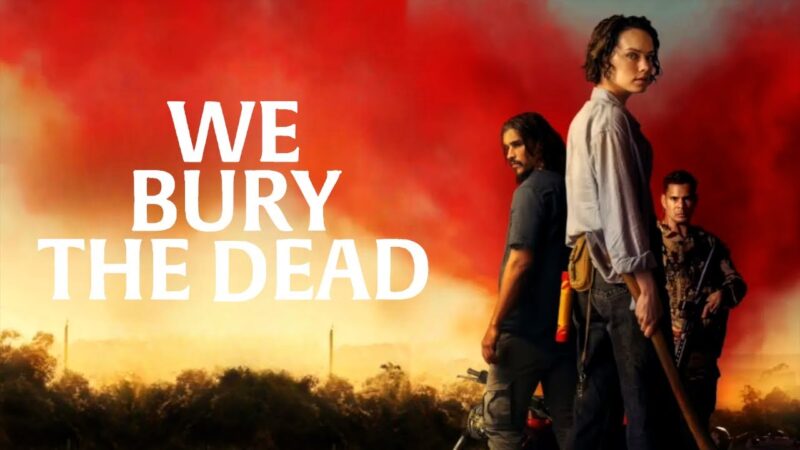
Tasmania gets the apocalypse it deserves in We Bury the Dead, all dry and dusty paddocks, empty roads, and quiet emotional catastrophes instead of skyscrapers collapsing and jets falling from the sky. The marketing promises high‑octane undead carnage; what Mother of Movies got instead is a deliberately paced Australian grief drama that just happens to be wearing zombie makeup.
Skip to a Specific Section
This review discusses early and mid‑film set‑up, themes, and a few non‑specific later beats, but avoids detailing the final revelations and ending. We Bury the Dead hsa a clearly marked section at the very end dives into full spoilers – safe to read until you hit that neon warning.
Neon Trailer, Slow‑Burn Reality
We Bury the Dead opens with Ava, a therapist whose memories of dancing with her husband are shot like fragile little ghosts. An unexplained global event, a kind of magnetic pulse, knocks people out. Some wake. Some don’t. Some… wake differently. Watch the full official trailer on YouTube via Umbrella Entertainment’s channel.
Ava volunteers to travel to an island in Tasmania to help recover bodies. Officially, it’s a humanitarian mission. Unofficially, she knows her husband was there, and she’s chasing both his body and answers. On the plane, someone tells her that those who wake are “lucky.” No one actually knows why some reanimate and others remain lifeless, but the military has already decided that the undead are a problem to be solved with bullets.
Here’s where the marketing sleight of hand kicks in. The trailer leans into the “zombie outbreak chaos” angle, guns, panic, and running bodies. The movie itself is mostly a quiet procedure. Ava and her new retrieval partner, Clay (beautifully easy on the eyes, quintessential “holy moly” Aussie bloke), walking into houses, cataloguing corpses, navigating empty Tasmanian landscapes, and muted interiors in slate blues and greys. It’s not a fireworks‑factory horror spectacle; it’s a slow, melancholy hike through the emotional hangover of an event the film refuses to over‑explain.
As a time‑pass watch for novice zombie connoisseurs, it works. But if you go in expecting Train to Busan by way of Mad Max, you’ll be sitting there feeling like you accidentally enrolled in Undead Grief Studies 101.
Zombies, But Make It Ambiguous
Mother of Movies has a soft spot for undead mythology that actually tries something different. “We Bury the Dead” does have a few intriguing tweaks.
The reanimated aren’t drooling Romero clones. When Ava and Clay first encounter one, the figure looks oily and dishevelled, movements sluggish, mouth working soundlessly. The military insists there’s “no brain activity,” but insists on shooting them anyway, the moment a flare goes up. You can see on Ava’s face, the lead is excellent at internal conflict, that if nobody understands what has happened to these people, blowing their heads off might not be the most ethical first response.
The film keeps most of the undead on the fringes. They’re glimpsed sporadically, not paraded front and centre. You hear them before you really see them: clicking noises, grinding teeth. Later, it’s revealed that some of that clicking is them literally breaking their own teeth. One of the more unnerving details in the film even if it’s never fully unpacked.
We Bury the Dead (2025) Review – Tasmanian Grief Zombies for Beginners
What the title leans into, more than gore, is personality residue. Some of the reanimated are hostile and lunge violently, others simply try to complete a final task, or stare with the faint echo of recognition. It’s very “not all undead,” in the same way we get “not all men” whenever the world tries to talk about systemic rot. Not all reanimated bodies are ravenous. Although ravenous for what remains elusive.
When the film plays in that register, undead as mirrors of unresolved human mess, it’s compelling. It just never quite synthesises those ideas into a coherent thesis.
Tasmanian Bleakcore – The Look and Feel
From an aesthetic standpoint, this is a well‑crafted Australian genre piece.
- The colour palette is almost entirely desaturated: steel skies, washed‑out farmhouses, grey‑blue uniforms, roads that look like they’ve given up on tourism.
- The cinematography savours empty distance, long shots of farmland, dust, red earth, and the kind of lonely highways you only see in regional Australia or true‑crime podcasts.
- Operatic, swelling music leans hard into catharsis: this is the end of the world, or at least the end of this small corner of it. Sometimes it adds emotional weight, sometimes it feels like it’s announcing profundity the script hasn’t entirely earned.
Ava’s journey across this landscape has a tactile sense of exhaustion. You feel the time, the distance, the futility of combing through houses full of suddenly interrupted lives. For those of us who lived through rolling global crises while politicians assured us things were “under control,” the matter‑of‑fact tone lands. Bureaucracy and military protocol trudge on long after meaning has left the building.
Even when I was side‑eyeing the plot, I couldn’t fault the effort in the world‑building textures.
Ava, Clay, and the Shape of Closure
Ava is an excellent lead. Daisy Rigley stands on her own, apparently searching for an ending to her story that allows her to move on. The script gradually reveals that her marriage was already fractured before the Event, fights, fertility struggles, and unsaid things left hanging in the air when her husband left for Tasmania. There was also a vague promise to talk “when he got back.” That “when” never comes.
Her decision to join the retrieval effort is less a noble service and more a self‑assigned penance tour. It’s one of the film’s smarter moves. She’s not just looking for his body; she’s looking for the version of him she can still speak to, accuse, forgive, or both.
Clay, on the other hand, is the kind of guy who sees a Harley and jokes about giving his left nut to ride it. He’s also quietly wounded, and the film allows their dynamic to shift from awkward strangers stuck on corpse duty to something like a trauma alliance. There’s flirtation, there’s tenderness (including a massage scene that doubles as a cheeky excuse to get his shirt off), but it never turns into a full romance. It’s more about two broken people finding a small, temporary pocket of connection in the ashes.
Does all of this add up to a grand, dramatic epiphany? Not really. But it does make the middle stretch watchable, even as the narrative keeps wandering in circles.
Where the Story Trips Over Its Own Grave
Here’s where that 3.5/5 energy comes in.
We Bury the Dead keeps hinting at big thematic swings, ethics of killing the undead, the psychology of closure, the political handling of a mass reanimation event, but mostly backs away from interrogating them. We get glimpses of riots, flashes of military overreach, and one particularly disturbing soldier whose storyline spirals into psychotic obsession and shrine‑like hoarding of the past. He’s a potent symbol of how grief and power can twist, but the film treats him like a detour rather than a core text.
Similarly, the mythology is suggestive rather than definitive. The undead grow more agitated over time, but the rules about why some attack and some bury their families are left fuzzy. Horror doesn’t have to explain everything, but when you build an entire movie around someone walking into rooms full of bodies, the “why” needs at least a backbone, not just vibes.
By the final act, I found myself invested in Ava and Clay, interested in the undead behaviour, impressed by the visuals… and still wondering what the movie wanted to say beyond “closure is complicated” and “Tasmania looks stunning at the end of the world.”
It plays like a beautifully shot, emotionally earnest, slightly pointless apocalypse, very watchable, just not transformative.
Mother of Movies Rating
We Bury the Dead is rated:
3.5 Not‑All‑Undeads, Still All Trauma out of 5
The first Australian premiere was on November 1, 2024 (Adelaide Film Festival, premiere). Releases to digital and streaming United States on January 2, 2026 / Australia February 5, 2026. For Canada, they get it from 2nd January. For the regional streaming options, check the link below.
Production Companies
The Penguin Empire
Campfire Studios
Giant Leap Media
Gramercy Park Media
LB Entertainment
(In association with)
Screen Australia
Vacancy Films (in association with)
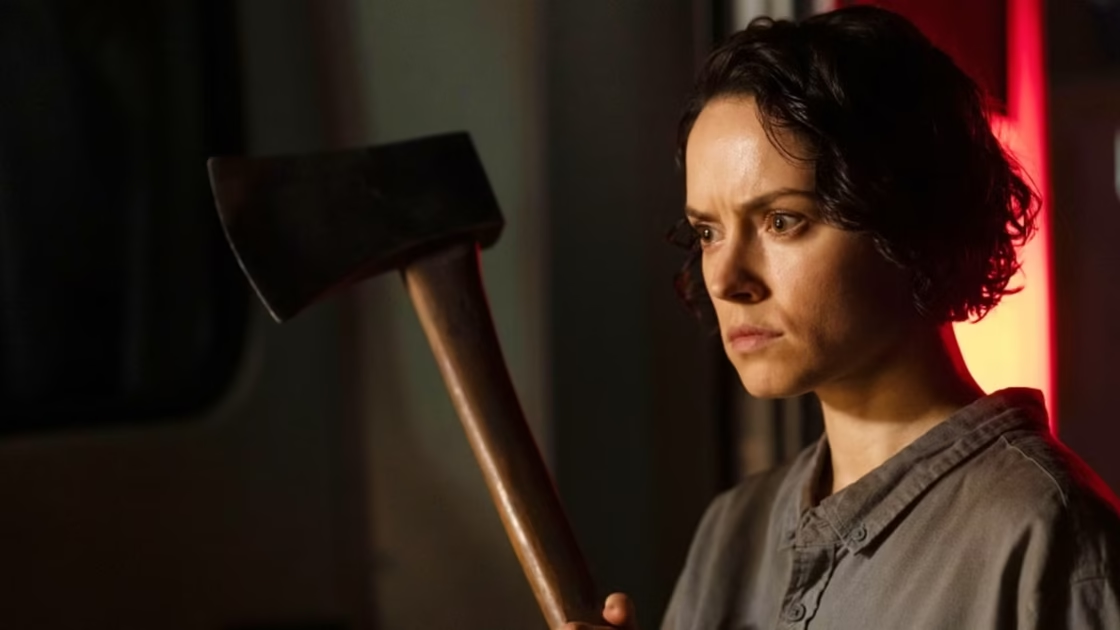
Soft Apocalypse, Gentle Zombies
We Bury the Dead swaps splatter for sorrow, sending a guilt‑ridden therapist across a haunted Tasmanian landscape where the undead feel more like unfinished conversations than monsters. It’s a well‑made, slow burn apocalypse – ideal for novice zombie fans who prefer grief to gore.
Similar Titles – Need More Soft‑Focus Undead?
If We Bury the Dead hits your sweet spot for slow‑burn, feelings‑first genre stories, you might also like:
- The Returned (Les Revenants, 2012 series) Mood‑driven, eerie, emotionally dense.
- The Girl with All the Gifts (2016) – More action, but similarly reflective.
- Cargo (2017) – Intimate, melancholy, low‑key.
- Ravenous (Les Affamés, 2017) – Sparse, contemplative, with its own weird rules.
- Silent Zone (2025) – Indie darling with zombies referred to as ferals.
We Bury the Dead Tasmanian Grief, Gentle Zombies and the Soft Apocalypse – Where to Watch & Streaming
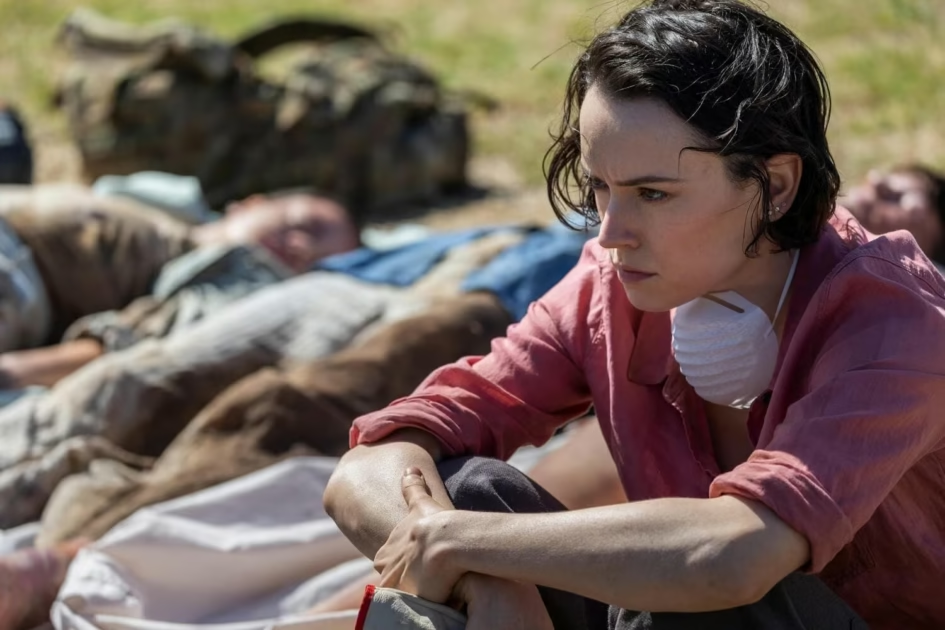
Full Spoilers Section (Third Act, Ending, Baby)
From here on, third‑act twists, the retreat, the affair, and the final scenes (including the baby) are discussed in detail. If you haven’t seen We Bury the Dead yet and want to go in clean, bail out now.
At the retreat, Ava finally reaches what she’s been walking toward the entire film. Her husband’s last known location. The emotional payload is not what the PR team’s action‑heavy trailer sold. However, it does become a memorable conclusion. Who doesn’t want to know what their husband gets up to on a retreat?
She finds his room. He’s dead, and crucially, not wearing his wedding ring. Among his things, she discovers the card of the woman he was having an affair with. The big catharsis isn’t “is he alive or undead?” but “who were we to each other when he died?” We learn Ava couldn’t get pregnant, they fought, she cheated first, and he cheated back. Or was he cheating the whole time? Their marriage rotted in a tangle of blame and silence. Her whole mission has been less about saving him, more about confronting what they both did.
In parallel, Clay re‑emerges (alive, her earlier fear that the soldier killed him turns out to be a feint). They share confessions, swim in the resort pool, raid the bar, light candles, and stage a kind of apocalypse‑era holiday. It’s momentarily joyful, but the film undercuts it with a brutal little beat. When an undead intrudes on their new bubble, Ava obliterates it without hesitation. Whatever empathy she had for the reanimated is now complicated by what she has learned and what she has lost; respect has been replaced by a hard-line boundary.
There’s a weed‑smoked funeral sequence in We Bury the Dead. A body pushed out on a boat, set adrift, that plays like a symbolic goodbye to all the “what ifs” rather than just one corpse.
The final big swing is the undead mother. Ava and Clay encounter a reanimated woman with blood on her thighs and back; they hear a baby crying and realise she has given birth post‑reanimation. The newborn is hidden among rocks nearby, somehow still alive in the middle of nowhere. Ava and Clay take the baby, essentially adopting it at the literal end of their world.
