
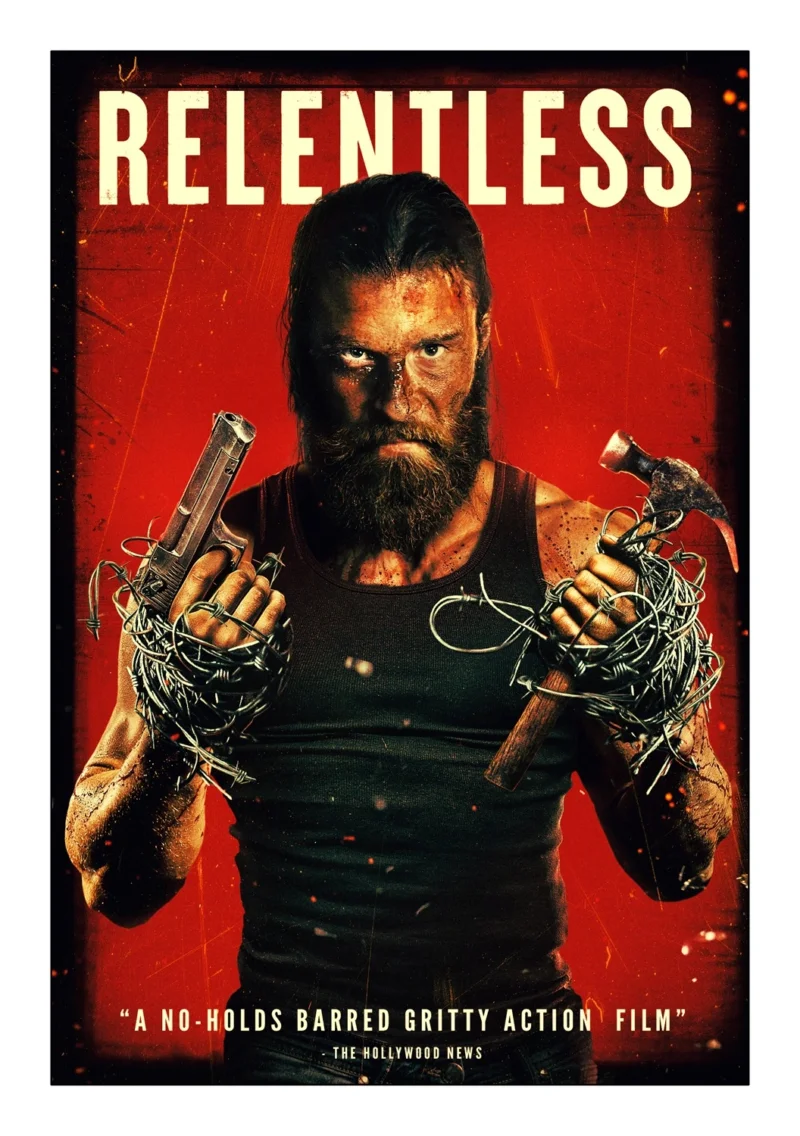
- Film Title: Relentless, also known as Syphon
- Cast: Jeffrey Decker (Teddy Brimsval), Jun Kushida (Shuhei Kinoshita)
- Director: Tom Bucci
- Writer: Tom Bucci
- Distribution: Saban Films
- Production: VE One Entertainment
- Release Date: 9 January 2026 (Australia)
- Review by: Mother of Movies
Relentless
I’ve finally managed to scrub the metaphorical blood off my screen. Relentless arrived as a screener courtesy of Saban Films, and having enjoyed director Tom Bucci’s previous chilly survivalist entry, Artik, I bumped this straight to the front of the queue. It is a jagged pill to swallow; a film that doesn’t say a lot, but rather screams in a language of broken bones and visceral grunts
For the gore-hounds and fans of fight sequences that prioritize messy desperation over clean martial arts, this is your Saturday night ticket. The narrative is admittedly thin, stretching a cat-and-mouse game over 93 minutes that sometimes feels a little long in the tooth, but when it hits, it hits with the blunt force of a sledgehammer.
The Setup: Not Just Another Home Invasion
The film introduces us to Teddy Brimsval (Jeffrey Decker), though we don’t know his name for a long time. He’s homeless, living in a car that smells of despair, and he has his sights set on a pristine, high-tech apartment occupied by Shuhei Kinoshita (Jun Kushida). Initially, the film frames this as a standard “haves vs. have-nots” robbery. Teddy tricks his way to the door, Shuhei refuses entry, and the tension snaps.
However, Mother of Movies smelled a rat, or rather, a setup, immediately. This wasn’t a random act of violence. When Teddy returns, not to steal a TV but to demand access to Shuhei’s laptop, the genre shifts. Shuhei isn’t a helpless victim; he’s a tech-savvy combatant who fights back with surprising ferocity. The initial brawl is choreographed exceptionally well. It’s not graceful; it’s a chaotic symphony of glass tables shattering and bodies being thrown through furniture.
Visceral Gore and The Sound of Violence
If you are squeamish, look away. The sound design here is gross in the best way possible. Every punch sounds wet; every impact crunches. The film earns its title in the third act when Teddy, hands broken and battered from having a post stabbed through them, resorts to wrapping his fists in barbed wire just to stay in the fight. It draws parallels to Beaten to Death, an Australian release I previously reviewed, although Relentless relies more on mystery than pure endurance.
There is a moment of brilliant cinematography amidst the carnage involving a bottle of water. Shuhei, tied to a chair, begs for a drink. Teddy pours it on the floor. The camera lingers as Shuhei tips his chair, desperate to lick the water from the ground. It’s a humiliating, beautifully shot sequence that solidifies the power dynamic before everything flips again.
Relentless 2025 is rated
3.5. Realizing you picked the wrong victim out of 5
Barbed Wire & Broken Bones
*Relentless* is a nasty piece of work in the best way. It trades the grace of martial arts for the visceral crunch of desperation. While the social commentary fumbles the bag, the sheer brutality of Decker vs. Kushida makes this a must-watch for gore-hounds.
Watch the “Relentless Trailer” and See Jun Kushida tied to a chair during the Interrogation Scene
It’s a shortened version of the full trailer, because that’s the way we roll.

Relentless 2026 Movie Ending Explained
The mystery of Relentless isn’t just about a home invasion; it’s about the erasure of self. We eventually learn that Teddy (the homeless man) tracked Shuhei down not through random luck, but by finding his previous victims. He left AirTags on their cars, following the trail of destruction from house to house until he found the source.
The Ending: “No Longer Faceless”
As Teddy puts it:
“Their entire identity completely evaporated. That’s how I found you.”
It turns out Shuhei is a scammer, but not just a low-level thief. He is a tech entrepreneur who destroys lives from behind a screen. When Teddy confronts him, demanding to know why he was targeted, Shuhei’s response is chillingly indifferent. He reveals that Teddy wasn’t special; he was just data.
“I didn’t even pick you. You were just a random name. All I had to do was find your signature and then it was game over. It was just the luck of the draw. Like how your people pick mine. You were just a faceless opportunity.”
This revelation, that his life was ruined on a whim, breaks Teddy. He asks, “Do you know how long I have been wondering what I did to deserve this?” before smashing the computer. This act doesn’t save him; it just unleashes Shuhei’s rage.
The Shift in Tone
Shuhei attempts to escape in Teddy’s car, nearly running him over, before the film descends into a brutal weapon-heavy brawl. The sound effects here are undeniably gross, visceral crunches and wet thuds that emphasize the damage being done.
It is here that the film attempts a pivot that didn’t quite land for me. As Shuhei stands over a broken Teddy, who is practically at death’s door, stabbed, dripping blood, and making sounds like a wounded animal, the villain launches into a tirade.
Shuhei screams: “You think you can destroy years of my work. You think you can ruin me. That’s the game we’re playing. You FKN piece of Shit.”
For me, this softened the ending. Teddy’s motivation was clear: he lost his wife because of his own vigilante spree, a fact we learn as he listens to her voice message to ground himself one last time. She wanted him to recover from his trauma. But Teddy wanted to know why.
The Finale: Barbed Wire and Faceless Victims
In a moment that likely earned the film its title, Teddy refuses to stay down. To reinforce his shattered hands for one final round, he wraps them in barbed wire. It’s a gruesome, “metal” visual. Despite this effort, the fight seemingly goes to the villain; Teddy is ultimately stabbed in the neck.
As they both lay dying on the ground, the dynamic shifts. Teddy reveals his true victory wasn’t physical.
“I switched them. Your hard drive… your entire database… they’re no longer faceless,” Teddy chokes out.
Shuhei panics, realizing his anonymity is gone. “What the fk did you do… what the fk did you do. You stupid Fk.”
Teddy laughs, a dying man’s last victory.
Shuhei, defeated and confused, mutters: “This was supposed to end with me and you. What the fk, man?”
This moment clarifies that they aren’t in on anything together; they are enemies to the bitter end. As the sound of sirens grows louder and Shuhei’s phone starts dinging with alerts, the reality sets in.
Teddy offers his final words:
“They’re all coming for you. You only have one option left. Run.”
Teddy dies, and the film cuts to Shuhei. But he doesn’t run. The final shot is of Shuhei breathing, composing himself as a clock ticks. He opens his eyes, steely and resolved, and stays put as the credits roll.
It’s a vindictive triumph. Teddy didn’t just want revenge; he wanted exposure. The film ends with Shuhei realizing the sirens approaching aren’t for his protection, but for his arrest. He has one option left: Run. It’s a bleak, open-ended conclusion that leaves the audience watching a clock tick as Shuhei composes himself, proving that some monsters are truly relentless.
Relentless (2026): A Visceral Revenge Thriller That Bleeds Scammer Justice
Filmmaker & Cast Notes
Tom Bucci (Director/Writer): Bucci is carving out a niche for stark, isolated storytelling. Much like his work on Artik, Relentless focuses on men pushed to the absolute brink of survival. He seems fascinated by the disintegration of the human body under duress, favoring practical, bone-crunching effects over CGI gloss.
Jeffrey Decker (Cast): Decker brings a haunting physicality to the role of Teddy. Known for smaller character roles, this lead performance proves he can carry the weight of a film almost entirely on his posture and pained expressions.
Similar Titles to Relentless 2026
Did you love the raw violence of Relentless? Check out these titles for more visceral revenge:
- Beaten to Death (2022): An Australian survival horror that matches Relentless beat-for-beat in terms of sheer physical punishment and isolation.
- The Beekeeper (2024): If you want to see scammers get destroyed on a much larger, more action-hero scale, this is the glossy cousin to Relentless.
- I Saw the Devil (2010): The ultimate cat-and-mouse revenge thriller where the lines between hunter and monster blur completely.
- Blue Ruin (2013): A revenge film featuring an incompetent protagonist, mirroring the messy, desperate nature of the fights in Relentless.
- Kate (2021): A female assassin. Like the film Crank, but for the ladies.
- Raging Fire (2021): Good versus bad with plenty of hand-to-hand combat.
- Novocaine (2025): Jack Quaid gets pummelled. It’s a must-see.
Relentless
Director: Tom Botchii
Date Created: 2026-10-11 22:18
3.5
