
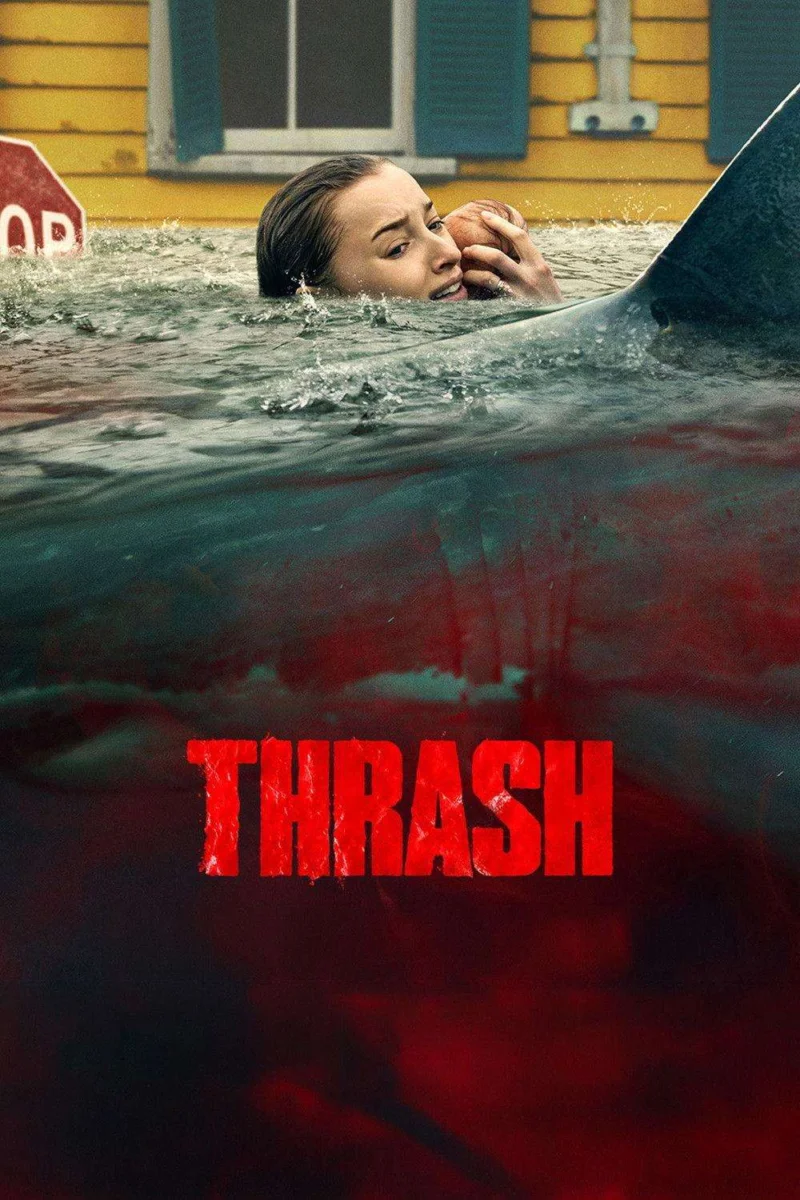
- Film Title: Thrash
- Cast: Phoebe Dynevor, Whitney Peak, Djimon Hounsou, Matt Nable, Andrew Lees, Alyla Browne
- Director: Tommy Wirkola
- Writer: Tommy Wirkola
- Distribution: Netflix
- Production: Sony Pictures, Hyperobject Industries
- Release Date: April 10, 2026
- Review by: Mother of Movies
This review contains moderate spoilers about the flooding sequence and character outcomes. The major twist involving the rescue and the final shark encounter is discussed. Read on if you don’t mind knowing how the survival plays out.
Thrash: When a Great Shark Movie Blinks Firs
Thrash is a disaster-shark hybrid that’s best when it stays underwater and falls apart the moment it surfaces and shows you what you’re actually dealing with. It’s a film strangled by being too much of the same and broaching on too much of the absurdity for a cult smash. You watch it and feel the tension, the water rising, the predators circling, and then, boom, a full CGI great white the size of a city block glides across the frame and you’re suddenly aware you’re watching a Netflix movie that cost money but maybe not enough money.
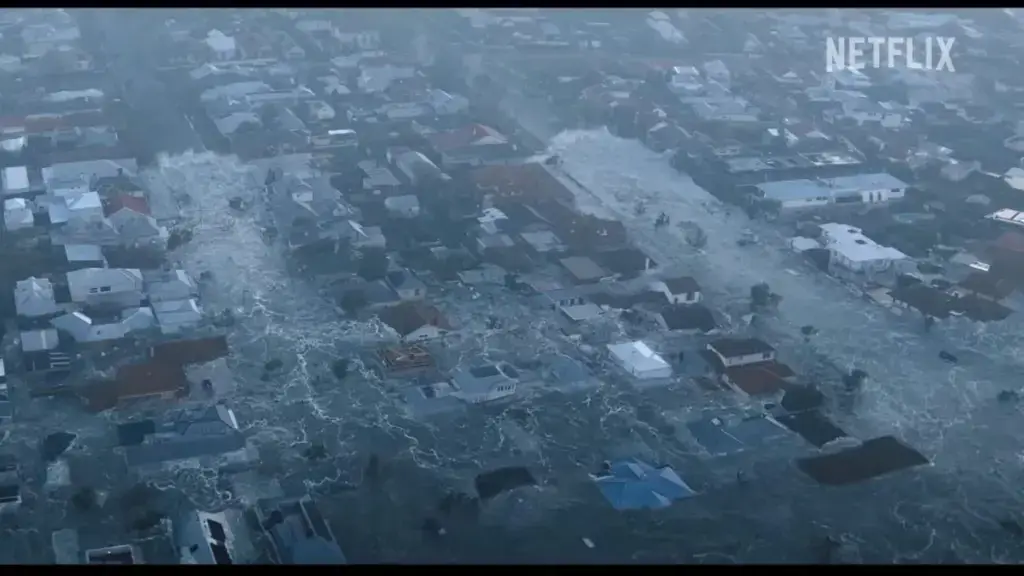
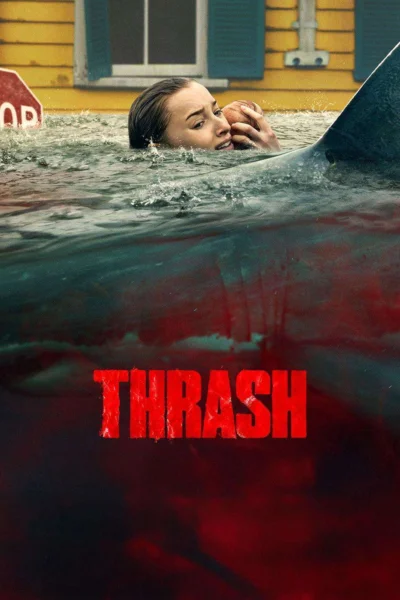
The premise is solid: Category 6 storm hits Annieville on the South Carolina coastline. Flooding. Sharks. People trapped in houses. Dakota (Whitney Peak) is an agoraphobic young woman who refuses to evacuate. Her uncle Dale (Djimon Hounsou), a marine biologist, is coming to get her. Lisa (Phoebe Dynevor) is a pregnant woman stuck in her car on the highway. The kids in the foster home are planning their escape route. Its Crawl meets Deep Blue Sea with a weather system that actually feels like it’s hunting a whole town.
Thrash (2026): Two Acts of Brilliance
The first act flooding sequence. I was locked in predictable excitement when the rescuer (Jimmy) disappeared into a cloud of blood and fins, the sound design scraped across the frame like something tearing through metal. The water itself is the star here. The way it consumes the town, the way it turns ordinary spaces into death traps. You feel the weight of it. The cinematography by Matt Weston uses the emptiness around submerged objects to amplify the devastation. When the sharks are barely visible, just fins, just shadows, the film has you.
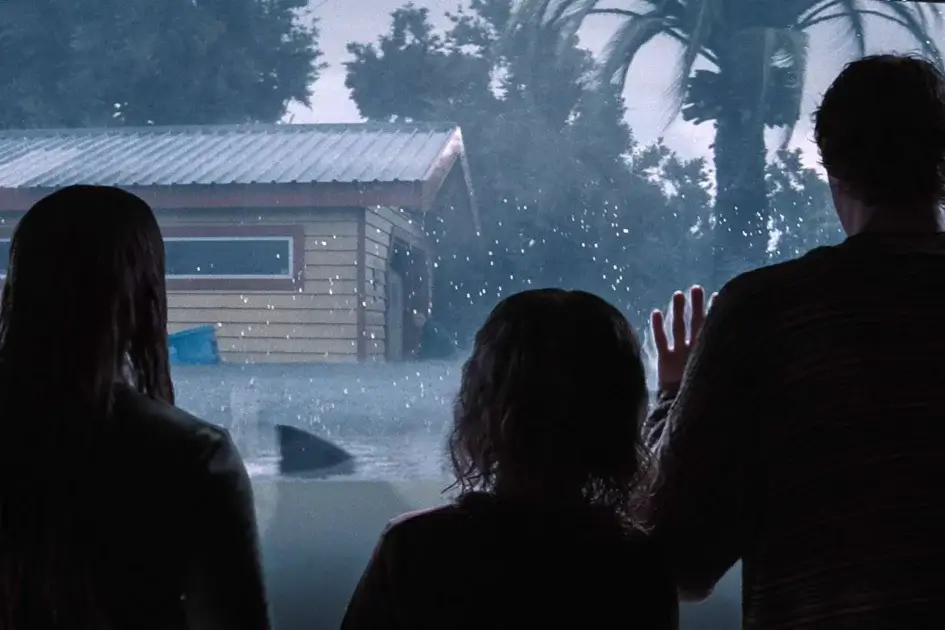
However, I laughed harder than expected in the second half when one of the foster kid’s chant “fuck Mr. Olsen” and the armless foster father literally bobs out of the water like a cursed buoy. There was a chance to establish some real evil in their family unit situation that could have been memorable. Instead, Matt Nable’s Billy Olsen is around just long enough for you to want him dead, and then the film grants that wish.
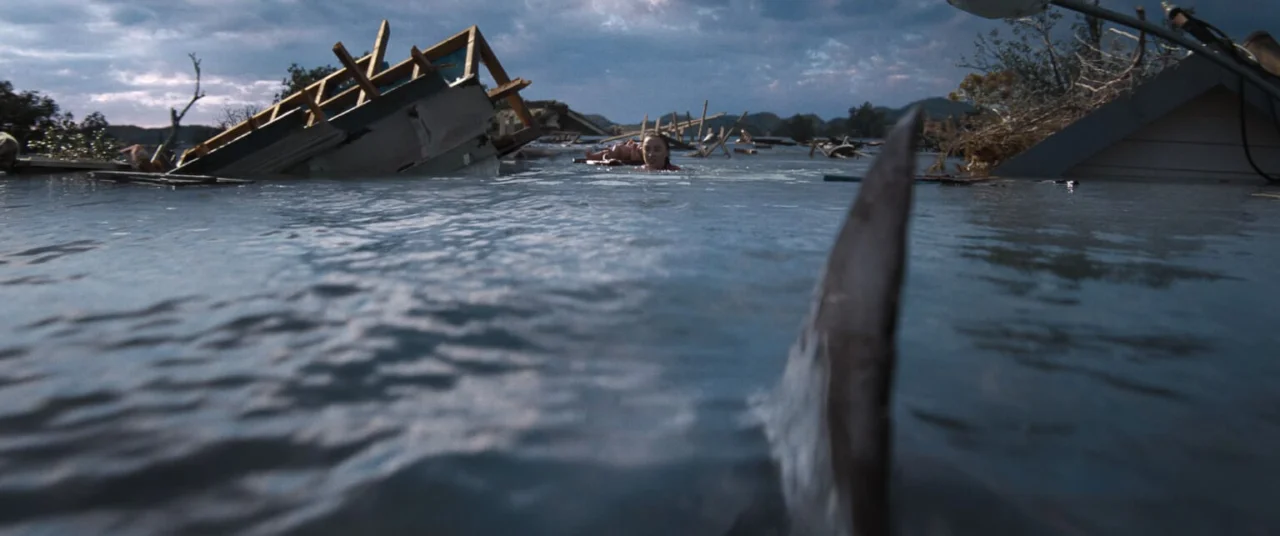
Thrash built its entire tension economy on not showing you the sharks. The animatronics and close-encounter parts with the tank sequences created a really great aesthetic. You couldn’t see the predators clearly. When you did get a close up, it looked good. But by the third act, director Tommy Wirkola and visual effects supervisor Bryan Jones seem to have lost faith in that restraint. Some of the wide shots of multiple full-body CGI sharks are executed well. The immersion, painstakingly built through two acts of confined spaces and murky water, though, slowly starts to wobble.
Between the over-the-top visuals that veered too far away from authenticity, and a woman using a stick to cut the umbilical cord after birthing her baby while being hunted by bull sharks, much of the more dedicated fans of films like this had turned that smile upside down.
The hybrid approach, blending animatronics for close ups with CGI for large-scale sequences, should have been seamless. On set, Phoebe Dynevor confirmed that for her character’s scenes, the sharks were replaced with “some stunt guys with tennis balls.” The problem isn’t the idea of mixing practical and digital. It’s that somewhere along the line, someone decide to go hard or go home and forgot they had the set-up for some realistic and scary shark stuff. The earlier sequences do the job because you’re seeing glimpses, reflections, the suggestion of danger. By the end, you’re watching rendered predators move through rendered flooded homes, and all you are doing was wishing you had watched Crawl again.
The cast carries what the effects can’t. Dynevor, shooting in Melbourne winter in two wetsuits under a pregnancy prosthetic, must’ve been hard physically. Dakota’s agoraphobia-driven paralysis was convincing for about five minutes until even blind Freddy could see there’s danger. Hounsou as Dale is wasted in the third act, reduced to a plot device by the finale, though I’ll admit shark movies have always had an inexplicable surplus of marine biologists on standby.
The water tank sequences, that 2-million-litre purpose-built outdoor tank at Docklands Studios, are where the film earns its budget. The production design by David Ingram transforms ordinary Melbourne locations (Canterbury, Mount Macedon, Mornington Pier) into disaster zones with convincing detail. The editor Martin Stoltz keeps the pacing tight until it isn’t. The score by Dom Lewis and Daniel Futcher does the heavy lifting when the visuals can’t. (Except for Lisa getting contractions as A Thousand Miles by Vanessa Carlton blares. No one liked that. No one.
Is Thrash worth streaming? If you go in expecting disaster horror with sharks, yes, for the first 80 minutes. There is definitely not an absence of sharks. If you stay for the finale, you’ll watch it turn into a film that revealed too much and trusted its audience too little. It’s a film starts off well and for two acts you have a good time. Then it turns into Temu Crawl sans the dog and swaps it for a baby. That’s frustrating because the foundation is solid. The premise works. The performances work. The practical effects work. But somewhere between the tank sequences and the final render, something broke.
The Tank and the Location in Thrash
The animatronics and shark puppetry (credit: Michael M. Foster, credited as Shark Puppeteer, Water Safety, and Stunt Assistant) created tangible threat. When you see a fin breach the surface of real water, your brain accepts it. When a stunt performer in a shark suit moves through the tank, there’s weight and displacement. Cinematography respects the limitation, brief glimpses, suggestive angles, darkness and murk doing the heavy lifting.
Then the third act arrives and Bryan Jones’s VFX team (Soho VFX, with Angela Levitan as VFX coordinator) unleashes full-body CGI sharks. Wide shots. Multiple predators. Rendered flooded backgrounds. The tonal shift is jarring. The digital sharks don’t move through water the same way the practical ones do. The lighting doesn’t match. The scale feels off.
It’s not that the VFX is bad, it’s that it’s visible, and visibility kills horror.
The Cinematography
Director of photography Matt Weston understood the assignment: keep the camera close, you’re trapped with the characters. The camera doesn’t pull back. It doesn’t give you a full picture of the threat.
Thrash’s filming approach reveals a fundamental truth about disaster-shark cinema: restraint and practical effects create dread. Revelation and CGI create too much of a reach. You can’t have both without one undermining the other.
THRASH is rated
3.5 Netflix’s Sharkicane Is a Shameless Crawl Clone, but I Didn’t Hate It out of 5
Practical Terror Undermined by Digital Excess
Thrash goes brilliantly for two acts, claustrophobic, tense, surrounded by water and real danger. Then it reveals its CGI sharks and loses the thread entirely. Dynevor anchors the survival, but the film’s commitment to restraint evaporates by the finale.
If the flood doesn’t kill you…Thrash also known as Beneath the Storm, tagline 2026
Need more shark movies?
Watch any of these:
- Great White Waters (2025)
- Fear Below (2025)
- House Shark (2019)
- Into the Deep (2025)
Thrash
Director: Tommy Wirkola
Date Created: 2026-04-10 19:18
