
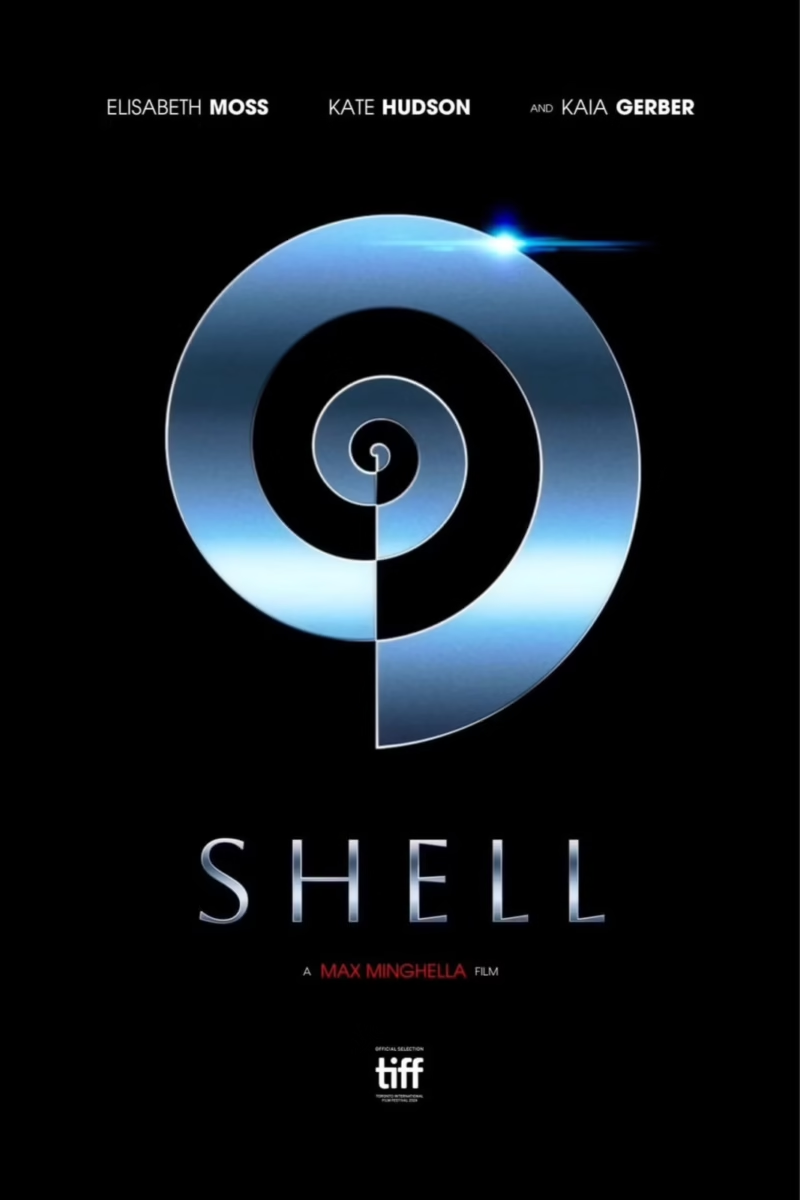
- Directed by: Max Minghella
- Written by: Jack Stanley
- Starring: Elisabeth Moss, Kate Hudson, Arian Moayed, Este Haim, Elizabeth Berkley, Kaia Gerber Cinematography: Drew Daniels
- Production Companies: Range, Dark Castle Entertainment, Love & Squalor Pictures, Blank Tape
- Distributed by: Republic Pictures / Rialto Distribution
- Release Dates: September 12, 2024 (TIFF); October 3, 2025
- Running Time: 100 minutes
- Reviewed by: Mother of Movies
This review discusses plot points, body horror reveals, and yes—the lobster situation. If you want to experience Samantha’s metamorphosis unspoiled, bookmark this and come back after you’ve shed your expectations.
The Fountain of Youth Runs Through the Ocean Floor
Shell arrives like a fever dream wrapped in shellfish DNA, and honestly? That’s exactly what Max Minghella’s directorial debut wants to be. Part body horror, part Hollywood satire, part cautionary tale about what happens when you let capitalism get its claws into anti-aging technology. This Elisabeth Moss-led black comedy commits so hard to its absurdist premise that by the time someone’s eating their own discarded skin at a dinner party, you’re not even sure if you should laugh or gag. Probably both.
Samantha Lake (Elisabeth Moss) is an actress navigating the soul-crushing machinery of Hollywood’s beauty industrial complex. She’s talented, she’s experienced, but she’s also, according to casting directors who think she’s left the room, “not young enough, not pretty enough, not skinny enough.” Her psoriasis doesn’t help. Neither does losing roles to kids she used to babysit. When her agent not-so-subtly suggests she hit the gym harder, Samantha’s at a crossroads familiar to anyone who’s ever been told their value has an expiration date.
Enter Shell, the biotech company promising eternal youth through a procedure that harnesses the regenerative properties of marine life. The pitch is Jurassic Park-adjacent in its delivery. A silver-haired scientist spruiks the value of creatures of the deep. Shellfish don’t age, so why should you? Led by the charismatic Zoe Shannon (Kate Hudson, clearly having the time of her life), Shell offers a pink fluffy robe, a sauna full of impossibly beautiful people, and the kind of transformation that makes your dating app matches quadruple overnight.
Moss brings her signature intensity to Samantha’s journey from overlooked character actress to Hollywood’s hottest commodity. She’s phenomenal at playing women trapped in systems designed to break them, and here she weaponizes that vulnerability into something darkly comedic. When Samantha emerges glowing and toned and suddenly booking the roles that rejected her weeks earlier. Moss plays it with equal parts relief and unease. She knows this is too good to be true. We know it’s too good to be true. But damn if it doesn’t feel good to watch Hollywood’s gatekeepers suddenly kiss her ass.
When Your Skincare Routine Becomes a Seafood Platter
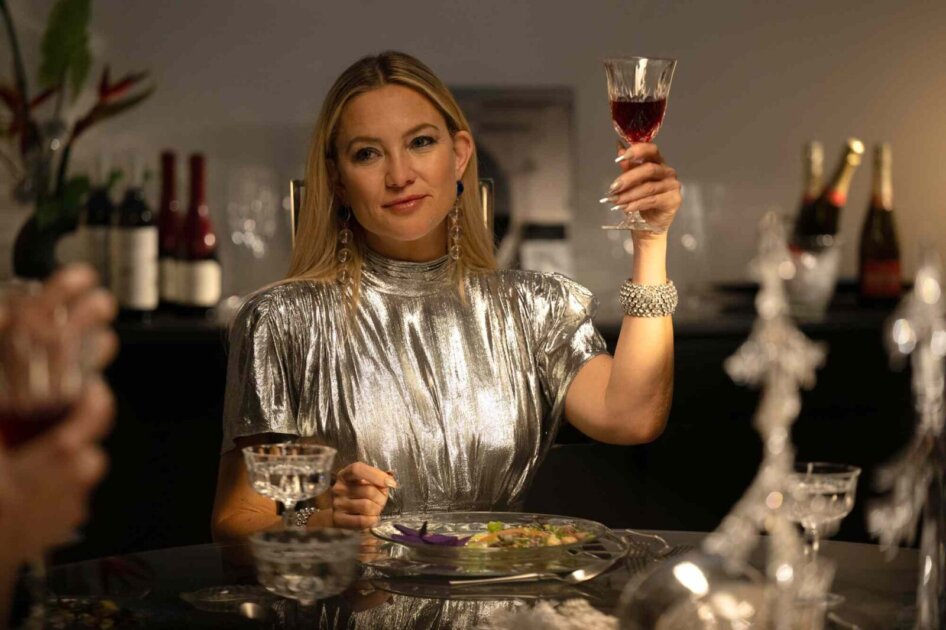
The film’s most memorable sequence happens at Zoe’s Christmas party, where Samantha and other Shell clients gather to celebrate their transformations. The dinner is exquisite. The conversation is bubbly. And then Zoe casually mentions they’re eating her discarded skin. She explains the shed layers are normally thrown away, but Zoe loves her new skin so much she’s been serving it as haute cuisine. It’s the kind of moment that could derail a lesser film, but Minghella leans into the grotesque absurdity with such commitment that it becomes perversely logical. Of course, these people would consume Zoe’s skin. It would be a privilege.
Kate Hudson’s Zoe is the film’s secret weapon. A wellness influencer crossed with a cult leader crossed with someone who genuinely believes she’s helping people. Hudson, typically cast in romantic comedies where her charm does the heavy lifting, here uses that same effervescence to mask something predatory. When she hands Samantha a vibrator and demands she use it until she “sees what everyone else will see on the outside,” it’s framed as empowerment. Really, though, it’s just another form of control. The male gaze repackaged as self-love.
The supporting cast, including Kaia Gerber as Chloe, the babysitting victim turned literal crustacean; Arian Moayed as the suspiciously enthusiastic Dr. Hubert; and Este Haim as Samantha’s concerned friend, Lydia, all understand the assignment. This is satire operating at a pitch just shy of full camp, and everyone’s committed to the bit.

The Lobster in the Room
Let’s address it: yes, people turn into lobsters. Specifically, Chloe, the fresh-faced ingenue who stole Samantha’s role. She becomes a giant, calcified lobster after Dr. Thaddeus Brand (Peter MacNicol) accidentally accelerates her transformation cycle. It’s revealed that Shell’s “side effects” include progressive calcification, essentially turning clients into the very sea creatures whose DNA they’ve borrowed. The company’s been covering up these transformations, disappearing clients who’ve gone full crustacean, and continuing to market the procedure to desperate Hollywood types.
When Chloe-the-lobster crashes out of the transport truck during a confrontation scene, the carnage is simultaneously horrifying and darkly hilarious. She recognizes Samantha, or at least, the lobster recognizes something, and proceeds to massacre Shell’s CEO, lawyer Chan (Randall Park), and various corporate goons with her massive claws. It’s The Substance meets Tusk meets Attack of the Crab Monsters, and somehow it works because Minghella never winks at the camera. The film plays it deadly straight, which makes it funnier and more disturbing in equal measure.
The climax sees Zoe trapping herself in one of Shell’s transformation pods, presumably to escape the lobster rampage. Only it explodes in a burst of genetic chaos. Samantha watches traumatized but alive, while the lobster presumably shambles off into the night. It’s an ending that refuses easy catharsis. There’s no heroic victory, just survival and the realization that the system is too big to kill with one rogue crustacean.
Profiting from Your Own Exposure
Here’s where Shell gets genuinely interesting and frustratingly muddled. The epilogue reveals that Samantha has written a tell-all book exposing Shell’s horrific practices. She’s become famous, again, this time as a whistleblower. She’s on talk shows, she’s celebrated, and she still looks phenomenal. The implication? She’s still benefiting from the treatment she’s denouncing. Shell is still operating. The system hasn’t collapsed; it’s just absorbed her criticism and kept churning.
It’s a cynical ending that should land with shock value, but the film doesn’t quite commit to the irony. Samantha’s final scene shows her embracing imperfection, food stuck in her teeth, a small moment of authentic humanity, but she’s still gorgeous, still profiting from a procedure that turned people into lobsters. Or maybe that’s the point.
On the other hand, it could be a tonal misstep in a film that couldn’t decide whether it wanted to be a body horror nightmare or an empowerment fable. I’m genuinely not sure. What I do know is that Shell is too smart to accidentally stumble into this ambiguity, which means it’s either brilliant or undercooked. I’m leaning toward the former.
Minghella’s Directorial Stamp: Actor Knows Actors
Max Minghella, best known for his acting work in The Handmaid’s Tale and The Social Network, makes his directorial debut with Shell, and you can feel his actor’s sensibility in every frame. He knows how to frame faces and when to let the absurdity speak for itself. The film’s futuristic aesthetic, self-driving cabs, vacuum bots, and sleek tech interfaces are never overplayed. It’s just futuristic enough to feel like a near-future cautionary tale without drowning in sci-fi world-building.
The score oscillates between ominous sci-fi synths and on-the-nose soundtrack choices that hammer home the “stay young forever” theme. Sometimes it’s a bit much; the music practically screams “this is about vanity” during certain sequences, but it fits the film’s heightened reality. Cinematography leans into clinical whites and oceanic blues, creating a sterile beauty that mirrors the procedure itself.
The Substance Meets “The Lobster”, But Make It Hollywood
Shell exists in conversation with recent body horror like Coralie Fargeat’s The Substance (aging actresses, grotesque transformations, industry critique) and Kevin Smith’s Tusk (absurd human-to-animal metamorphosis played disturbingly straight). It also shares DNA with Yorgos Lanthimos’ The Lobster (people becoming crustaceans as societal punishment) and David Cronenberg’s entire filmography (body as a site of horror and transformation). But Minghella’s film is less interested in Cronenbergian psychosexual dread and more focused on the economics of beauty, who profits when we’re all terrified of aging, and what happens when the cure is worse than the disease.

Filmmaker and Cast Highlights
Max Minghella makes his directorial debut after years as a character actor (The Social Network, The Handmaid’s Tale, Teen Spirit). His father, the late Anthony Minghella, directed The English Patient and The Talented Mr. Ripley, so cinema runs in the family.
Elisabeth Moss continues her reign as Hollywood’s go-to actress for women trapped in nightmarish systems. Her work here complements her roles in The Handmaid’s Tale (patriarchal dystopia), The Invisible Man (gaslighting and abuse), and Her Smell (self-destruction in the music industry).
Kate Hudson pivots from rom-com queen to sinister wellness guru with surprising ease. Known for Almost Famous and How to Lose a Guy in 10 Days, Hudson rarely gets to play characters this darkly manipulative.
Jack Stanley (writer) previously worked on The Girlfriend Experience (which is Awesome!) and brings that show’s clinical examination of transactional relationships to Shell‘s exploration of beauty as currency.
Controversy/Trivia: The film premiered at TIFF 2024 to divisive reactions; some critics hailed it as a bold satire, while others found its tonal shifts jarring. Republic Pictures’ decision to release it in October 2025 positions it as counterprogramming to traditional horror fare, banking on its black comedy credentials to attract audiences tired of jump scares. Early test screenings reportedly had walkouts during the skin-eating dinner sequence, which the marketing team is now leaning into afterwards.
Body Horror Meets Hollywood Satire
Shell is what happens when you let Elisabeth Moss shed literal skin while skewering beauty standards. Max Minghella’s directorial debut commits so hard to its absurdist premise, yes, people become lobsters, that by the time Kate Hudson’s serving her own discarded flesh at dinner, you’re not even sure if you should laugh or scream.
“Shell” Rating and Verdict:
Shell is rated
4 out of 5 Beautiful Monsters Who Profit from Their Own Metamorphosis
“Shell commits so hard to its absurdist premise that by the time someone’s eating their own discarded skin at a dinner party, you’re not even sure if you should laugh or gag. Probably both.”
Mother of Movies Quote for the film Shell 2025.
Similar Titles to Shell 2025 Section:
Need More Body Horror That Bites Back? Films Like Shell:
- The Substance (2024) – Demi Moore’s aging actress undergoes experimental treatment with grotesque results.
- Tusk (2014) – Kevin Smith’s nightmare where a man is surgically transformed into a walrus. Absurdist body horror played disturbingly straight.
- The Lobster (2015) – Yorgos Lanthimos’ dystopia where single people become animals. Shell borrows the crustacean transformation but swaps romance for vanity.
- Titane (2021) – Julia Ducournau’s Palme d’Or winner about body modification and identity.
- Crimes of the Future (2022) – Cronenberg’s return to body horror, where surgery becomes performance art.
Shell
Director: Max Minghella
Date Created: 2024-09-12 22:07
4
