
Film Title: Until Dawn
- Cast: Ella Rubin, Michael Cimino, Odessa A’zion, Ji-young Yoo, Belmont Cameli, Maia Mitchell, Peter Stormare
- Director: David F. Sandberg
- Writer: Gary Dauberman and Blair Butler
- Based on: Until Dawn by PlayStation Studios
- Distribution: Screen Gems
- Production: PlayStation Productions, Screen Gems, Vertigo Entertainment, Coin Operated, Mangata
- Release Date: April 25, 2025
- Review by: Mother of Movies – 2026 Folk horror, watch Whistle
The ground is about to turn red. I’m diving into the deaths, the loops, and the creatures below. Proceed only if you’ve survived the night.
If you’ve ever played the 2015 PlayStation hit Until Dawn, you know the drill: teenagers, storms, bad decisions, and the Butterfly Effect (A seemingly insignificant change triggers disproportionately large consequences). I went into this streaming release expecting the usual video game adaptation curse, like most Uwe Boll attempts at adapting horror games. Still, director David F. Sandberg has managed to craft something that sits comfortably in the “pleasant timepasser” category. It’s not reinventing the wheel, but it is spinning it with enough force to keep you watching.
We start with a classic setup that feels like every slasher movie you’ve ever seen, yet somehow remains endearing. The group includes the requisite archetypes: the single guy Max (Michael Cimino), the couple Abe (Belmont Cameli) and Nina (Odessa A’zion), Megan (Ji-young Yoo), who has a touch of the “shining,” and our protagonist Clover (Ella Rubin). They are retracing the steps of Clover’s sister, Melanie, who went missing exactly one year ago. It’s a pilgrimage of grief that quickly turns into a road trip from hell.
The atmosphere is heavy from the jump. The group stops at a tiny, decrepit gas station where we meet a cryptic attendant played by the legendary Peter Stormare. He drops lines about every year being “the same but different,” which feels like a meta-nod to the time-loop mechanics that are about to unfold. Stormare is doing what Stormare does best, being unsettlingly weird. It turns out he’s actually Dr. Alan Hill, a psychiatrist/trauma specialist, but for the first act, he’s just the creepy guy warning the kids not to go into the woods. Naturally, they ignore him.
Stuck in a Bubble
The transition from a road trip to a nightmare is handled with some visual flair. The group argues about turning back as a storm closes in, only to suddenly break through into a clearing that feels hermetically sealed from the rest of the world. It’s a bubble of calm surrounded by a wall of storm, centered around a strange blue house serving as a Welcome Center. It’s eerie, quiet, and features a calendar stuck on October 24, 1998.
This is where the film excels: the mystery of the setting. It’s not just a cabin in the woods; it’s a purgatory. Abe, a psych major with a penchant for filming everything, starts uncovering missing persons posters hidden behind bake sale flyers. The realization that they are in a place where time is broken lands well. Nina finds the guest book where missing sister Melanie has written her name dozens of times. It’s a great visual cue of madness that requires no dialogue to understand.
![Video game adaptations horror 2025 [Until Dawn Movie 2025]](https://vanessasnonspoilers.com/wp-content/uploads/2026/01/Until-Dawn-movie-Based-on-a-video-Game-1120x630.webp)
Death is Just a Reset
The horror kicks in with a masked killer (“Psycho”) who looks like he shopped at the “generic slasher villain” store, complete with a white nail and jeans. However, the film subverts expectations by killing everyone off relatively quickly. Abe investigates a noise and gets taken out. Nina screams and joins him. Max tries to be the hero, grabbing a chair to fight back, only to get a shard stabbed into his eye. It’s brutal, but strangely, not visceral. The lighting is dim, obscuring the worst of it, which might disappoint gorehounds looking for Terrifier levels of splatter.
But then, the hourglass turns, and they wake up. All their photos are now on the missing board. They remember dying. It’s a Happy Death Day overture but with more dread and less humor. This self-awareness allows for some meta-commentary where the characters realize they are in a movie-like scenario, acknowledging the tropes just as the lights flicker, something that didn’t happen in the previous loop.
Witches, Wendigos, and Loose Lore
The film starts to wobble in the third act. We move from a slasher mystery to supernatural chaos involving possession, a “Glore Witch,” and the Wendigo. Megan, the semi-psychic, gets possessed and killed, warning them not to let “it” in. Clover, desperate to find Melanie, eventually confronts the witch, who drops the ultimatum:
Survive the night or become part of it.
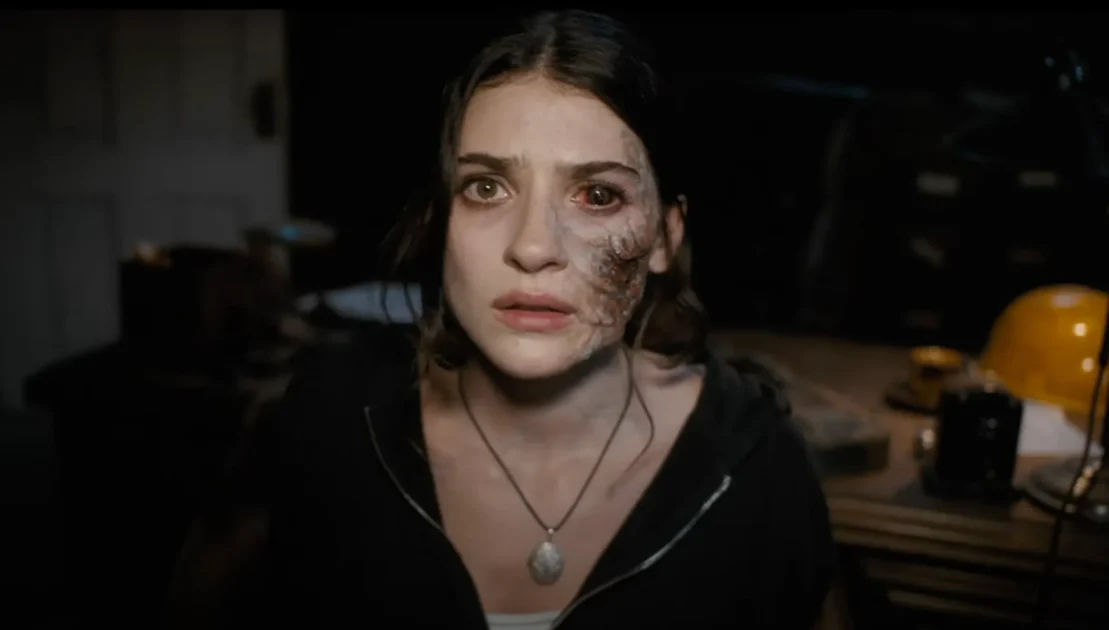
The mythology gets a bit “VHS Alien” here, disjointed and frantic. We learn the town was swallowed by a mining accident, and Dr. Hill has been trying to help the trapped souls. The Wendigo transformation is the ticking clock. The longer they stay in the loop, the more they physically degrade (extra teeth, distorted features) until they turn into monsters.
Practical effects are the MVP of Until Dawn. The creatures and the grime look tangible. There’s no glossy CGI overlay ruining the immersion; the blood looks sticky, and the costumes degrade realistically. However, Clover’s transition to a “one-woman army” feels unearned. She decides she is “sick of death,” stabs a monster, and runs off to save a sister who is likely already a Wendigo.
The finale sees Clover confronting Dr. Hill, realizing that for them to escape, someone has to die permanently. In a twist, she decides it’s him. She lets his coffee cup drift into the water (which has previously caused reactions), and he explodes. It’s a chaotic end that sees the survivors crawling out of a dirt hole, the same one we saw at the start, just as the sun rises.
Filmmaker Stamps
David F. Sandberg (Director) brings his signature high-concept horror efficiency seen in Lights Out and Annabelle: Creation. He knows how to frame a scare in the dark, utilizing negative space to make the audience lean in before the jump. His cameo is a nice easter egg for fans. Look for him as a face on the missing persons board. Gary Dauberman (Screenplay) is a veteran of the Conjuring universe, and his fingerprints are on the group dynamic and the “cursed object/location” lore, even if the threads between the Psycho, the Witch, and the Wendigo get tangled.
Did you love Until Dawn?
If you dig atmospheric horror with a side of time manipulation, check out:
- Triangle (2009): The gold standard for “trapped in a loop” horror on a boat.
- Dry Blood (2017): An underrated Gem that holds onto a space in time.
- The Final Girls (2015): A more comedic take on being trapped inside a horror movie.
- Happy Death Day (2017): Time loops, murder, and a distinct lack of Wendigos.
- The Ritual (2017): Friends hiking, woods, and ancient creatures.
- One More Shot (2025): Sliding Doors with Tequila.
The Verdict
Until Dawn is a 3.5 out of 5. It’s a solid, practical-effect-heavy horror that respects its source material’s branching narrative by trapping its characters in a loop of death. It doesn’t quite stick the landing with its muddled lore, but for a streaming night in, it works.
Until Dawn is rated:
3.5 Resets before the coffee gets cold out of 5
Practical Effects & Chill
David F. Sandberg delivers a solid creature feature that respects its PlayStation roots without needing a controller. While the third act gets a little messy with its lore, the practical gore and atmospheric dread make for a fun, snowy ride.
Until Dawn
![Until Dawn Review [2025]: A Time-Loop Trap With Death at Morning](https://vanessasnonspoilers.com/wp-content/uploads/2026/01/Until-Dawn-2025-film-800x450.jpg)
Director: David F. Sandberg
Date Created: 2026-04-25 16:35
3.5
