
Film Title: Primate
Cast: Johnny Sequoyah, Jessica Alexander, Troy Kotsur, Victoria Wyant, Gia Hunter, Benjamin Cheng
Director: Johannes Roberts
Writer: Johannes Roberts, Ernest Riera
Distribution: Paramount Pictures
Production: 18Hz Productions
Release Date: September 18, 2025 (Fantastic Fest); January 9, 2026 (United States)
Review by: Mother of Movies
This review keeps major reveals locked in the cage where they belong. However, narrative structure, kill creativity, and thematic chaos are discussed freely. A death count breakdown lives at the end for gore enthusiasts. Proceed with caution or reckless abandon, your choice.
When Your Grief Counselor Has Fangs
Johannes Roberts’ Primate crashes into 2026 like that friend who shows up uninvited, drinks all your beer, and leaves blood on the carpet, chaotic, exhausting, and occasionally entertaining in its sheer nerve. After a Fantastic Fest debut that had gore hounds losing their minds, this 89-minute primate rampage asks: what happens when the family pet you’ve been using as an emotional support animal decides you’re the one who needs therapy, violently?
The setup is deceptively simple. Lucy Pinborough (Johnny Sequoyah) hasn’t seen her famous deaf author father, Adam (Troy Kotsur), in years. When she arrives at his remote Hawaiian cliffside estate with best friend Kate (Victoria Wyant) and the unwelcome third wheel Hannah (Jessica Alexander), Lucy’s frenemy who exists solely to create friction, the stage is set for family reconciliation. Instead, they get primal carnage courtesy of Ben, the family chimpanzee who’s contracted rabies from a mongoose bite that Adam dismissed as inconsequential.
Roberts, who previously gave us the claustrophobic dread of The Strangers: Prey at Night and the underwater tension of the 47 Meters Down films, trades his usual atmospheric restraint for something closer to Evil Dead meets The Purge, if the purge was orchestrated by one very angry primate with a vendetta against human hubris.
Aesthetic Choices That Swing Between Brilliant and Baffling
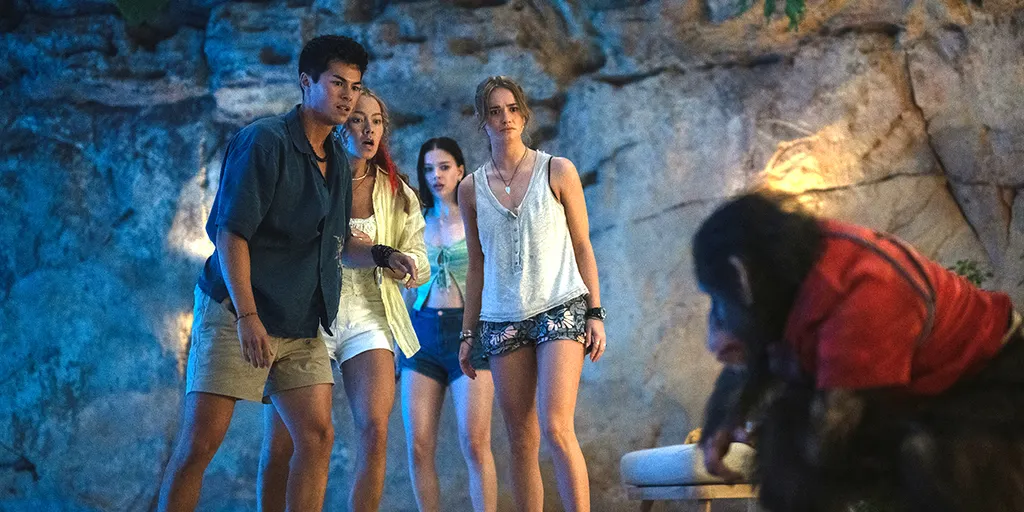
Cinematographer Stephen Murphy captures Hawaii’s lush beauty with establishing shots that belong in a tourism commercial, which makes the subsequent bloodbath feel even more transgressive. The house itself, an open-concept luxury with floor-to-ceiling windows, becomes a glass cage where the hunter-and-hunted roles reverse with brutal efficiency.
But here’s where Primate trips over its own tail: Ben’s appearance flip-flops more than a politician during election season. One moment, he’s absolutely drenched in viscous drool and blood, eyes clouded with infection. Cut to a close-up, and he looks like he just walked out of a PetSmart grooming appointment. Did someone off-camera hose him down between takes? For a film that stakes its reputation on visceral horror, these aesthetic face-plants (pun absolutely intended, given all the jaw-ripping) shatter immersion faster than Ben shatters skulls.
Adrian Johnston’s score does heavy lifting when the visuals falter, alternating between eerie silence and percussive chaos. It’s the kind of sound design that makes you flinch before the violence arrives, training your nervous system to anticipate carnage through audio cues alone. Roberts exploits this conditioned dread with mixed results.
Performances That Navigate Chaos With Uneven Results
Johnny Sequoyah carries Primate on her shoulders with the kind of final girl energy that feels authentic rather than assigned. Lucy’s arc, from resentful daughter to reluctant protector, has genuine emotional stakes, even when the script saddles her with clunky exposition about her dead mother and the chimp who represents her lingering grief.
Troy Kotsur, the Oscar-winning deaf actor from CODA, brings gravitas to Adam that the thin characterization doesn’t deserve. His deafness becomes a narrative device, sometimes effectively (the suspense of him wandering oblivious through carnage) and sometimes lazily (why make him deaf if it’s just for one jump scare?). Kotsur’s sign language exchanges with his daughters carry more emotional weight than any of the scripted dialogue, which says something about Roberts and Ernest Riera’s writing priorities.
Jessica Alexander’s Hannah occupies the unenviable position of “character the protagonist hates, but the audience might actually like.” She’s prickly, sure, but she’s also the one who tries to call for help, who attempts actual escape plans, and who nearly makes it to safety, foiled only by grabbing the wrong car keys in a moment of cruel irony. Alexander brings surprising depth to what could’ve been a throwaway frenemy role.
Benjamin Cheng’s Nick, Lucy’s childhood crush, and Kate’s brother get the short end of the narrative stick. His attempt to physically confront Ben by pushing him off the cliff represents the kind of toxic masculinity horror films love to punish, and Primate delivers that punishment with bone-crunching finality.
When Gore Becomes the Point Instead of the Punctuation
Let’s address the elephant, or rather, the chimpanzee, in the room: Primates’ violence is cartoonishly excessive. This is a film where a rabid primate rips the lower half of someone’s face off, holds it up to his own like a grotesque mask, and makes it “laugh” in a moment of absurdist horror that feels ripped from a Rob Zombie favorite.
For gore enthusiasts, this is catnip. For those seeking narrative cohesion or thematic depth, it’s exhausting. The jaw-ripping trend that’s infected recent horror, see Terrifier 2, Evil Dead Rise, and Talk to Me, reaches its apex here, as if Roberts decided subtlety was for filmmakers who don’t understand what audiences really want. And maybe he’s right. The Fantastic Fest crowd reportedly went feral for these moments, hooting and hollering like they were watching gladiatorial combat.
But here’s my issue: when every kill becomes a showcase for practical effects wizardry, death loses its sting. The first jaw-ripping is shocking. By the third, it’s routine. Primate wants to have it both ways, to be taken seriously as a grief allegory while also delivering the kind of splatter that earns its hard-R rating ten times over. It succeeds at the latter while fumbling the former.
Narrative Mechanics That Creak Under Scrutiny
The film’s structure, opening with a flash-forward of veterinarian Dr. Doug Lambert (Rob Delaney in an uncredited cameo) entering Ben’s cage, then rewinding to show how we got here, promises a ticking clock thriller. Instead, it delivers a series of increasingly implausible scenarios held together by characters making decisions that defy basic survival instincts.
Why does Adam dismiss the lab’s rabies warning with “there’s no rabies in Hawaii”? Why do the drunk party crashers Drew and Brad mistake a blood-splattered crime scene for evidence of a “really cool party”? I have more examples, but these character choices are just plot contrivances designed to move bodies into Ben’s killing radius.
The pool sequence, which dominates the film’s midsection, showcases Roberts at his most inventive. Trapping the survivors in water while a primate who can’t swim stalks the perimeter is genuinely tense, even if it stretches credulity that Ben never just… waits them out.
But then Adam arrives home, and the film’s internal logic collapses entirely. He strolls through his destroyed house eating leftover pizza, oblivious to the carnage, because… he can’t hear screaming? The scene plays for suspense, but it reads as farce.
When Your Filmmaker Stamp Becomes a Straightjacket
Johannes Roberts has built a career on contained thrillers where environment dictates terror, the trailer park in Prey at Night, the ocean depths in 47 Meters Down, and the morgue in Play Dead. Primate continues this tradition by transforming a luxury home into a killing floor.
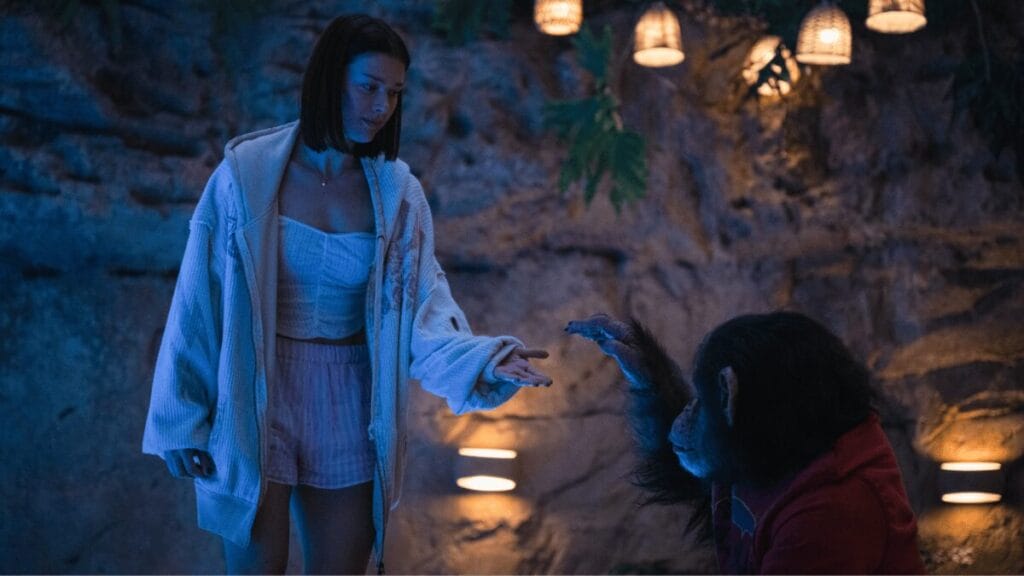
The Hawaiian setting actually does significant work here; Roberts and cinematographer Stephen Murphy capture the estate’s dramatic positioning with sweeping shots from the ocean looking into the house, showcasing both its architectural elegance and its vulnerability. The pool area is spectacularly designed, with one side completely open to the cliff edge (no fencing, no glass barrier, just a straight drop to the rocks below), creating organic tension before Ben even shows up. A cave-like rock staircase connects the main house to the pool level, giving the space just enough separation to make upstairs/downstairs cat-and-mouse games believable.
Why the Rabies Angle Matters (And Doesn’t)
Using rabies as the catalyst for Ben’s transformation is simultaneously inspired and underexplored. Rabies, a disease that rewires the brain to create aggression, hydrophobia, and eventual paralysis, is terrifying precisely because it’s real. The virus literally hijacks your nervous system to turn you into a transmission vector for itself. In that sense, Ben isn’t a monster; he’s a victim of biological warfare.
But Primate isn’t interested in that tragedy. Roberts wants his cake (a sympathetic animal driven mad by disease) and to eat it too (a slasher villain who orchestrates elaborate kills). Real rabies would render Ben increasingly uncoordinated and confused as the disease progressed. Movie rabies gives him superhuman strength and strategic thinking. He opens car doors, stalks prey with tactical precision, and even engages in psychological warfare by toying with his victims.
This disconnect between scientific reality and cinematic necessity isn’t unique to Primate; see every zombie movie ever made. If you’re going to invoke real-world disease, commit to its limitations or embrace full fantasy. Primate gets stuck in the middle, wanting credibility it hasn’t earned.
The Verdict: Absurdist Carnage That Forgets Why We Care
Primate succeeds as a showcase for practical effects and fails as everything else. If your tolerance for narrative inconsistency is high and your appetite for creative kills is insatiable, Roberts delivers a buffet of viscera.
The film’s 89-minute runtime feels simultaneously too long (the pool sequence drags) and too short (character development is nonexistent). It’s the cinematic equivalent of a roller coaster that’s all loops and no story, thrilling in the moment, forgettable once you exit.
Roberts has proven he can craft tension in confined spaces. Primate suggests he’s less interested in that craft than in chasing viral moments. The jaw-ripping scene is already making rounds on horror Twitter, divorced from context, and celebrated. Maybe that’s the point. Maybe in 2026, when attention spans are measured in TikTok seconds, a film that delivers shareable shock is more valuable than one that lingers in your psyche.
But Mother of Movies prefers horror that haunts rather than just horrifies. Primate is a technical achievement in the service of empty calories, a film that will satisfy your immediate craving for chaos but leave no lasting impression beyond “remember when the monkey ripped that guy’s face off?”
Primate is rated:
3.75 Reasons to never adopt exotic pets out of 5
Verdict & Rating – Primate 2026
Gonzo Gore Without the Gravitas
Primate delivers jaw-ripping carnage (literally) and practical effects that’ll make gore hounds howl, but trades emotional resonance for shock value. Roberts knows how to stage violence; he’s just forgotten why we should care who’s bleeding.
Filmmaker DNA: Johannes Roberts’ Contained Chaos
Johannes Roberts made his mark with location-specific horror that transforms familiar spaces into killing grounds. The Strangers: Prey at Night (2018) weaponized nostalgia and neon against a trailer park backdrop. 47 Meters Down (2017) and its sequel 47 Meters Down: Uncaged (2019) proved he could wring tension from claustrophobia and dwindling oxygen. Play Dead (2022) turned a morgue into a puzzle box of survival.
His films share DNA: isolated settings, limited casts, real-time pacing, and an emphasis on practical effects over CGI wizardry. When Roberts is firing on all cylinders, he creates pressure-cooker scenarios where the environment dictates every choice. Primate has the isolated setting and practical carnage.
Roberts’ partnership with writer Ernest Riera (who also worked on 47 Meters Down: Uncaged) continues here, but their script feels rushed.
What the Internet Says: Divisive Carnage
Primate premiered at Fantastic Fest 2025 to a polarized response. Genre enthusiasts praised its practical effects and willingness to push boundaries; the jaw-ripping scene became instant horror folklore, shared across social media with equal parts glee and disgust. Critics were less kind, with many noting the film’s narrative inconsistencies and underdeveloped characters.
The film’s production faced minimal controversy, though animal rights groups questioned the use of a human performer (Miguel Torres Umba) in motion-capture rather than CGI. 18Hz Productions defended the choice as necessary for the film’s visceral realism, noting no animals were harmed and all primate behavior was choreographed with primatologist consultants.
Paramount’s decision to give Primate a limited theatrical release before fast-tracking to streaming suggests they knew exactly what they had, a cult item for horror completists rather than mainstream crossover. The 89-minute runtime indicates studio-mandated cuts may have happened, though Roberts hasn’t publicly discussed whether his original vision was longer or more ambitious.
The Death Count: A Study in Subverted Expectations (Click the Arrow for Spoilers)
[SPOILER SECTION – PROCEED WITH CAUTION]
For those who want the gory details without watching the film, here’s how Roberts upends traditional slasher economics:
Dr. Doug Lambert (Rob Delaney) – Dies in the cold open, face torn off while trying to medicate Ben. Establishes the threat and wastes a recognizable actor in under five minutes, a power move.
Nick (Benjamin Cheng) – The childhood crush and would-be hero gets head-planted into rocks after attempting to physically overpower a primate. Dies roughly 40 minutes in, when most films would be building to his unrequited love arc. Roberts’s shock-kill, delivered with cranial trauma.
Drew and Brad (Charlie Mann, Tienne Simon) – The drunk party crashers who mistake carnage for celebration. One gets his lower jaw ripped off in the scene that’s become Primate‘s calling card, Ben holding the severed jaw up to his own face and making it “laugh” is the kind of gonzo imagery that births memes. The other dies offscreen, discovered by Adam with similar facial destruction.
Kate (Victoria Wyant) – The best friend who survives the pool sequence only to get her skull crushed with a rock in the stairwell while trying to retrieve Lucy’s phone. Her death is brutally efficient, no prolonged suffering, just sudden violence that underscores how quickly safety evaporates.
Hannah (Jessica Alexander) – The frenemy who finally shows heroism by escaping to call the police, only to be killed before help arrives. She gets the wrong car keys in a moment of tragic irony, then dies screaming into a 911 call. Roberts lets you hear the operator’s confusion as Hannah’s pleas turn to gurgles, nasty work that earns the R-rating.
Survivors: Lucy, Erin, and Adam limp away with trauma and injuries, but alive. Ben goes over the balcony in the climax, with Lucy delivering the final blow, a nice inversion of the “dad saves daughter” trope Roberts sets up but doesn’t deliver.
The structure is fascinating because it kills off presumed protagonists early (Nick) while letting “expendable” characters (Hannah) survive long enough to become complex. It’s the kind of narrative shell game that works better in theory than execution, because the film never quite commits to making you care about anyone beyond Lucy.
Roberts and co-writer Ernest Riera seem more interested in subverting horror tropes than building a coherent world. The “final girl’s annoying friend” dies, but not when you expect. The childhood crush becomes an early casualty rather than a third-act hero. The father figure arrives to save the day, but only after everyone else has done the heavy lifting. These inversions feel calculated rather than organic, as if the writers were checking boxes on a “how to make your horror movie feel fresh” listicle.
[END SPOILERS]
Where to Watch
Primate
Director: Johannes Roberts
Date Created: 2026-01-29 17:10
3.75
