
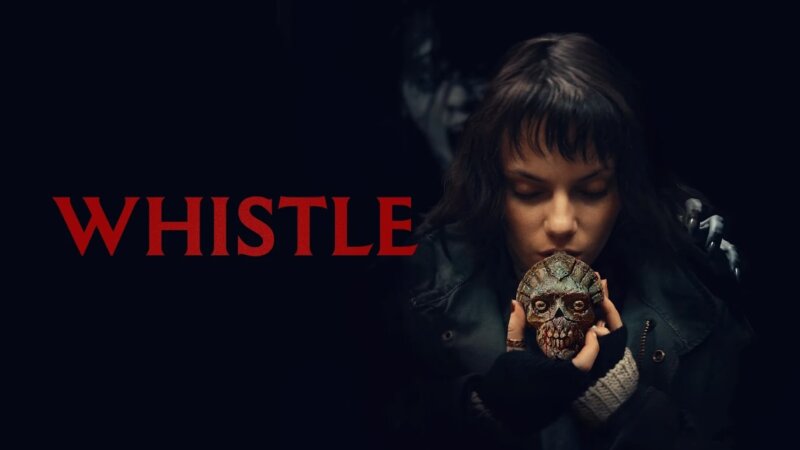
Film Title: Whistle
Cast: Dafne Keen, Sophie Nélisse, Percy Hynes White, Sky Yang, Jhaleil Swaby, Ali Skovbye, Nick Frost, Michelle Fairley
Director: Corin Hardy
Writer: Owen Egerton
Distribution: Elevation Pictures (Canada), Shudder (US), Black Bear Pictures (British Isles)
Production: No Trace Camping and Wild Atlantic Pictures
Release Date: Theatrically February 6, 2026 / Streaming March 3, 2026
Review by: Mother of Movies
This review discusses key deaths, the curse mechanics, and thematic elements without ruining the final act. If you want to experience the whistle’s scream completely fresh, bookmark this and come back after watching.
The Death Whistle Screams and Nobody Wins
Remember when Final Destination made us afraid of everyday objects? Or when The Ring convinced a generation that VHS tapes were harbingers of doom? Whistle attempts to resurrect that cursed-artifact anxiety for the streaming era, wrapping an Olmec death whistle in teenage angst and existential dread. Directed by Corin Hardy (The Nun, The Hallow) and written by Owen Egerton (Mercy Black), this supernatural thriller asks: what if your death wasn’t just inevitable, but actively hunting you down in the form of your future corpse?
The premise hooks immediately. During a championship basketball game, star athlete Mason “Horse” Raymore (we never really get to know him) sees a burning figure only he can perceive. Moments later, in the locker room showers, he’s consumed by flames in an opening that establishes the film’s willingness to get nasty.
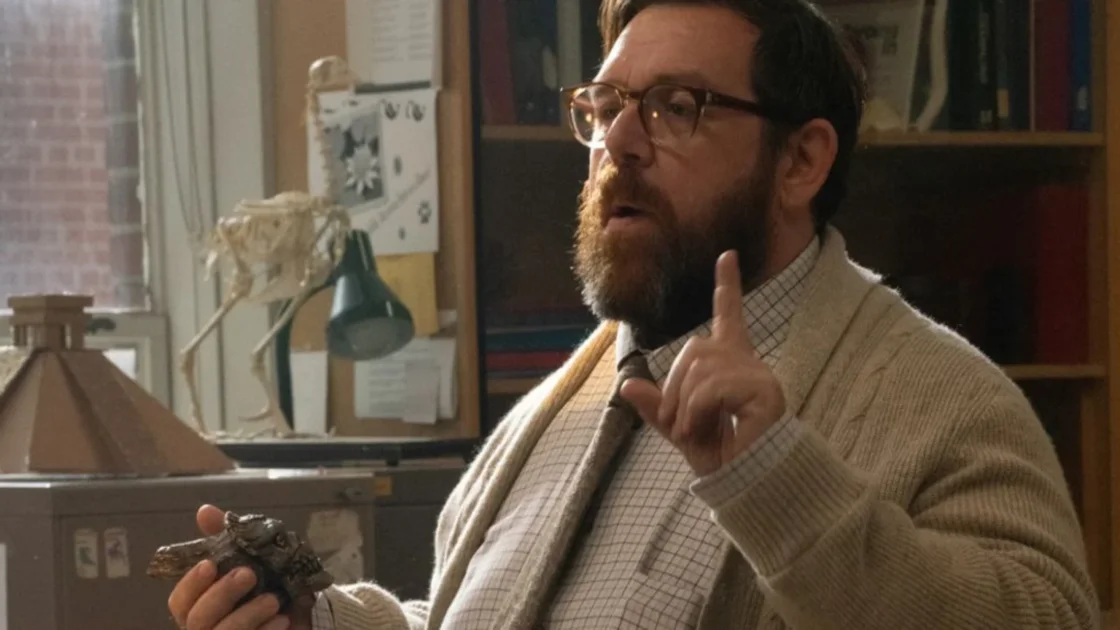
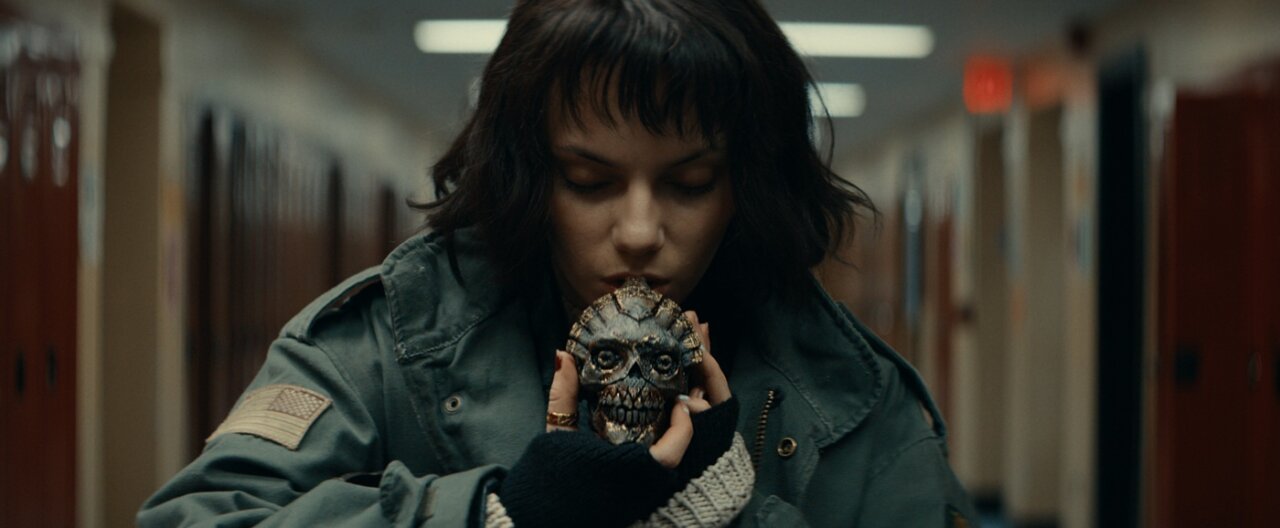
Fast-forward six months, and transfer student Chrys Willet (Dafne Keen) inherits Mason’s locker at Pellington High, along with the skull-shaped whistle that started it all. When Mr. Craven (Nick Frost, doing his best “doomed teacher who googles the wrong artifact” routine) blows the whistle to make sure it’s in working order, after discovering it’s worth $35,000 in good condition, he seals his fate faster than you can say “cursed eBay listing.”
The whistle’s rules are simple: blow it, and if it screams back, you’re marked for death. Your demise manifests as the aged, decayed version of yourself you’d become at your natural death. Except it’s coming for you now. It’s a clever twist on mortality that gives the film its emotional indifference. Grace (Ali Skovbye) would’ve lived to old age, so her death-self is a withered crone chasing her through a winter solstice maze. Dean (Jhaleil Swaby) never touched the whistle but still gets dragged in because he heard it, a rule that feels arbitrary until you realize the curse doesn’t care about your participation, only your proximity.
Dafne Keen Straddles the Chaos
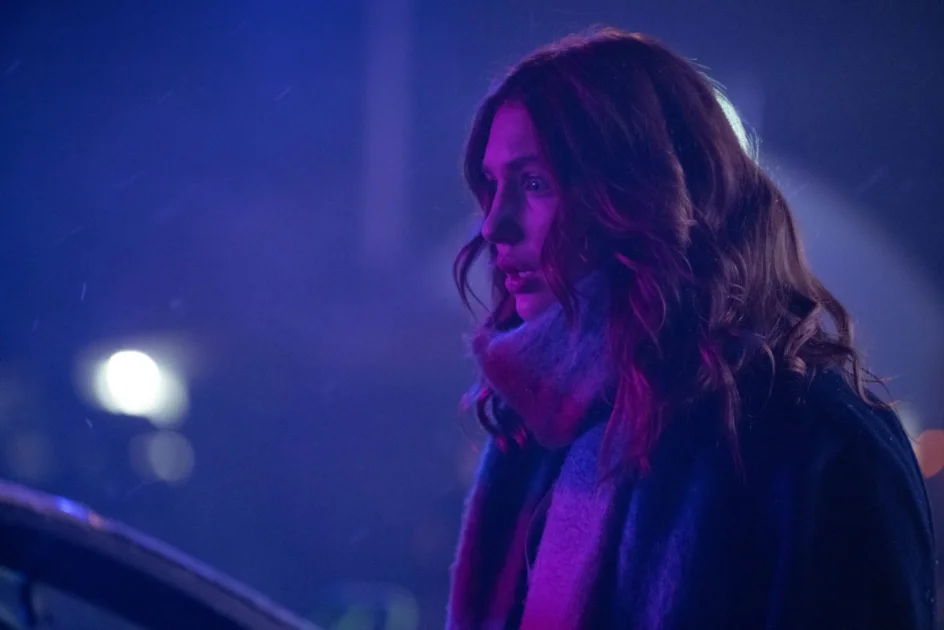
Keen, fresh off her acclaimed turn in His Dark Materials, brings a raw vulnerability to Chrys that elevates what could’ve been generic Final Girl territory. Her backstory, an overdose that she believes killed her father, adds layers of guilt and self-destruction that make her eventual plan to “die and come back” seems complicated. Especially when curses usually find a way around such things. When she and Ellie (Sophie Nélisse, from her Yellowjackets days) decide the only escape is to flatline and revive each other, it’s less about outsmarting death and more about two traumatized kids who’ve already stopped fearing it.
Nélisse matches Keen’s intensity, and their chemistry transforms what could’ve been a throwaway queer subplot into the film’s emotional nicety. Their relationship develops organically against the backdrop of supernatural carnage. A midnight festival kiss scored to Joy Division’s “Love Will Tear Us Apart” shouldn’t work in a horror movie, but here it does. It’s the kind of moment that reminds you these are teenagers navigating first love while being stalked by literal death omens, which is somehow more relatable than it should be in 2026.
Percy Hynes White’s Rel (the cousin who swipes the whistle shortly before Mr. Craven’s demise) gets the short end of the narrative stick. His death feels rushed, a casualty of the film’s need to maintain momentum rather than explore his character beyond “guy who never gets the girl.” Sky Yang’s Noah, the violent youth pastor who becomes the film’s third-act token of Death, is more interesting. Though his sudden appearance feels like a screenwriting convenience. When he accidentally transfers the curse to himself via Ellie’s blood, it’s satisfying in a “the asshole gets his comeuppance” way, but also frustratingly abrupt for a character introduced so late.
Where the Whistle Loses Its Breath
Hardy’s direction is fine but rarely inspired. The death sequences range from genuinely exciting (Mason’s fiery shower demise, Grace’s maze chase) to frustratingly obscure (Dean’s car accident death would have left his parents in a mental hospital or, at the very least, on the news). The film’s aesthetic borrows heavily from early 2010s supernatural thrillers, think Sinister meets It Follows, but never quite commits to either’s atmospheric dread or slow-burn tension. The score, while cool, leans on generic horror stings when silence might’ve been more effective.
The biggest narrative stumble is Rel’s death. According to my notes and the film’s internal logic, he had a solid plan. Drug the local dealer (who’s established as genuinely terrible), mark him with blood, and let the curse transfer. It’s morally gray enough to be interesting, and Chrys and Ellie’s attempt to stop him feels like misplaced heroism.
When Rel dies because they intervene, it’s frustrating, not because it’s tragic, but because it feels like the script is punishing a character for thinking strategically. The dealer was an asshole who contributed to overdoses in the community. Let the curse take him. Instead, we get a “nobody should die” speech that rings hollow in a movie where people are already dying.
The film also can’t decide if it wants to be a meditation on mortality or a body-count thriller. Mason’s grandmother, Ivy (Michelle Fairley, criminally underused), delivers the curse’s exposition with gravitas, “Death is not a choice, it is inevitable”, but the film immediately undercuts this by introducing the blood-transfer loophole. If death is inevitable, why does the curse allow escape clauses? It’s the kind of internal contradiction that plagues many “cursed object” movies, but it’s especially glaring here because the script keeps gesturing toward philosophical depth.
A Cycle That Won’t Break
The ending, three months later, a new student blows the whistle in the same locker, is predictable but thematically consistent. Cursed artifacts don’t stay buried, and teenagers don’t learn from other people’s mistakes. It’s cynical in a way that feels appropriate for a film about death’s inevitability, even if it also feels like sequel bait.
Egerton’s script has moments of genuine wit. The Divinyls’ “Back to the Wall” playing as Chrys arrives at her new school is a perfect needle-drop, and the winter solstice festival gives the film an excuse for atmospheric lighting and pagan imagery that Hardy exploits well. When Chrys tells Ellie, “death isn’t the enemy,” it’s meant to be profound, but it lands as hollow because we haven’t spent enough time with these characters outside of crisis mode.
The Verdict: A Scream Worth Hearing, If Not Remembering
Whistle is a popcorn supernatural horror that borrows liberally from better films without quite justifying its existence. It’s Final Destination with a skull whistle artifact, It Follows without the sustained dread, and The Ring minus the iconic imagery. What saves it from total mediocrity is the cast and a premise that, while derivative, is executed with enough craft to be entertaining. Hardy knows how to stage a scare, even if he doesn’t always know when to let silence do the work.
Just maybe don’t blow any ancient artifacts you find in your locker. Or do. Natural selection works in mysterious ways.
Cursed Artifact Chaos Meets Teen Angst
Whistle resurrects the cursed-object thriller with Olmec mythology and Final Destination energy. Dafne Keen and Sophie Nélisse elevate familiar territory, but the film can’t decide if it wants philosophical depth or body-count thrills.
WHISTLE is rated:
3 ancient artifacts that should’ve stayed buried out of 5
Filmmaker Spotlight: Corin Hardy & Owen Egerton
Corin Hardy established his horror credentials with The Hallow (2015), a creature-feature that demonstrated his ability to blend practical effects with atmospheric dread. His work on The Nun (2018) showcased his skill with gothic imagery, even if the script didn’t match his visual ambitions. With Whistle, Hardy continues his pattern of prioritizing mood over narrative coherence; his death sequences are visceral and well-staged, but the connective tissue between scares often feels perfunctory. He’s a director who understands horror grammar without quite mastering horror syntax.
Owen Egerton brings literary horror sensibilities from his work on Mercy Black (2019) and his novels (The Book of Harold, Hollow). His scripts often explore guilt, trauma, and the ways we manufacture our own demons, themes present in Whistle‘s exploration of Chrys’s overdose guilt and the curse’s connection to inevitable mortality.
Internet Buzz: Early festival screenings noted the film’s queer representation, with Chrys and Ellie’s relationship praised for feeling organic rather than performative. Some viewers on genre forums have debated whether the film’s “die and revive” loophole undermines its themes about death’s inevitability, while others appreciate it as a metaphor for suicide ideation and survival. The Olmec death whistle is a real artifact, used in pre-Columbian rituals, which has sparked discussions about cultural appropriation in horror, though the film doesn’t engage deeply with the whistle’s actual historical context beyond surface-level lore.
background: linear-gradient(135deg, rgba(10,20,30,0.9) 0%, rgba(5,10,20,0.95) 100%); padding: 28px; border-radius: 12px; border: 1px solid rgba(0,128,128,0.3); box-shadow: 0 20px 60px rgba(0,0,0,0.6), inset 0 1px 0 rgba(255,255,255,0.05); backdrop-filter: blur(10px); position: relative; overflow: hidden; font-family: -apple-system, BlinkMacSystemFont, ‘Segoe UI’, Roboto, ‘Helvetica Neue’, Arial, sans-serif; “>Whistle is streaming on:
“It’s Final Destination with an Olmec artifact, It Follows without the sustained dread, and The Ring minus the iconic imagery, competent horror that borrows without quite justifying its existence.”
— Whistle (2026)
Need More Cursed-Object Chaos? Similar Titles:
Final Destination (2000) – The granddaddy of “you can’t cheat death” horror, with more elaborate kills and a similar inevitability theme.
It Follows (2014) – A sexually transmitted curse manifests as a shape-shifting entity. Slower burn, more atmospheric dread.
The Curse of Audrey Earnshaw (2020) – A Witchcraft curse movie, passed down through generations.
Truth or Dare (2018) – Teenagers cursed by a supernatural game. Similar “pick who dies” moral dilemmas.
Smile (2022) – Trauma as contagion, with a curse passed through witnessing. More psychological horror.
Until Dawn (2026) – A Time loop curse.
