
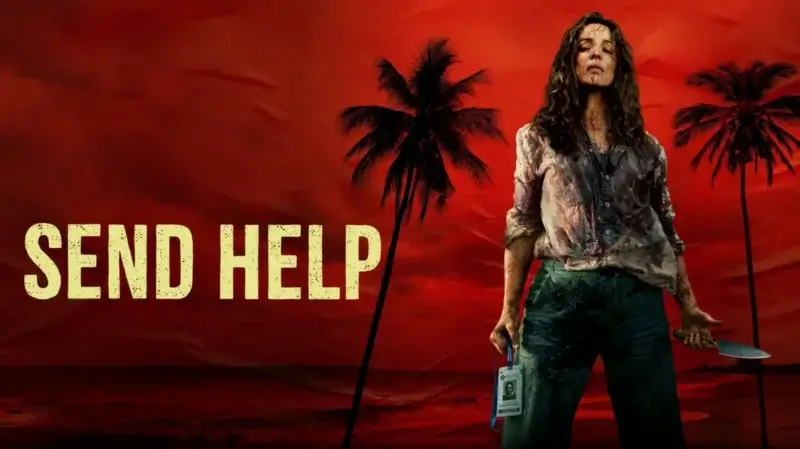
Film Title: Send Help
Cast: Rachel McAdams, Dylan O’Brien, Xavier Samuel
Director: Sam Raimi
Writer: Damian Shannon, Mark Swift
Distribution: Available for rent
Release Date: January 20th 2026
Review by: Mother of Movies
Skip to a Specific Section
This review dissects the entire twisted journey, including deaths, deceptions, and that deeply uncomfortable rat-penis switcheroo. If you want to experience Linda’s descent into island madness fresh, bookmark this for later.

The Office Meets Lord of the Flies (With Murder)
Sam Raimi hasn’t made a horror film since Drag Me to Hell in 2009. Send Help suggests he spent at least some of those sixteen years in a very bad office job. The film opens with that painfully familiar corporate theatre we’ve all endured: the undervalued assistant, the credit-stealing colleague, the nepotism hierarchy who mistakes cruelty for leadership. Linda (Rachel McAdams, buried under frumpy cardigans and strategically placed moles) has spent seven years as the invisible backbone of her company.
Donovan (Xavier Samuel) waltzes in after six months and claims her work as his own. When new VP Bradley Preston (Dylan O’Brien) arrives, all trust fund smugness and inherited authority, he doesn’t just overlook Linda’s contributions; he actively finds her repulsive and plans to shuffle her out. It’s the kind of workplace humiliation that makes you want to scream into the void. Or, in Linda’s case, hope you land on a deserted island and never have to work again. Sometimes a plane crash can solve all your problems.
The film telegraphs its survival-thriller pivot early, with blink-and-you ‘ll-miss-it shots of rock-climbing photos, survival books, and knot-tying manuals in Linda’s apartment. When the corporate jet goes down in spectacular, violent fashion, most of the cast gets ejected in ways that would make Final Destination nod approvingly. Donovan, in a moment of pure survival-of-the-fittest ugliness, tries to steal Linda’s seat mid-crash. She stabs him with a fork. He’s sucked out. She closes the window blind on his dying face like she’s shutting out a bad Zoom call.
It’s brutal. It’s also the film’s thesis statement: when the system fails you long enough, watching it collapse feels like justice.

Paradise Found, Sanity Lost
What follows is where Send Help pivots from dark comedy into something genuinely unsettling. Linda washes ashore with her survival skills fully activated. She builds shelter, sources water, catches food, while Bradley flails uselessly nearby. When he starts to recover, he’s not gratetful, he’s still expecting her to serve him. The power dynamic hasn’t shifted; it’s just relocated to a beach with no HR department.
McAdams plays Linda’s transformation with unnerving precision. She’s not suddenly empowered or liberated; she’s unraveling. When she spots a rescue boat and deliberately doesn’t signal it, the film tips its hand: this isn’t about survival anymore. It’s about control. It’s about finally being seen. And when Bradley fires her (yes, fires her while stranded on a deserted island), she doesn’t rage. She just… keeps going and building her camp. Making her toilet wine. Living her best feral life while he starves twenty feet away.
Linda’s toilet‑wine confession lands with the kind of survivalist flair that makes you realise she’s far more capable than she lets on. On the island, she adapts her skills with unsettling ease, the same quiet practicality she once used when she let her abusive husband drive drunk instead of stopping him.
She didn’t kill him, but she also didn’t save him, and that moral grey zone flavours everything she brews, including the makeshift booze she and Bradley use to take the edge off being stranded together. It’s delivered with the casual tone of someone discussing meal prep, and O’Brien’s Bradley finally understands he’s not stuck on an island with his assistant; he’s stuck on an island with someone who’s been waiting for an excuse.
The Raft, The Rat, and The Reckoning
Bradley’s escape attempt, secretly building a raft, poisoning Linda’s dinner with berries, and fleeing in the night, fails spectacularly. His raft disintegrates. A wave smashes him back to shore. As Linda revives him, she vomits repeatedly into his face, which is both darkly comedic and a perfect visual metaphor for their entire relationship.
Then comes the blue-ringed octopus toxin scene, where Linda paralyzes Bradley and convinces him she’s castrated him. It’s deeply uncomfortable, crossing from psychological thriller into sadistic torture territory. The film plays it for dark laughs, but it’s the moment Send Help loses any pretense of rooting for Linda as an underdog. She’s not reclaiming power, and she’s not playing to win. Or is she?
But the real horror show begins when Bradley’s fiancée, Zuri, arrives with a private search party. Linda, seeing her carefully constructed isolation threatened, leads them along a route she knows has a crumbling cliff edge. Zuri falls. The guide tries to save her. Both plummet to their deaths.
The film wants us to believe that Linda feels guilty, even, but the staging suggests otherwise. She chose that path. She knew what could happen. And when Bradley later discovers Zuri’s hand sticking out of the sand (ring still visible, because subtlety is not this film’s strong suit), the moral lines have already blurred beyond recognition.
The House, The Horn, and The Hollow Victory
The third act reveals that Linda discovered a fully furnished house on the island weeks ago and has been lying about their isolation, recontextualizing everything. She had an escape route. She had resources. She chose this. The knife she’s been using, the supplies she’s been rationing, all came from a place she deliberately hid from Bradley while watching him suffer.
Their final clash isn’t staged as a heroic victory so much as the inevitable collapse of two people who’ve run out of lies to tell themselves. The violence is feral, the kind that strips away any illusion that either of them is still playing at civility. Bradley’s last‑ditch manipulation backfires, and Linda’s realisation that the “poisonous plant zone” was never about botany but about him hits just as he arms himself with whatever he can rip from the walls. When the gun fails, the struggle turns primal, and Linda survives not because she’s stronger, but because she finally stops letting him decide how the story ends.
Cut to: Linda post-rescue, fully glammed up, playing golf, writing self-help books with the tagline
“Help’s not coming. You’d better start saving yourself.”
She drives off in a sports car with her bird, breaks the fourth wall, and winks at the camera.
It’s meant to be empowering. It lands as sociopathic. Maybe that’s the point.
When Satire Swallows Itself
Send Help wants to be a feminist revenge fantasy about a woman who stops waiting for validation and takes what she deserves. But by making Linda an actual murderer, not just of her abusive ex, but of innocent bystanders and a man she’s psychologically tortured, the film undercuts its own commentary. There’s a difference between punching up at systemic inequality and gleefully watching someone commit atrocities because they were underappreciated at work.
The performances are committed. O’Brien keeps Bradley’s entitlement fully intact as fear takes over, turning his victimhood into a grim confirmation of who he always was rather than any kind of shift. By the end, you almost forget he passed her over for a frat buddy.
The production design is solid, the crash sequence genuinely harrowing, and the island cinematography occasionally striking.
But the tonal whiplash is exhausting. Is this a comedy? A thriller? A cautionary tale about what happens when we devalue people until they snap? The film never decides, so it ends up being a mishmash of better survival thrillers, workplace satires (Swimming with Sharks), and “woman goes feral” narratives (Promising Young Woman) without the thematic coherence of any of them.
The final act reveals that Linda had resources all along, transforming her from a sympathetic survivor to a calculating predator, but the film still wants us to cheer for her book deal and sports car. It’s the cinematic equivalent of saying “gaslight, gatekeep, girlboss” unironically while someone commits manslaughter.
The Verdict
Send Help has moments of sharp satire and genuinely tense survival sequences, but it collapses under the weight of its own moral confusion. You can make a film about a woman who becomes a monster, Promising Young Woman did it brilliantly, but you have to acknowledge that she’s become a monster. This film wants to celebrate Linda’s “glow-up” while glossing over the fact that her self-actualization required multiple deaths, torture, and pathological dishonesty.
It’s watchable. The crash sequence alone is worth the price of admission. But as a statement on workplace inequality, gender dynamics, or survival ethics, it’s a mess, like someone pitched “‘What if Horrible Bosses met Cast Away, but make it a girlboss origin story’ to the writers of Baywatch and nobody asked follow-up questions.
Send Help is rated:
3.5 Dead Fiancées Sticking Out of Convenient Sand Piles out of 5
Corporate Revenge Meets Island Madness
Send Help starts as workplace satire, crashes into survival thriller, then skids into morally confused territory where torture-by-rat-penis passes for empowerment. McAdams commits fully, but the script can’t decide if Linda’s a hero or a monster.
Similar Titles to Send Help: Need More Stranded-and-Unhinged Energy?
- Sweetheart (2019) – Woman vs. island monster, but make it a metaphor for being ignored. Kiersey Clemons delivers a one-woman survival showcase. Watch the trailer for Sweetheart here.
- Swimming With Sharks (1994) — Workplace revenge, you already name it in the body, makes sense to include.
Hunting Emma (2017) — Emma’s car breaks down in the middle of no-where. South African horror worth your time. - Severance (2006) — Corporate group, wilderness, dark comedy meets survival horror.
- Calibre (2018) — An underrated indie gem. Just watch it cold and thank me later.
- Dead Sea (2026) — It’s a messy B-movie about a girl who ends up on the wrong side of a fisherman.
Online Chatter
The blue-ringed octopus paralysis scene and fake castration sequence will generate the most online noise, not least because it’s the moment Send Help stops pretending it’s a dark comedy and reveals itself as something considerably nastier. The film’s attempt to position Linda’s actions as empowerment while depicting graphic violence against a helpless victim is a tonal miscalculation that will spark genuine debate about how revenge narratives frame female agency. Raimi’s last horror outing was Drag Me to Hell in 2009, and his last R-rated film before that was The Gift in 2000. He’s clearly not easing back in gently.
