
- Film Title: Thinestra
- Cast: Michelle Macedo (Penny), Melissa Macedo (Penelope), Gavin Stenhouse (Josh), Shannon Dang (Chaela), Norma Maldonado (Amanda), Brian Huskey (Neils), Annie Ilonzeh (Demetria), Mary Beth Barone (Mariah)
- Director: Nathan Hertz
- Writer: Avra Fox-Lerner
- Release: 14th April 2026
- Production: Dogplayer, Hitmakers Media, Mary Ellen Moffat, Stay Lucky Studios
- Distribution: Breaking Glass Pictures Release Date: 2026
- Review by: Mother of Movies
This review contains major plot spoilers for Thinestra. If you want to experience the full grotesque journey of Penny and Penelope cold, stop reading after the opening section and come back after you’ve watched.
Thinestra is a film about self-hatred made literal, and it doesn’t flinch. Director Nathan Hertz and writer Avra Fox-Lerner have crafted something that sits uncomfortably between body horror and social commentary. A movie that understands the toll of perpetual dieting in a way that feels less like preaching and more like a scream. It’s grotesque, it’s relatable, and it’s unsettling.
The film opens with a spin class instructor yelling about sugar and restraint, and you feel it immediately. The suffocation of self-optimization. Penny sits in her apartment surrounded by sticky notes reminding her she has the willpower to be smaller. She works in advertising retouching images of women who still need fixing, still need happiness injected into their faces. She eats salads while her coworker devours pizza. She starves. She fantasizes about doughnuts, glazed ones, specifically, and when a boy asks her out, she’s too busy avoiding carbs to notice he likes her as she is. This is the world Thinestra builds: one where thinness is the price of entry to everything, including love.
Then comes the Christmas party. The food is everywhere. Penny sneaks treats. Her boss, just a representation of why women want to crush the patriarchy, catches her eating and delivers the line that breaks her:
“A moment on the lips, a lifetime on the hips.”
She steals cookies after. She eats most of them. She throws them away. She retrieves them. This cycle is so recognizable it’s almost painful to watch. Not because the acting was bad, it wasn’t, but because the specificity of that shame is real. Anyone who’s struggled with food and body image will see themselves in Penny’s desperate, cyclical self-sabotage.
Enter Thinestra. The pill arrives via Maria, the model who’s been oozing an unidentified substance throughout her modelling gig. (Nobody questions it. The photographer dismisses it as “so hot in the studio the model is melting”).
Maria hands Penny the pills with an ominous warning: “No pain, no gain.” She takes one that night, and what happens next is the film’s most visceral sequence. Penny vomits. Her skin loosens. Fat literally squeezes out of her body in grotesque, glistening chunks. Her toilet clogs. The imagery is aggressively repulsive flesh rendered as waste, expelled like poison. In the moment, I thought the pacing would kill the horror of it. It didn’t. The scene is sustained, unflinching, and deeply uncomfortable. This is the film’s thesis made visual: the body as the enemy, purged and discarded.
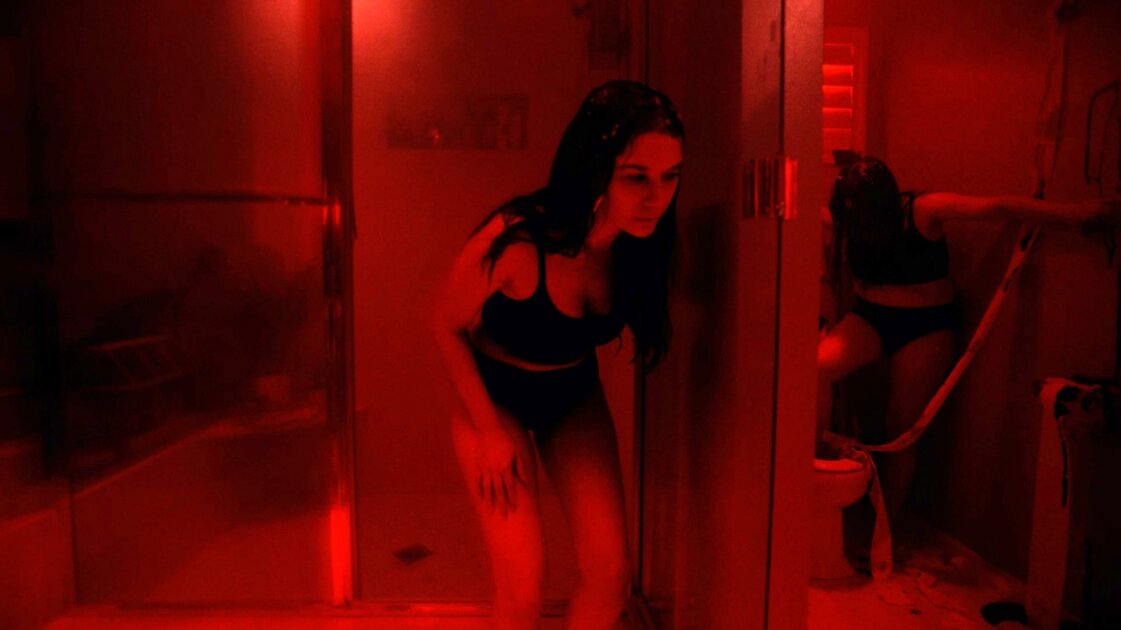
But here’s where Thinestra pivots into something disturbing. The fat she expelled doesn’t disappear. It coalesces. It becomes Penelope, a feral, ravenous doppelgänger who crawls through the city consuming everything in her path. A homeless man in a tent. Josh, the neighbor who liked Penny before. Her coworker Chaela. Her mother. Penelope is hunger made flesh; the embodiment of every appetite Penny has tried to suppress. She growls. She kills. She eats.
Michelle Macedo carries this dual performance with a control that’s impressive. Penny, as the thin version, moves differently, lighter, freer, suddenly desirable to the world around her. Her boss touches her shoulder. She fits into clothes she bought as a goal. But the growl signals something else. When Penelope takes over, there’s a feral quality to Macedo’s physicality. She’s no longer playing a woman; she’s playing a hunger that wears a woman’s face. The film never makes it entirely clear whether Penelope is separate from Penny or an expression of her fractured self. That ambiguity is the film’s cruelest insight. You can’t actually separate yourself from your appetites. They’re part of you. They’re always going to come back.
The cinematography works in a Jekyll-and-Hyde palette of red and blue, red for purging, transformation, and violence; blue for the eerie lucid stretches where Penny is herself again. When she is calm and hollowed out, not yet understanding why she doesn’t feel cured. The blue sequences are almost more disturbing than the red; she’s coherent, she’s present, standing right at the edge of relapsing into Penelope without knowing it.
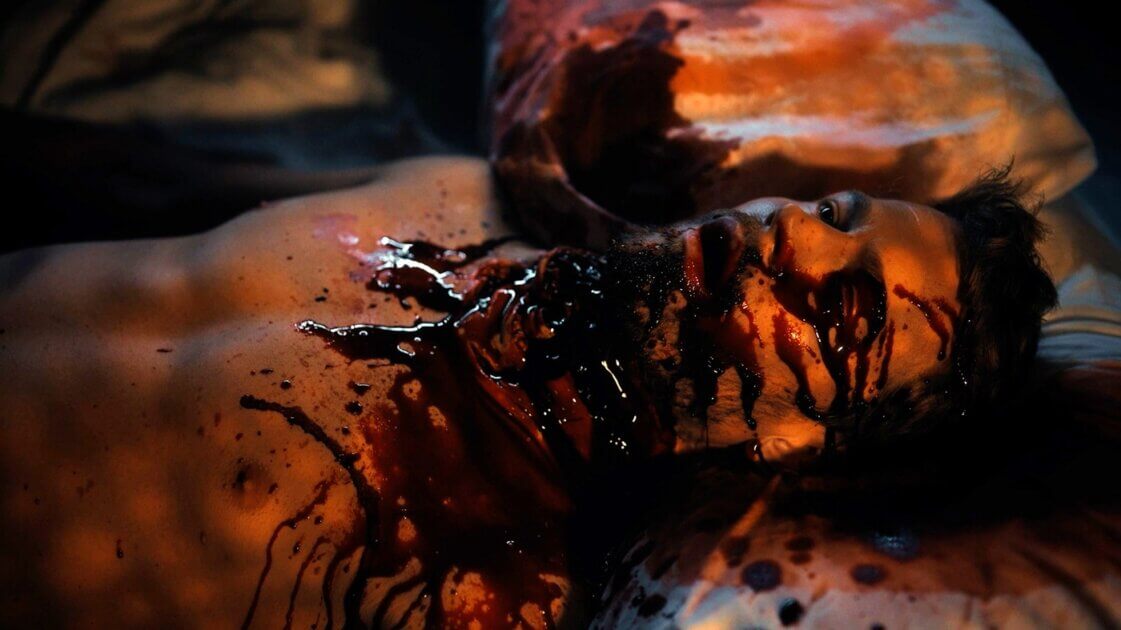
The lighting is deliberately artificial throughout, there’s no natural world here, just the fluorescent prison of self-optimization. Before the transformation, negative space swallowed her, kept her couch-bound and apart from the world. After, it contracts around a body the world has decided to make room for. The sound design is sparse, mostly effects, no traditional score. Just the wet sounds of purging, the growls of Penelope, the mundane noises of a life lived in constant self-surveillance
The film’s argument becomes most pointed when Penny doesn’t die, and more importantly, doesn’t reverse. She survives. She wakes up in the hospital still thin. The self-hatred that drove her here was real, and the film isn’t interested in undoing it. There’s no redemption arc on offer. Chaela visits, and Penny kills her mid-hug. The industry, meanwhile, keeps moving, the film ends with a television playing the completed Snog eggnog ad campaign, and more importantly the Thinestra weight loss regime is now FDA approved, and available to the general public. Its side effects mentioned in the same breezy way any pharmaceutical ad does. The weight loss machine doesn’t pause.
Her mother was the only one who said it plainly, that you can’t excise the parts of yourself you hate because they’re part of you, and Penelope killed her for it. Wisdom doesn’t survive here. The industry does.
This ending is either profound or punishing, depending on your read. I hated that choice but loved the idea behind it. The film refuses to offer the comfort of a moral lesson. It doesn’t say “love yourself as you are” or “thinness isn’t everything.” Instead, it suggests something darker. The machinery of self-hatred is so powerful, so normalized, that even literal monstrosity can’t stop it. Penny gets what she wanted. She’s thin. She’s beautiful. She’s also a killer. The film doesn’t judge her for it. It just observes. It documents. It warns.
Like Titane and Swallow before it, Thinestra understands that what a woman does to her own body, what she forces it to expel, endure, consume, is where the real horror lives. But it’s also speaking directly to a moment when the popularity of weight loss drugs has resulted in the heroin chic of the 2020s. Stars are becoming rake-thin again. The cycle is repeating. Thinestra arrives as a kind of fever dream warning. This is what happens when you convince people their bodies are the problem. They’ll consume anything to fix it. They’ll hurt anyone. They’ll hurt themselves.
Penny’s mother delivers the film’s most honest line:
“You can’t do away with the parts of you that you hate because they are a part of you and you can never be rid of it.”
It’s the only moment of genuine wisdom in the film, and the film punishes her for it. Penelope kills her. Wisdom doesn’t survive in this world. Only hunger does.
Is Thinestra worth watching? If you’re prepared for body horror that doesn’t look away, if you can sit with the unease of seeing your own relationship with food and beauty reflected back at you through a monster, then yes. It’s not a comfortable film. It’s not meant to be. But it’s honest in a way that most films about women and bodies aren’t. It doesn’t offer solutions. It offers recognition. And sometimes that’s more valuable than reassurance.
Thinestra is rated
3.75 Self-Hatred Made Flesh out of 5
The Verdict
Body Horror as Social Diagnosis
Thinestra doesn’t offer comfort or solutions. It offers a mirror held up to the machinery of self-hatred, and it doesn’t flinch. Nathan Hertz’s debut is visceral, unsettling, and prophetic about the moment we’re living through. Michelle Macedo carries the dual role with stunning control. This is body horror that means something.
Visceral Impact
9/10
Rewatch Value
High
Director Stamp
Nathan Hertz makes his feature directorial debut with Thinestra. The pacing is occasionally uneven; the second act drags in places where tighter editing could have maintained momentum, but Hertz demonstrates real control over tone and visual language. His choice to drain the film of traditional score and rely on sound design and effects is bold and effective. He trusts the audience to sit with discomfort.
Writer Avra Fox-Lerner constructs a narrative that functions simultaneously as body horror, social satire, and psychological breakdown. The script never condescends to its audience. It assumes intelligence and doesn’t soften its argument for comfort. The casting of Michelle Macedo in the dual role is crucial; she brings a physicality and emotional specificity that makes the warring nature of Penny and Penelope feel good rather than gimmicky.
Need more? Films like Thinestra are:
- Titane (2016) — Julia Ducournau’s body horror masterpiece about a woman who becomes pregnant with a car. Extreme, visceral, and deeply unsettling. A film about bodies refusing to behave.
- Swallow (2019) — A woman begins consuming inedible objects as an act of rebellion and self-harm. Slow-burn, psychologically devastating, and visually stunning. Body horror as metaphor for voicelessness.
- The Babadook (2014) — Jennifer Kent’s exploration of grief and maternal rage as a physical monster. A film about the parts of ourselves we can’t control or destroy, no matter how hard we try.
- Frankenstein (2026) — A more hands on existential self-image but body horror, nonetheless.
- Teeth (2007) — A body horror film about female sexuality and bodily autonomy. Darkly funny and deeply uncomfortable. A film about the body as weapon and warning.
- Hatching (2022) — Body horror about self-image that takes a new twist and a dark phycology.

Thinestra
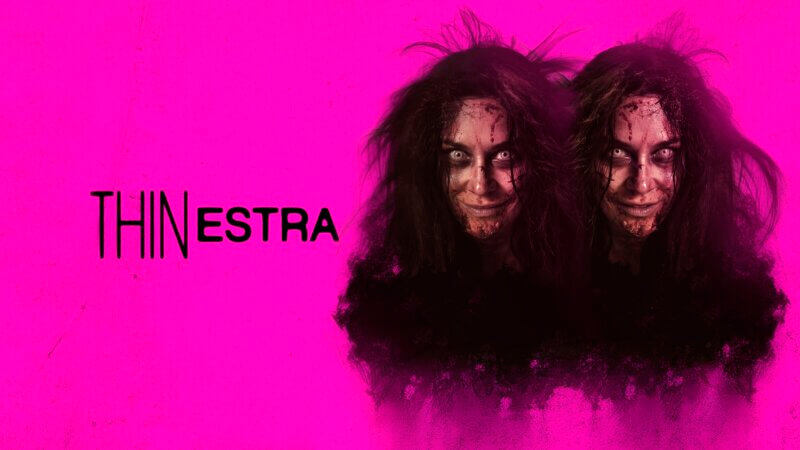
Director: Nathan Hertz
Date Created: 2026-04-14 06:21
3.75
