
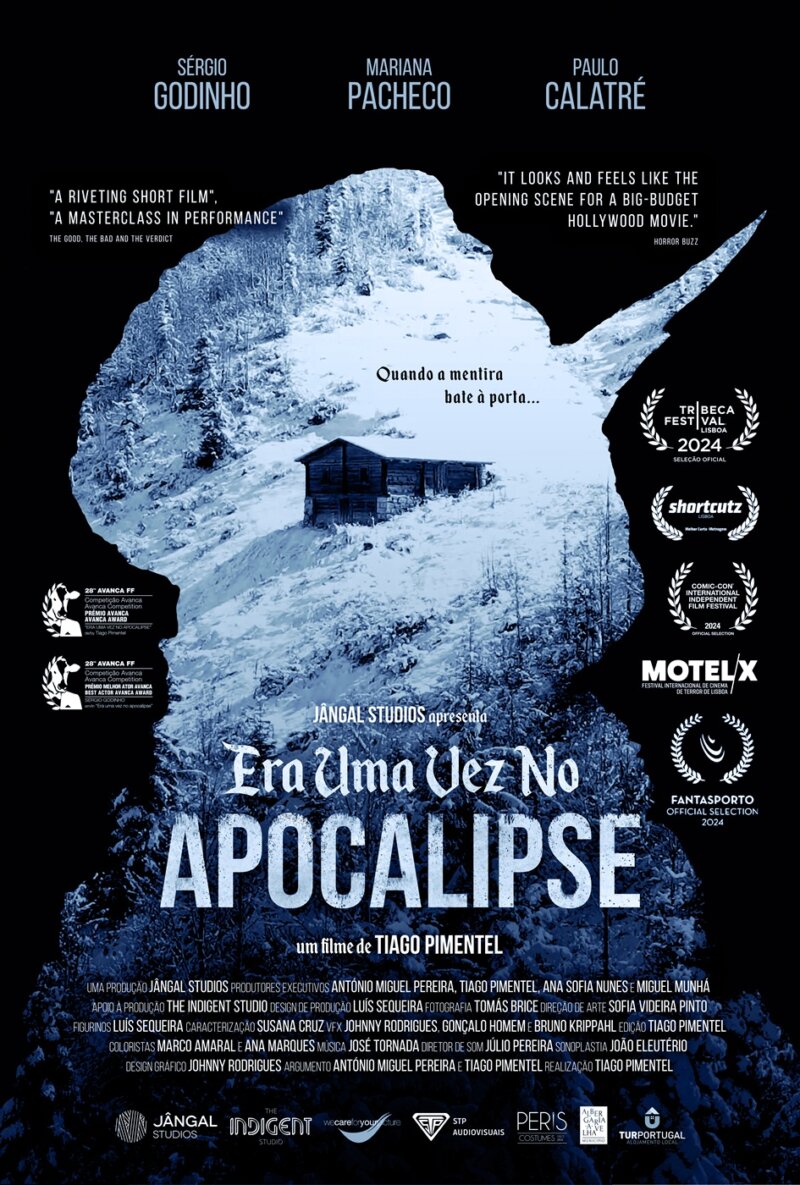
There’s a particular kind of dread that arrives quietly. Not with orchestral swells or jump scares, but through the meticulous observation of small things, a jam in a staff, a brown beanie left in plain sight, the weight of a book’s spine. Portuguese director Tiago Pimentel’s 21-minute short film Once Upon a Time in the Apocalypse (Era Uma Vez no Apocalipse) understands this intimately. It’s a sturdy lesson in restraint, where what remains unsaid carries more menace than any exposition dump could manage.
Skip to a Specific Section
A Totalitarian Thriller Where Every Object Tells a Story
The film opens on Ernesto (Sérgio Godinho) and Helena (Mariana Pacheco) in their cramped, dimly lit home. The world outside requires gas masks. The government controls the narrative through crackling radio broadcasts. And Helena has just returned from a scavenging mission with something she absolutely cannot leave behind, something that will destroy them both if discovered.
This review contains zero plot reveals. We’re keeping the mystery alive so you experience the full impact of this film exactly as Pimentel intended.
The Anatomy of Tension Without Spectacle
What strikes you immediately about Once Upon a Time in the Apocalypse is its refusal to telegraph drama through conventional means. There are no swelling strings here, no dramatic camera movements. Instead, Pimentel builds dread through what cinematographer Tomas Brice captures in the frame, the claustrophobic geometry of a room where every corner might hide evidence, every shadow might conceal guilt.
The production design (courtesy of Luis Sequeira) transforms their home into a pressure cooker. Thick clothing. Muted colors. Objects positioned with deliberate significance. When Helena mentions her “stick” has jammed, and Ernesto repairs it to reveal a blade mechanism, the scene functions as both practical exposition and thematic statement: everything in this world has a dual purpose, a hidden function, a reason to fear.
Then comes the knock.
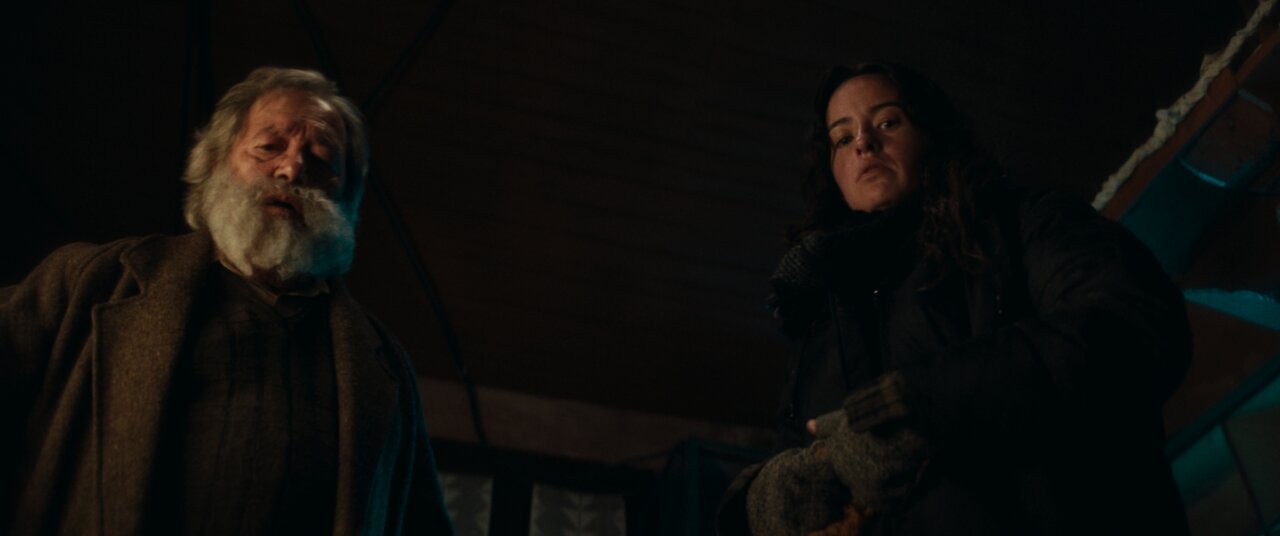
Colonel Salavisa (Paulo Calatré) arrives with the casual menace of someone who doesn’t need to raise his voice to dominate a room. He removes his gas mask, a gesture that immediately communicates the threat level of the outside world, and begins a conversation that only appears social. What unfolds is a masterclass in power dynamics, where every exchange carries subtext. When Salavisa comments on Ernesto’s lack of whiskey or bread, he’s not making small talk. He’s establishing hierarchy. He’s reminding Ernesto of his place in the social order.
The script for Once Upon a Time in the Apocalypse (by António Miguel Pereira and Tiago Pimentel) accomplishes something deceptively difficult. It makes mundane dialogue feel like psychological warfare. Salavisa describes crimes, asks questions, and touches objects in the home, all while maintaining the veneer of an official survey. Godinho’s performance as Ernesto is a study in barely contained panic. He’s a man trying to appear compliant while his world collapses in real-time. The tension doesn’t escalate dramatically; it’s already there, baked into every line, every glance, every pause.
Where Small Details Become Catastrophic
There’s a moment when the camera holds on a brown beanie. It’s not subtle, but it doesn’t need to be. Pimentel trusts that we understand what we’re seeing. Salavisa notices things Ernesto cannot hide. He asks about a spare bed. A cot. These aren’t accusations yet; they’re observations. But their observations were made by someone who already knows the answers.
The turning point arrives with a book. A specific book that carries historical weight and government-designated danger. When Salavisa identifies it, the temperature in the room drops several degrees. This object, this thing, becomes the fulcrum upon which the entire dynamic pivots. It reveals truths about Ernesto that complicate our understanding of who he is and what he’s willing to risk.
Mariana Pacheco, despite limited screen time, communicates volumes through presence alone. The chemistry between this trio, Godinho, Pacheco, and Calatré, crackles with authenticity. You believe these relationships. You believe the stakes. You believe that everything is about to shatter.
Sound, Silence, and the Space Between
José Tornada’s score (or rather, the strategic absence of it in key moments) deserves particular mention. The film understands that silence is a tool. The crackling radio serves as both worldbuilding and emotional anchor, a reminder that surveillance is constant, that the state’s voice is always present. When the power cuts in and out, it’s not just a technical detail; it’s a visual metaphor for instability, for systems failing, for the fragility of their situation.
The re-recording mixer (João Eleutério) and production sound mixer (Júlio Pereira) craft an acoustic environment where every sound matters. A door knock. A blade is sliding. Breathing. These aren’t background elements, they’re narrative instruments.
The Ending That Reframes Everything
What Once Upon a Time in the Apocalypse does in its final minutes is something genuinely rare: it takes everything you thought you understood and forces you to reconsider it. Not through plot twists for their own sake, but through thematic revelation. The film’s title suddenly makes sense in a way that hits differently on reflection.
Pimentel has completed a feature-length script, and frankly, the world needs to see it. This short is a proof of concept that demonstrates a filmmaker who understands how to weaponize intimacy, how to make a single room feel like the entire world, how to suggest horrors without ever showing them explicitly.
Did You Love This Dystopian Thriller? Watch These Similar Titles:
The Handmaid’s Tale (Limited Series) – Totalitarian oppression, hidden resistance, intimate character drama wrapped in systemic terror.
Parasite (2019) – Class warfare told through meticulous production design and the revelation of hidden truths through objects and spaces.
Children of Men (2006) – Dystopian cinema that prioritizes character and atmosphere over big ticket moments, government control as a suffocating presence.
The Nightingale (2018) – Intimate resistance against occupation; a woman’s agency in an impossible situation.
Never Let Go (2024) – Isolation, government control, and the question of what’s real versus what we’re told to believe.
The Filmmaker’s Fingerprints
Tiago Pimentel is a Portuguese director whose work demonstrates a fascination with constraint as a creative tool. Once Upon a Time in the Apocalypse marks him as a filmmaker who trusts his audience’s intelligence, believing that suggestion is more powerful than exposition, and that the unseen threat is more terrifying than the visible one. The fact that he’s already completed a feature script suggests we’re looking at someone who understands narrative architecture at a fundamental level. His visual language is restrained but purposeful, every frame earning its place.
António Miguel Pereira (writer) has crafted dialogue that functions as subtext. The script never explains what’s happening; it allows the characters’ choices and evasions to do that work. This is sophisticated screenwriting that respects the viewer’s ability to read between lines.
Sérgio Godinho brings a trembling vulnerability to Ernesto; he’s a man whose fragility is also his strength. His ability to convey desperation through stillness is remarkable. Mariana Pacheco embodies a quiet defiance; even in her absence, her presence shapes the entire narrative. Paulo Calatré is chilling precisely because he never needs to raise his voice. He’s a predator who doesn’t need to hunt aggressively when his prey is already caged.
What People Are Saying About Once Upon a Time in the Apocalypse
The film is making festival rounds, playing at small theatres like The Roxy and collecting accolades, a testament to its resonance with industry gatekeepers and serious cinephiles. While broader critical discourse is still developing, the festival circuit’s embrace suggests this is a work that will find its audience among those who value psychological precision over action-driven narratives. Pimentel’s background in visual storytelling (his previous work includes Projeto Delta) indicates a director with consistent vision and technical sophistication.
The Verdict
Strangled by Brilliance
A 21-minute lesson in psychological suspense that proves constraint breeds innovation. Pimentel’s restraint is his superpower.
Once Upon a Time in the Apocalypse is rated
4.5 out of 5 Totalitarian Regimes That Fear a Single Book
This is the kind of short film that reminds you why cinema matters as a medium. It’s not interested in visual excess or comfort. It’s interested in the suffocation of living under systems designed to control you, and in the small acts of defiance that come at a high cost. It’s interesting in what we’re willing to lose for the people we love, and what that loss actually means.
If you encounter this at a film festival, clear your schedule. Sit with it. Let it unsettle you. Then think about it for days afterward. Support this director and follow him on Instagram.
“A precision piece in psychological suspense that proves constraint breeds innovation. Pimentel’s restraint is his superpower, this is cinema that strangles you with silence.”

Once Upon a Time in the Apocalypse Review 2024: A Dystopian Thriller That Redefines Psychological Horror – Watch the Trailer

| What | Details |
|---|---|
| Title | Once Upon a Time in the Apocalypse (Era Uma Vez no Apocalipse) |
| Director | Tiago Pimentel |
| Writers | António Miguel Pereira, Tiago Pimentel |
| Cast | Sérgio Godinho (Ernesto Veríssimo), Mariana Pacheco (Helena), Paulo Calatré (Colonel Salavisa) |
| Cinematographer | Tomas Brice |
| Production Designer | Luis Sequeira |
| Composer | José Tornada |
| Runtime | 21 minutes |
| Production | Projeto Delta (2024) |
| Producers | Miguel Munhá, Ana Sofia Nunes, António Miguel Pereira, Tiago Pimentel |
| Review by | Mother of Movies (vanessasnonspoilers.com) |


