
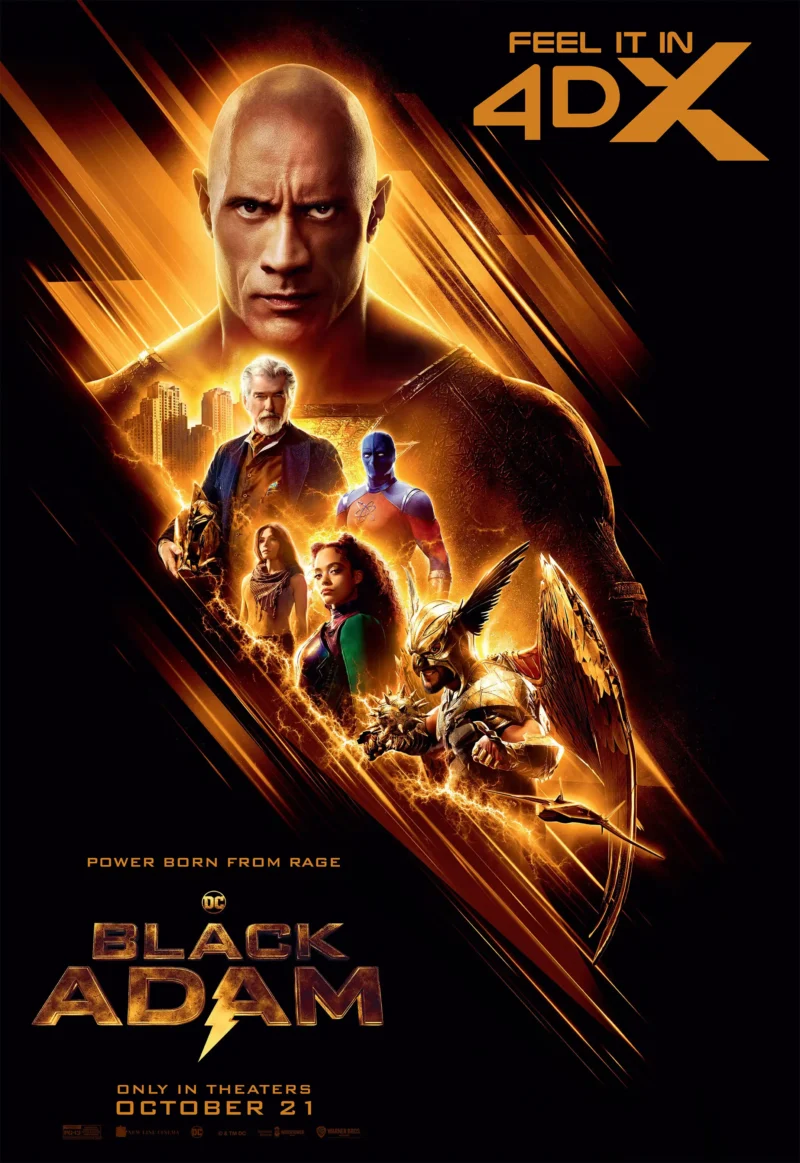
Updated January 2025: When Black Adam first thundered into theaters in October 2022, it arrived with all the subtlety of Dwayne Johnson’s biceps bursting through a tactical vest. Now, as we revisit this DCEU entry in the wake of James Gunn’s franchise reboot announcements, the film reads differently, less as a confident franchise-builder and more as a fascinating artifact of what DC’s cinematic universe could have been before the slate got wiped clean.
Review by: Mother of Movies
This review contains mild thematic discussions and references to the film’s structure, but no major plot revelations. If you’re allergic to knowing Superman shows up in a post-credits scene that literally everyone on the internet has already spoiled, maybe close your eyes for the last paragraph.
A DCEU Entry That Defied Critics and Won Over Audiences
The numbers tell an interesting story: while critics at Rotten Tomatoes initially gave it a lukewarm 37% (a score that hasn’t budged), audience approval climbed from 80% to 87% over time, with IMDb holding steady around 6.1/10 based on nearly 300,000 reviews. That’s the kind of split that makes film discourse delicious. Critics saw a derivative superhero origin story; audiences saw The Rock electrocuting mercenaries and grinning through the carnage.
Ancient Gods, Modern Chaos
Director Jaume Collet-Serra (Orphan, The Shallows) opens in ancient Kahndaq, a Middle Eastern nation where thousands of slaves mine precious materials under brutal oppression. The prologue wastes no time establishing stakes: injustice, a mystical crown, and the legend of a champion who’ll rise to protect the oppressed. Flash forward 5,000 years, and resistance fighter Adrianna (Sarah Shahi) is hunting that very crown while dodging Intergang mercenaries who’ve turned modern Kahndaq into a warzone.
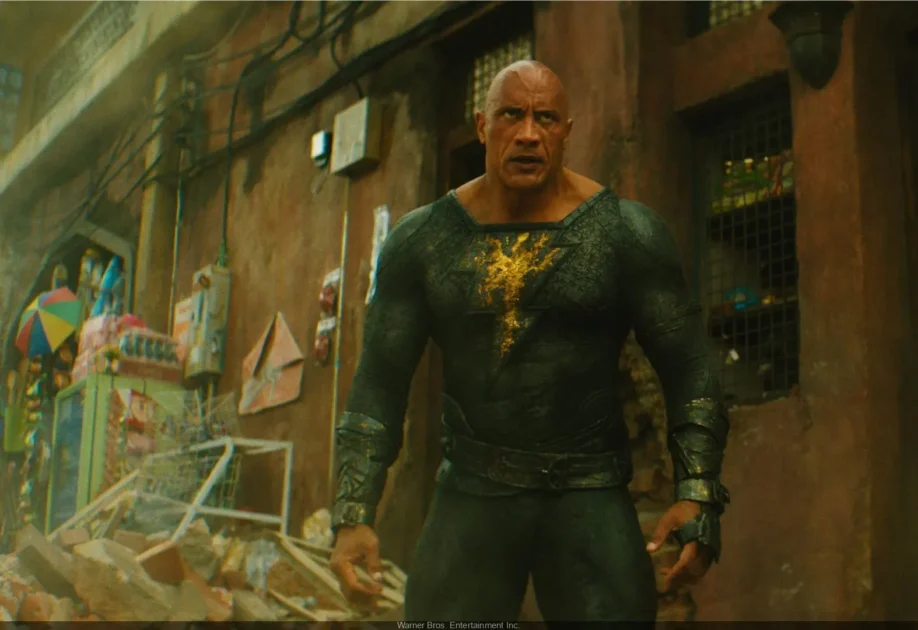
When cornered, she utters the magic word, Shazam!, and unleashes Teth Adam (Johnson), an anti-hero whose idea of conflict resolution involves turning enemies into ash clouds. Unlike the Boy Scout heroes saturating the genre, Adam doesn’t do quippy banter or moral hand-wringing. He’s a blunt instrument wrapped in black leather and crackling with enough voltage to power a small city. Johnson leans into the role with the kind of committed intensity he usually reserves for leg day, playing Adam as someone perpetually annoyed that people keep asking him not to murder everyone.
The Justice Society: Colorful Backup Dancers
Here’s where Black Adam stumbles into familiar superhero territory. The Justice Society, Hawkman (Aldis Hodge), Dr. Fate (Pierce Brosnan), Atom Smasher (Noah Centineo), and Cyclone (Quintessa Swindell), arrive to neutralize Adam, but they function more as narrative speed bumps than fully realized characters. Brosnan brings gravitas to Dr. Fate’s cosmic wisdom, and Hodge’s Hawkman has solid chemistry sparring with Johnson’s immovable object, but Atom Smasher and Cyclone feel like they wandered in from a CW series that got cancelled before finding its footing.
The quartet exists primarily to give Adam someone to fight who isn’t immediately vaporized, which is both practical and disappointing. There’s potential here, Atom Smasher’s fanboy enthusiasm, Cyclone’s eco-warrior edge, but the screenplay by Adam Sztykiel, Rory Haines, and Sohrab Noshirvani (a three-writer team that shows its seams) never digs deeper than surface-level characterization. They’re window dressing in a film that knows its main course is watching The Rock throw lightning bolts.
Collet-Serra’s Kinetic Playground
What Black Adam lacks in narrative sophistication, it compensates for with visceral spectacle. Collet-Serra stages action sequences with the kind of spatial clarity that’s become rare in modern blockbusters: you always know where characters are in relation to each other, even when Adam is ricocheting between enemies like a sentient pinball. The violence toes the PG-13 line aggressively; bodies disintegrate, bones crunch, and the film revels in Adam’s brutality without crossing into gratuitous gore.
Cinematographer Lawrence Sher (who shot Joker, interestingly) bathes Kahndaq in dusty golds and shadowy blues, giving the fictional nation a lived-in texture that contrasts nicely with the CGI mayhem. The score by Lorne Balfe pulses with electronic menace, though it occasionally drowns in generic blockbuster bombast when the film needs it to breathe.
The mid-credits scene teasing Superman (Henry Cavill, in what we now know was a false promise) lands differently in 2025. What seemed like a franchise-launching moment now feels like a relic from an alternate timeline where Cavill’s Man of Steel wasn’t unceremoniously written out of Gunn’s new DCU. It’s a reminder that superhero universe-building is less chess match, more Jenga tower waiting to collapse.
A Warm, Fuzzy Popcorn Flick with Teeth
Black Adam isn’t trying to reinvent the superhero wheel; it’s perfectly content being a big, dumb, entertaining spectacle anchored by a movie star who understands exactly what kind of film he’s in. Johnson doesn’t reach for pathos or complexity; he plays Adam as a force of nature, gradually remembering why he cared about humanity in the first place. The relationship between Adam and Amon (Bodhi Sabongui), Adrianna’s son, provides the film’s emotional anchor without veering into mawkish territory.
For viewers exhausted by Marvel’s quip-heavy formula or DC’s previous grimdark aesthetic, Black Adam splits the difference; it’s violent without being joyless, funny without undercutting its stakes. It’s the kind of film where The Rock can deliver the line “I don’t lose” with a straight face, and you believe him because he’s The Rock.
Is it essential viewing? Not particularly. But as a showcase for Johnson’s charisma and Collet-Serra’s action choreography, it delivers exactly what it promises: a superhero who solves problems by throwing people through buildings, and does so with enough style to make you forget you’ve seen this origin story a dozen times before.
Filmmaker Stamp
Jaume Collet-Serra has built a career on elevated B-movies. Orphan (2009) remains a genuinely twisted thriller, while The Shallows (2016) wrung maximum tension from Blake Lively versus one very determined shark. His work often features isolated protagonists fighting overwhelming odds, and he brings that sensibility to Black Adam‘s desert warfare sequences. Before this, he directed Johnson in Jungle Cruise (2021), establishing a working rhythm that shows in their comfort with the material.
The three-writer team of Adam Sztykiel (Shazam! Fury of the Gods), Rory Haines (The Mauritanian), and Sohrab Noshirvani (The Mauritanian) brings varied experience, though the screenplay’s uneven characterization suggests competing visions never fully coalesced. Sztykiel’s familiarity with DC’s magical corner helps integrate the Shazam! mythology, even if the film ultimately keeps that connection at arm’s length.
Dwayne Johnson spent over a decade developing Black Adam as a passion project, initially cast as the villain in Shazam! before spinning off into his own vehicle. His production company, Seven Bucks Productions, shepherded the film through multiple script iterations, with Johnson reportedly pushing for a harder edge than typical DCEU fare. That persistence shows in the final product’s willingness to let its protagonist be genuinely ruthless, even if the franchise-building ambitions ultimately came to nothing when DC rebooted its universe.
The film’s visual effects team faced the challenge of differentiating Adam’s electrical powers from Shazam’s lightning-based abilities, opting for a darker, more destructive aesthetic. Practical stunts were prioritized where possible, with Johnson performing many of his own wirework sequences to maintain physicality in the heavily CGI environments.
Electrifying Anti-Hero Energy
Black Adam doesn’t reinvent superhero cinema, it just lets The Rock throw lightning bolts and vaporize mercenaries with gleeful abandon. It’s violent, charismatic, and refreshingly unconcerned with being anything other than a big, dumb, entertaining spectacle.
“Black Adam splits the difference between Marvel’s quip-heavy formula and DC’s grimdark aesthetic; it’s violent without being joyless, funny without undercutting its stakes, and anchored by a movie star who understands exactly what kind of film he’s in.”
– Mother of Movies on Black Adam
Pros and Cons of Watching Black Adam
Pros:
- The Rock’s Ruthless Charisma – Johnson commits fully to playing an anti-hero who solves problems by turning enemies into ash clouds, no moral hand-wringing required.
- Visceral Action Choreography – Collet-Serra stages sequences with spatial clarity rare in modern blockbusters; you always know where bodies are flying.
- Refreshing Brutality – The film pushes PG-13 violence to its limit, giving audiences a superhero who actually feels dangerous instead of sanitized.
- Dr. Fate Steals Scenes – Pierce Brosnan brings gravitas and cosmic wisdom to every frame, elevating the Justice Society beyond generic backup heroes.
- Lived-In World-Building – Kahndaq feels like an actual place with history and texture, not just a CGI playground for destruction.
Cons:
- Justice Society Feels Undercooked – Atom Smasher and Cyclone get surface-level characterization, functioning more as colorful set dressing than fully realized heroes.
- Three-Writer Syndrome – The screenplay shows its seams with competing tonal priorities and uneven narrative focus.
- Generic Blockbuster Score – Lorne Balfe’s music pulses with menace but too often drowns in familiar bombast when subtlety would land harder.
- False Franchise Promises – The Superman tease now reads as a relic from a universe DC immediately abandoned, making the post-credits scene feel hollow.
- Derivative Origin Beats – Despite its edge, Black Adam still hits familiar superhero origin checkpoints without adding much new to the formula.
Black Adam Movie Trailer 2022
Similar Films
If you hate trailers, catch this teaser instead of the full version.
- Man of Steel (2013) – Zack Snyder’s divisive Superman reboot with destructive action sequences and a hero learning restraint (or not).
- Venom (2018) – Another anti-hero origin story where the protagonist solves problems violently, and audiences loved it despite critical dismissal.
- Suicide Squad (2016) – DCEU ensemble featuring morally ambiguous characters with flashy action, divisive critical reception, and strong audience approval.
- Shazam! (2019) – Direct mythological connection to Black Adam’s powers, lighter tone, but shares magical DC universe elements.
Villain or Superhero?
Is Black Adam a Villain?
In the comics, he is a supervillain. In the 2022 Black Adam film, he is a superhero.
